This error often points to a problem with the temperature sensor, although its exact meaning depends on your Tefal model. Fortunately, understanding what triggers the warning can help you identify the problem and determine whether a simple check or professional repair is necessary.
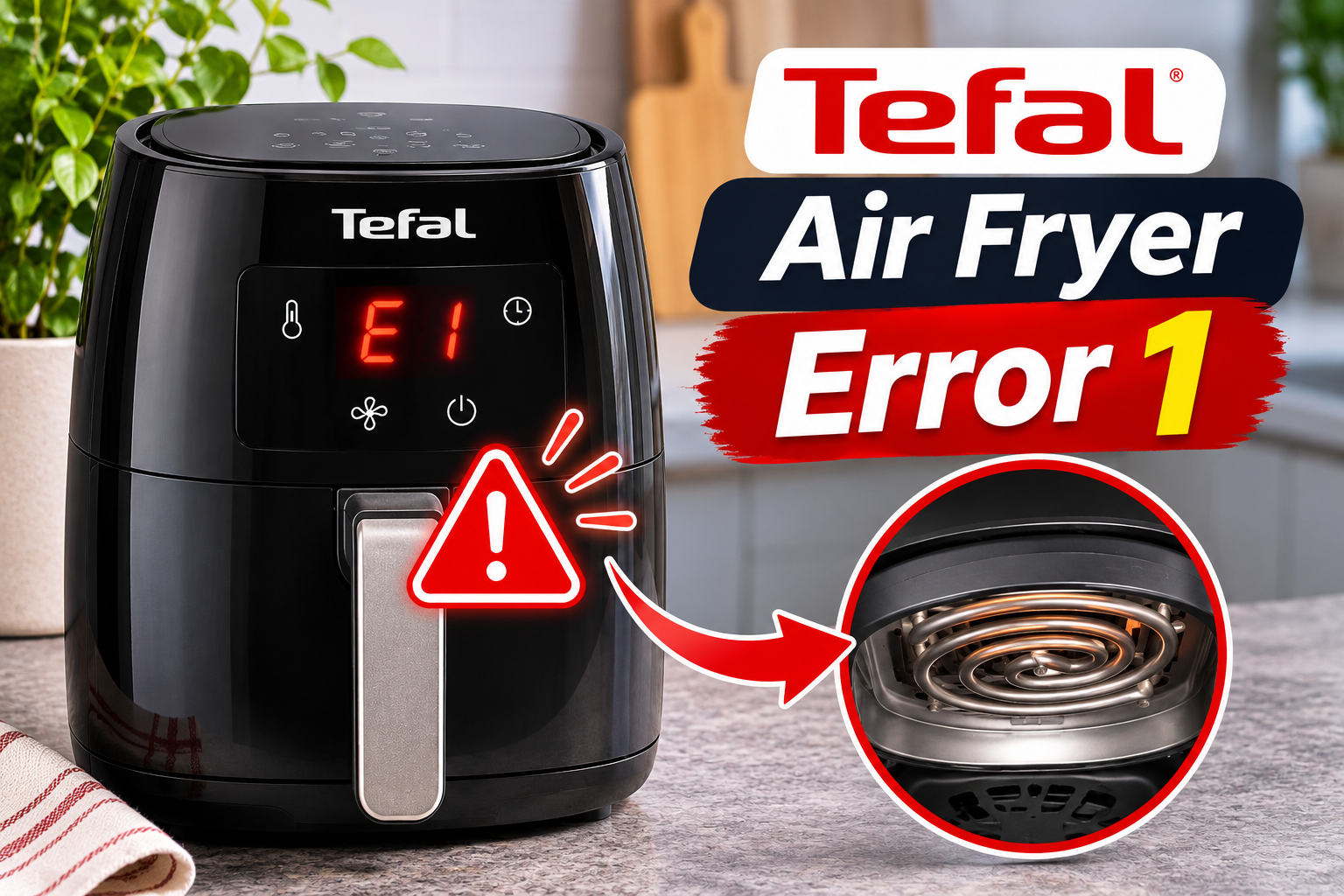
What Does Error 1 Mean on a Tefal Air Fryer?
Error 1, usually displayed as E1, indicates that your Tefal air fryer has detected a fault in a component or system it monitors. On several Easy Fry models, the error relates to the temperature sensor, which helps the appliance regulate cooking heat.
The temperature sensor continuously monitors heat inside the air fryer and sends information to its electronic control board. The board uses these readings to control the heating element and maintain the selected cooking temperature. If the sensor stops providing reliable information, the appliance may interrupt its operation to prevent unsafe heating.
According to Tefal’s official technical documentation, Error E1 indicates a temperature sensor failure on the EY40 series. However, the Multicook Actifry MY7408G1 uses E1 specifically for a short circuit in its upper temperature sensor. Some ActiFry Genius models use E.1 or E.2 for a fan problem instead.
When this warning appears, your air fryer may stop heating, interrupt the cooking program, or refuse to operate. The display may remain illuminated even though the appliance won’t cook. Because these symptoms can result from different internal faults, checking your exact model number is essential before attempting any troubleshooting.
Tefal Air Fryer Error 1 [FIXED]: Likely Causes
Several faults can cause Error 1 on a Tefal air fryer, with sensor problems being particularly relevant to models that use E1 for temperature sensor failure. Understanding these possibilities will help you recognize useful warning signs and avoid unnecessary repairs.
1. Faulty Temperature Sensor
A defective temperature sensor is one of the main reasons certain Tefal air fryers display Error 1. This small component measures temperature and allows the control board to adjust the heating element during cooking.
Many electronic cooking appliances use a thermistor, which changes its electrical resistance as the temperature changes. The control board interprets this change to determine how hot the appliance is. When the sensor develops an internal electrical fault, its readings can become unreliable or disappear entirely.
Sensor failure can occur following repeated heating and cooling cycles, physical damage, or deterioration of internal components. Depending on the fault, the sensor may develop an open circuit, which interrupts its electrical path, or a short circuit, which creates an unintended electrical connection.
You might encounter E1 immediately after plugging in your air fryer, even when the cooking chamber is completely cold. Alternatively, the error may appear during operation if the sensor develops an intermittent fault as it heats up.
However, these symptoms alone cannot confirm that the sensor needs replacement. A technician must check the sensor and its connections against the specifications for your model.
2. Loose or Poor Temperature Sensor Connections
Sometimes, the temperature sensor itself is working, but its electrical connection to the control board has become unreliable.
Inside the air fryer, small wires and connectors carry the sensor’s signals to the electronic control system. If a connector becomes loose, damaged, or contaminated, the board may receive incorrect readings or lose communication with the sensor.
This can happen because of deterioration over time, movement during handling, previous improper repairs, or moisture affecting an electrical contact.
An intermittent warning can be one clue. For example, your air fryer might operate normally on one occasion and display E1 during another cooking session. The error could also appear after the appliance warms up.
Tefal’s EY40 series technical guidance specifically instructs repair technicians to check temperature sensor connections before replacing the sensor. However, these connections are inside the appliance, so inspecting or adjusting them is not a suitable household troubleshooting task.
3. Damaged Internal Sensor Wiring
The wiring connecting the temperature sensor to the control board can also cause Error 1 if it becomes damaged.
Air fryers repeatedly heat up and cool down. Their internal wiring is designed to tolerate normal operating conditions, but excessive heat, mechanical damage, or deterioration can eventually affect the insulation or electrical conductors.
A damaged wire might interrupt the sensor signal completely. In other circumstances, exposed conductors could contact each other or another component, creating an electrical fault.
You may notice that the error appears repeatedly during cooking or immediately whenever the appliance starts. However, damaged wiring usually produces no obvious external symptoms.
A burning smell, unusual smoke, visible melting, or electrical sparking is a much more serious warning. If any of these signs appear, stop using the air fryer immediately and disconnect it from power if you can do so safely.
Internal wiring checks require appropriate electrical testing equipment and a qualified technician. Attempting to identify the damaged wire by opening the casing can expose you to hazardous electrical components.
4. Moisture or Contamination Affecting Electrical Components
Moisture entering an air fryer’s electronic components can interfere with electrical signals and potentially damage the temperature sensing circuit.
This may happen if the appliance is accidentally exposed to spilled liquids, submerged during cleaning, or cleaned with excessive water. Although removable baskets and trays are often washable, the main electrical housing must be handled differently.
Water reaching an internal connector or circuit board can create unwanted electrical paths or encourage corrosion. Either problem may interfere with the sensor readings and cause a malfunction warning.
For example, if your Tefal air fryer develops Error 1 shortly after liquid enters the main housing, moisture damage deserves consideration. However, this timing does not prove that moisture caused the fault.
Tefal specifically warns against using water to clean the interior body of certain Multicook Actifry models because it can damage the heat sensor.
Keep in mind that cleaning residue from the cooking basket is different from cleaning an internal electrical connection. If you suspect liquid entered the appliance’s electrical housing, it should remain unplugged until a qualified repair professional determines that it’s safe to use.
5. Fan Problems on Certain ActiFry Models
Although Error 1 commonly refers to a temperature sensing problem, some Tefal ActiFry models use the code differently.
For example, the ActiFry Genius FZ760 manual identifies E.1 or E.2 as a fan malfunction, while E.4 indicates a temperature sensor fault. This distinction matters because replacing a temperature sensor won’t resolve an unrelated fan problem.
The fan circulates hot air around the food to support consistent cooking. If its operation is interrupted, the air fryer may struggle to circulate heat properly or stop the cooking process.
On compatible ActiFry models, an incorrectly fitted removable ventilation grille or filter, foreign material in the removable parts, or an internal fan malfunction may contribute to this warning.
You might hear an unusual fan noise before the appliance stops, although a fan can also fail without making an obvious sound.
If you own an ActiFry Genius displaying E.1, start by checking the removable parts specified in its manual rather than assuming the temperature sensor has failed.
Tefal Air Fryer Error 1 [FIXED]: How to Fix
The appropriate solution depends on whether your model uses Error 1 for a temperature sensor fault or a fan malfunction. Start with the following safe checks, and avoid attempting internal electrical repairs yourself.
1. Confirm Your Tefal Air Fryer Model and Error Code
Before attempting a repair, identify your air fryer’s model number and check what Error 1 means for that particular appliance.
Tefal manufactures several air fryer ranges, including Easy Fry, ActiFry, and combination cooking appliances. Their control systems and error codes are not always identical.
Follow these steps.
-
Switch off the air fryer and unplug it.
-
Allow the appliance to cool completely.
-
Find the model reference on the product identification label, usually located underneath or behind the appliance.
-
Write down the model number and the exact error shown on the display.
-
Visit Tefal’s official website and search for the instruction manual using your model reference.
-
Check the troubleshooting or error code section for the recommended action.
Pay particular attention to whether your display shows E1, E.1, or another code. These distinctions may affect the diagnosis.
For instance, a model showing E1 because of a temperature sensor short circuit needs a different repair from an ActiFry showing E.1 because its fan isn’t operating.
Once you’ve confirmed the error’s meaning, you can focus on the appropriate checks without wasting time on unrelated components.
2. Switch Off and Restart the Air Fryer
If your air fryer has displayed Error 1 for the first time, a controlled restart can help determine whether the warning was temporary.
First, cancel the cooking program if the controls still respond. Unplug the appliance from the electrical outlet and allow it to cool before attempting another start.
The ActiFry Genius FZ760 manual recommends unplugging the appliance, waiting 10 seconds, and reconnecting it when the general “Er” message appears. However, this procedure is specific to that model and should not be treated as a universal reset instruction.
For another model, follow its own manual. If the appliance is undamaged, dry, and safe to reconnect, check whether the warning returns when you switch it on.
If Error 1 disappears, that doesn’t necessarily mean an internal fault has been repaired. Monitor normal operation, and discontinue use if the error returns.
Do not repeatedly restart an air fryer that continues displaying a sensor error. A defective temperature sensing system may be unable to regulate heat correctly.
3. Check the Air Vents and Clean Accessible Parts
Proper airflow supports normal air fryer operation. Although blocked ventilation is not an established direct cause of E1 on every Tefal model, checking accessible air passages can help rule out a separate airflow problem.
Unplug your air fryer and wait until it has cooled completely. Then inspect the exterior air vents for obvious obstructions.
Use the following precautions.
-
Remove nearby objects that might block the air inlet or outlet.
-
Check for visible food debris around accessible ventilation openings.
-
Wipe the exterior using a suitable soft cloth, following your manual’s cleaning instructions.
-
Clean the removable cooking basket and tray as recommended for your model.
-
Allow all washed components to dry completely before reinstalling them.
Avoid inserting sharp objects, brushes, or tools deep into ventilation openings. Doing so could damage internal wiring, fan blades, or other components.
Also, never pour water into an air vent or spray cleaning solution directly into the appliance.
After cleaning, position the air fryer on a stable, heat resistant surface with the ventilation space specified in its instruction manual.
If the error was related to an accessible obstruction on a model that monitors fan operation, correcting the obstruction may help. However, an E1 code caused by a failed sensor will generally require a separate repair.
4. Check for Signs of Recent Moisture Exposure
If Error 1 appeared shortly after cleaning, consider whether moisture could have reached an area that should remain dry.
Start by examining the removable basket, tray, and other washable accessories. These parts should be fully dry before being reinstalled.
Next, inspect the exterior for signs of spilled liquid, particularly around the controls, electrical housing, or ventilation openings. Do not remove any covers to investigate further.
If the appliance was simply reassembled with a damp removable basket, clean and dry the accessories according to the manual.
However, if water entered the main housing, leave the air fryer unplugged and arrange a professional inspection. Allowing it to sit for several hours does not guarantee that hidden electrical contacts are dry or free from damage.
Likewise, don’t use a hair dryer, heater, or oven to force moisture out of the appliance. Excessive heat could damage plastic parts and internal components.
5. Check Removable Fan and Ventilation Parts on Compatible ActiFry Models
If you have an ActiFry Genius model whose manual identifies E.1 or E.2 as a fan error, inspect the removable components associated with airflow.
The FZ760 troubleshooting instructions specifically recommend checking that the ventilation outlet grille, removable filter, pan, and lid are correctly positioned. They also recommend looking for foreign objects in removable parts.
Here’s the safest approach.
-
Unplug the appliance and allow it to cool.
-
Remove the cooking pan and other user removable parts according to the manual.
-
Examine accessible removable components for trapped food, debris, or damage.
-
Clean the permitted parts using the manufacturer’s instructions.
-
Refit each component securely in its correct position.
-
If everything appears normal and the appliance is safe to reconnect, follow the manual’s instructions for checking whether the fault remains.
A removable grille or filter that’s incorrectly fitted may contribute to airflow problems, so proper assembly is worth checking before seeking repair.
However, if the code returns, the fan motor or another internal component may have failed.
Avoid attempting to turn the internal fan manually or operate the appliance with protective components removed. If the fault persists after the recommended external checks, professional diagnosis is necessary.
6. Contact an Authorized Tefal Repair Technician
If Error 1 continues after the relevant safe checks, the appliance may require professional servicing.
For Easy Fry EY40 models, Tefal’s technical document directs technicians to examine the sensor connections and replace the temperature sensor when necessary. On the Multicook Actifry MY7408G1, Tefal advises contacting an authorized service center when E1 appears.
A qualified repair technician can carry out the appropriate electrical diagnosis, which may include checking the following.
-
Temperature sensor: Whether its electrical characteristics match the manufacturer’s specifications.
-
Sensor connections: Whether the internal connector is secure and functioning.
-
Wiring: Whether the sensor circuit contains damaged conductors or unwanted electrical connections.
-
Fan system: Whether the motor and related components operate correctly on models that associate E1 with a fan fault.
-
Control electronics: Whether the circuit board is correctly interpreting the sensor signal.
These checks help distinguish a defective sensor from another component producing similar symptoms.
Before arranging a repair, note when the error appears, your model reference, and any unusual behavior preceding the fault. This information can help the technician narrow down the possible cause.
You can locate an approved repair provider through Tefal’s official website or contact its customer support team for assistance.
If the appliance is still under warranty, contact Tefal or the retailer before arranging a paid repair. Warranty conditions vary by country, product, and purchase date.
If the warranty has expired, request a repair estimate and compare it with the cost of an appropriate replacement. A failed temperature sensor may be repairable, but the final cost depends on the model, parts availability, and labor involved.
Avoid purchasing a replacement sensor based solely on the E1 code. The correct part must match your appliance, and a proper diagnosis should establish whether replacement is necessary.
Wrap-Up
Tefal Air Fryer Error 1 usually points to a temperature sensor problem on models that use E1 for sensor faults, although certain ActiFry models associate the warning with fan operation. Identifying your exact model is therefore the most useful starting point.
Simple checks involving power, cleanliness, ventilation, and removable components can help rule out some problems. However, a persistent sensor or electrical fault requires professional attention.
If the warning keeps returning, avoid further cooking attempts and arrange an appropriate repair. Addressing the problem early can help protect your appliance and ensure it operates safely again.