Fortunately, understanding what this error means can help you determine what to do next. Although some basic troubleshooting checks are worth trying, a persistent E1 error often indicates an internal fault that needs professional attention.
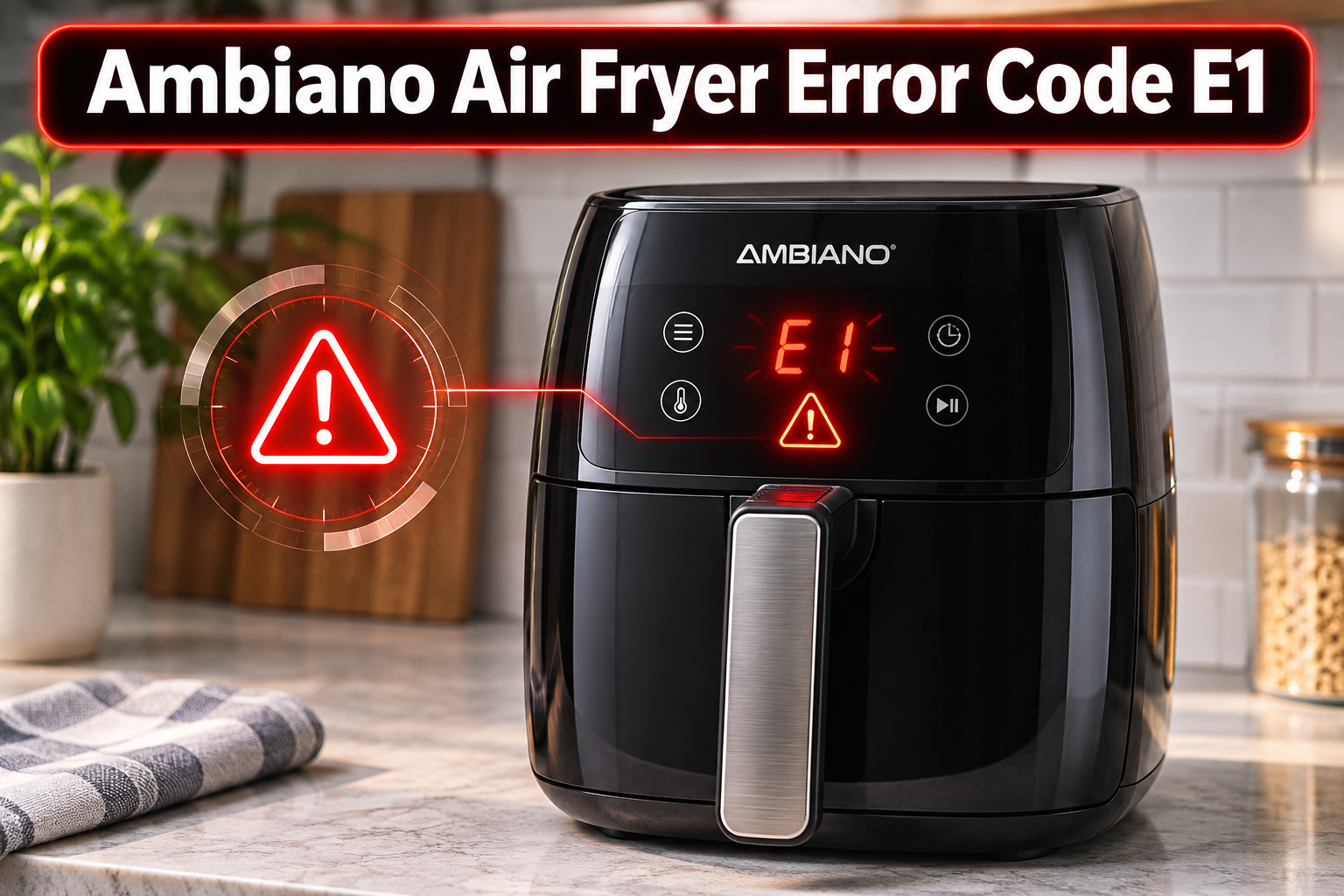
What Does Error Code E1 Mean on an Ambiano Air Fryer?
The E1 error code on an Ambiano air fryer generally indicates a problem with the internal temperature sensor or its electrical circuit. This sensor measures the temperature inside the appliance and helps its control system regulate heating during cooking.
Under normal conditions, the temperature sensor continuously sends information to the electronic control board. The board uses this information to control the heating element and maintain the selected cooking temperature. If the sensor stops sending reliable information, the appliance may display an error rather than continue operating normally.
According to the user manual for the Ambiano MD 18763 XL 5.3-quart air fryer, both E1 and E2 indicate that the internal temperature sensor has reported a fault. The manual recommends contacting customer service rather than attempting an internal repair. Some other air fryer designs use E1 specifically for an open temperature sensor circuit, meaning the electrical connection needed to read the sensor has been interrupted.
You may notice that the error appears immediately after switching on the air fryer or partway through cooking. In either situation, avoid continuing to use the appliance while E1 remains displayed. Because Ambiano has produced different air fryer models, checking your particular model’s instructions is essential before assuming that every E1 error has exactly the same cause.
Ambiano Air Fryer Error Code E1 [FIXED]: Common Causes
Several internal faults can prevent an Ambiano air fryer from reading its temperature correctly. Although the error points toward the temperature monitoring system, identifying the exact defective component requires further diagnosis.
1. A Faulty Temperature Sensor
One of the main possible causes of error code E1 is a malfunctioning temperature sensor. Many electronic air fryers use a component called an NTC thermistor, which changes its electrical resistance as the temperature changes. The control board measures this change to determine how hot the cooking chamber has become.
If the sensor develops an internal electrical break, the board may lose the temperature reading it needs. Consequently, the appliance can display E1 and stop heating. This is particularly relevant to models that define E1 as an open temperature sensor circuit.
Temperature sensors operate through repeated heating and cooling cycles. Over time, a component can deteriorate or develop an internal fault. However, the appearance of E1 alone doesn’t establish that the sensor itself has failed.
A faulty sensor may cause the error to appear immediately when you connect the appliance to power. Alternatively, the error might develop during cooking if the electrical fault becomes noticeable as the appliance heats up. These symptoms provide useful clues, but a qualified technician must check the sensor and its circuit to confirm the diagnosis.
2. A Loose Temperature Sensor Connection
Sometimes, the temperature sensor itself is working, but its connection to the electronic control board has become unreliable.
The sensor communicates with the board through electrical wires and connectors. If a connector becomes loose or develops poor electrical contact, the board may receive an interrupted signal. Depending on the model, this can produce the E1 error.
One clue is an error that appears intermittently. For example, your air fryer might work during one cooking session but display E1 the next time you use it. The fault may also occur after the appliance has heated up.
However, intermittent operation doesn’t prove that a connector is loose. A failing sensor or damaged wire can produce similar symptoms. Since these connections are inside the appliance, checking them requires professional servicing rather than removing the housing yourself.
3. Damaged Internal Sensor Wiring
The wires connecting the temperature sensor to the control board are another possible source of the problem.
These wires carry the sensor’s electrical signal. If one becomes broken or its connection deteriorates, the control board may be unable to read the sensor even when the sensor remains functional.
Internal wiring can become damaged through mechanical stress, excessive heat, deterioration, or an earlier manufacturing defect. Because air fryers operate at high temperatures, their internal wiring and insulation must be suitable for the conditions inside the appliance.
You might suspect wiring damage if the error started after the appliance was dropped or suffered a strong impact. Nevertheless, an E1 code doesn’t confirm that any particular wire has broken.
In some cases, the damaged section may be near a connector, while in others, the problem may involve the sensor’s attached wiring. A technician can distinguish these faults through appropriate electrical tests.
Avoid opening the housing, pulling internal wires, or attempting to reconnect components yourself. Air fryers contain electrical parts that can present a shock or fire risk if handled incorrectly.
4. A Faulty Electronic Control Board
The electronic control board manages several important functions in your Ambiano air fryer. These include interpreting temperature information, responding to control panel settings, and regulating the heating process.
If the section of the board responsible for reading the temperature sensor develops a fault, it may report E1 even when the sensor and its wiring are functioning correctly.
Electrical component failure, damaged connections, or moisture reaching internal electronics can interfere with the board’s operation. Depending on the damage, you may notice other problems, such as an unresponsive control panel or irregular display behavior. However, these symptoms aren’t exclusive to a faulty board.
A control board problem is generally considered after the sensor, wiring, and connectors have been evaluated. Replacing the board without confirming the fault can be unnecessarily expensive, especially if a smaller component is responsible.
Ambiano Air Fryer Error Code E1 [FIXED]: How to Fix
Since E1 generally concerns the temperature monitoring system, basic troubleshooting cannot resolve every case. Still, a few safe checks can help you identify a temporary problem, rule out unrelated operating issues, and decide whether professional repair is necessary.
1. Confirm the Error Code and Your Air Fryer Model
Before trying any troubleshooting method, make sure your appliance is actually displaying E1.
Depending on the control panel design, some error codes can look similar at a quick glance. Check whether the display reads E1, E2, or another combination of letters and numbers.
Next, locate the model information on the appliance’s identification label. This label is commonly found underneath or at the back of the air fryer. Switch off and unplug the appliance before moving it, and allow it to cool completely.
Look for information such as the following.
-
Model number
-
Product code
-
Serial number, if provided
-
Electrical rating
-
Manufacturer or distributor details
Once you have the model number, consult the corresponding user manual.
This matters because Ambiano air fryers aren’t all built with identical controls and error reporting systems. For example, the MD 18763 manual groups E1 and E2 together as temperature sensor faults, while some other designs distinguish between open and shorted sensor circuits.
Follow the instructions for your particular model whenever they differ from general troubleshooting advice.
2. Switch Off the Air Fryer and Allow It to Cool
If E1 appears while your air fryer is cooking, stop using the appliance and disconnect it from the electrical outlet.
Allow it to cool fully before handling the basket or inspecting any accessible areas. Cooling is particularly important if the error appeared after a long cooking session.
Follow these steps.
-
Stop the cooking process using the power or stop button, if it responds.
-
Unplug the power cord from the wall outlet.
-
Place the appliance in a safe position on a stable, heat-resistant surface.
-
Allow it to cool completely without covering its ventilation openings.
-
Once the appliance is cool, remove the basket carefully and check for any obvious damage or unusual residue.
Cooling can resolve some temporary operating conditions, but it won’t repair a broken temperature sensor, damaged wire, or faulty control board.
Therefore, don’t assume that overheating caused E1 simply because the error appeared during cooking. A sensor circuit fault can also become noticeable when the appliance is hot.
If you noticed a strong burning smell, unusual smoke, melting plastic, or visible electrical damage, leave the air fryer unplugged and seek professional assistance.
3. Try a Simple Power Reset
A power reset is another reasonable troubleshooting step, provided the appliance has no signs of damage or overheating.
Electronic appliances sometimes experience temporary control problems that disappear after their power supply is disconnected and restored. Although a reset won’t repair a physical component fault, it can help establish whether the error remains present.
To reset your Ambiano air fryer safely, follow these steps.
-
Make sure the appliance is switched off.
-
Disconnect its plug from the wall outlet.
-
Allow the appliance to cool completely.
-
Leave it disconnected for approximately 10 minutes.
-
Reconnect it to a suitable electrical outlet once it has cooled.
-
Check whether E1 still appears on the display.
The 10-minute period is a general troubleshooting interval rather than a confirmed reset requirement for every Ambiano model. If your manual gives different instructions, follow those instead.
If E1 appears again immediately, stop troubleshooting and arrange professional diagnosis. Repeatedly disconnecting and reconnecting the appliance is unlikely to solve a persistent sensor circuit fault.
If the error disappears, that result is encouraging, but it doesn’t prove the appliance has been repaired. An intermittent sensor connection may temporarily work again before failing later.
If E1 previously appeared during cooking, contact the appropriate service provider before returning the appliance to normal use, even if the display currently looks normal.
4. Check the Cooking Basket and Ventilation Openings
Your next step is to examine the parts of the air fryer that are safe to access without opening its housing.
Although a poorly seated basket or blocked vent isn’t an established direct cause of E1, these conditions can create separate operating problems. Checking them helps rule out issues that may have occurred alongside the error.
Start with the cooking basket. After the appliance has cooled, remove the basket and check whether anything is preventing it from fitting into its compartment.
Look for food particles, incorrectly positioned removable inserts, or physical damage around the basket.
Once everything is clean and properly arranged, slide the basket back into position. It should fit as described in your model’s manual without requiring excessive force.
Next, examine the air intake and exhaust openings. Make sure they aren’t covered by kitchen towels, packaging, accumulated debris, or nearby objects.
The Ambiano GT-AF-14-US manual, for example, specifies clearance around the appliance and warns against covering it during operation. Other models may have different spacing requirements, so use the instructions supplied with yours.
Keep in mind that correcting a basket or ventilation problem doesn’t necessarily clear E1. If the temperature sensor circuit is faulty, the error may remain even when the appliance is perfectly clean and correctly assembled.
5. Clean and Dry the Accessible Parts
Food residue, grease, and moisture can create maintenance problems in an air fryer. Although ordinary grease buildup isn’t a confirmed cause of the E1 sensor fault, proper cleaning is worthwhile when checking the appliance’s condition.
First, unplug the air fryer and make sure it has cooled completely.
Remove the basket, cooking tray, and any other removable accessories according to your owner’s manual. Wash only the parts the manufacturer identifies as washable, using the recommended cleaning method.
For models that allow handwashing, warm water, mild dish soap, and a soft sponge are generally suitable. Avoid abrasive materials that might damage the cooking surfaces.
Once the removable parts are clean, dry them thoroughly before placing them back in the appliance.
You can also wipe accessible exterior surfaces with a slightly damp cloth, provided the instructions for your model allow it. Keep water away from electrical openings and the control panel.
Never pour water into the appliance, immerse the main housing, or spray cleaning liquid through its ventilation openings.
If liquid recently spilled into the air fryer housing, don’t attempt to dry the internal electronics by switching the appliance on. Have it examined by a qualified repair professional.
Cleaning may improve airflow and remove residue that causes smoke or unpleasant smells. However, it cannot reconnect a broken sensor wire or restore a defective electronic component.
If E1 remains after these safe checks, further cleaning is unlikely to resolve the underlying fault.
6. Contact a Qualified Appliance Repair Technician
If the E1 error continues to appear, the most appropriate next step is to contact Ambiano after-sales support or a qualified small appliance repair technician.
The MD 18763 user manual specifically recommends customer service when E1 or E2 appears. This is consistent with the possibility of an internal temperature sensor fault requiring specialist diagnosis.
A technician may need to check the temperature sensor, electrical connections, wiring, and control board to identify which component has failed.
For example, a sensor may need replacement if its electrical characteristics are outside the manufacturer’s specified range. However, if the sensor is working correctly but its signal cannot reach the control board, repairing the appropriate wiring or connector may be necessary.
Similarly, a defective control board may require replacement if the other parts of the temperature monitoring circuit are functioning normally.
These repairs involve internal electrical components and should be carried out by trained personnel using suitable equipment and replacement parts.
Before arranging a repair, check whether your air fryer is still covered by its warranty. You can find the relevant service information on the warranty card, packaging, or user manual.
When contacting support, provide the model number, purchase details, and a description of when E1 first appeared. Also explain whether the error appears immediately after switching on or during cooking.
If the unit is out of warranty, ask for the expected repair cost before authorizing the work. Depending on the appliance’s age, replacement part availability, and repair charges, purchasing a replacement air fryer may be more economical.
Avoid purchasing a generic temperature sensor or control board based solely on the E1 code. Different Ambiano models can use different components, and an incorrect replacement may create additional faults.
Wrap-Up
The Ambiano air fryer E1 error generally indicates that the appliance is having trouble monitoring its internal temperature. Although the problem may involve the sensor itself, its wiring, or the electronic control board, the display alone cannot identify the exact faulty component.
Start by checking your model’s manual, disconnecting the appliance, and performing the safe troubleshooting steps described above. If E1 persists or returns, avoid further cooking attempts and contact a qualified technician. Addressing the fault properly will help you determine whether your air fryer can be repaired safely or should be replaced.