A KitchenAid dishwasher displaying error code 4-4 may fill with water but fail to wash your dishes properly. You might notice that the usual spraying sound is missing, the cycle stops unexpectedly, or the Clean light starts flashing.
This error generally points to a problem with the wash motor or its electrical circuit. Fortunately, identifying the cause can help you avoid replacing expensive components unnecessarily. Some basic checks are simple, although electrical faults require professional attention.
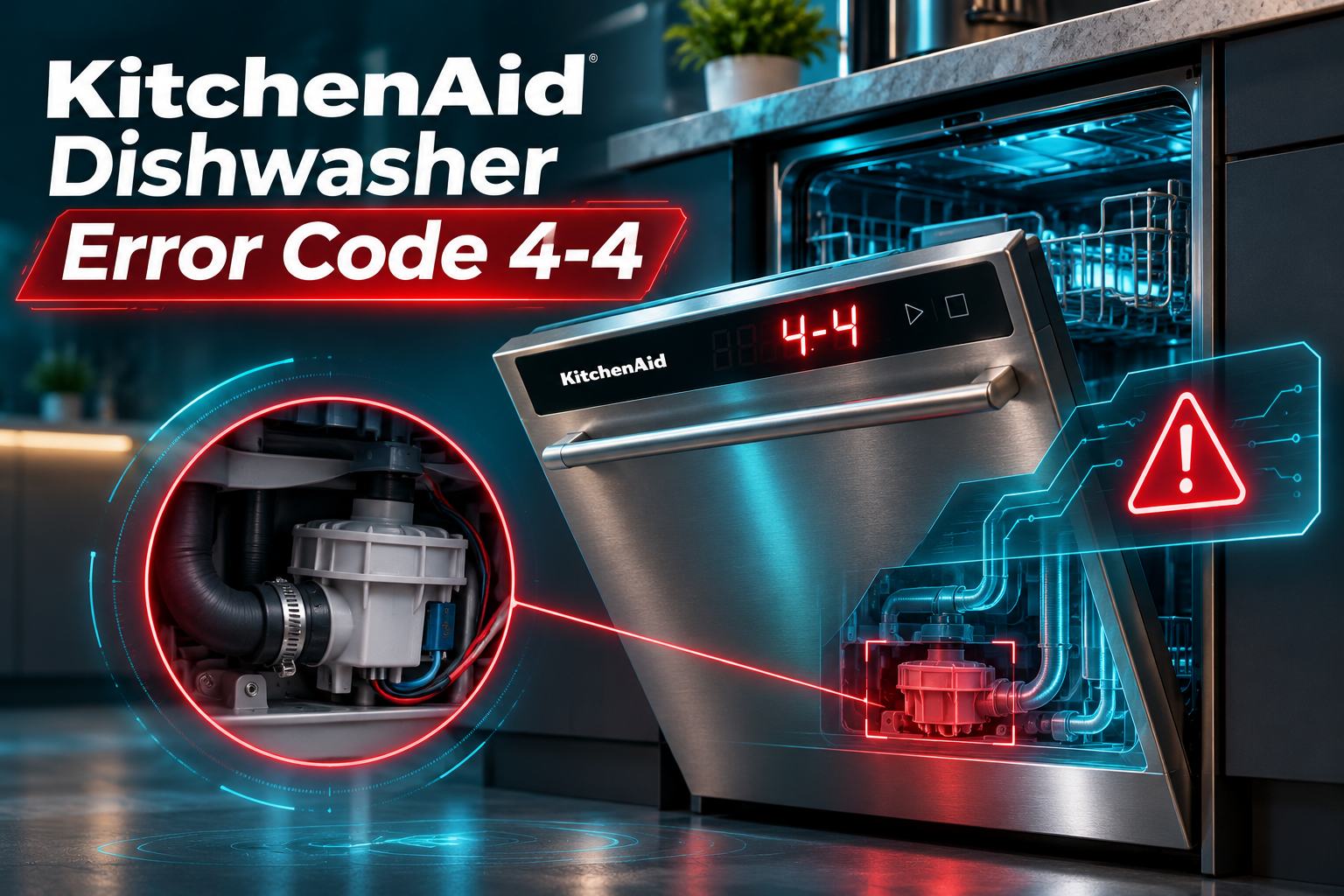
What Does KitchenAid Dishwasher Error Code 4-4 Mean?
KitchenAid dishwasher error code 4-4 indicates a wash motor failure on models that use this diagnostic code. It means the dishwasher’s control system has detected a problem with the motor or the electrical circuit responsible for operating it.
The wash motor powers the circulation pump, which moves water through the dishwasher’s spray arms. During a normal washing cycle, the pump forces water through these arms to remove grease, food particles, and detergent from your dishes.
When the wash motor stops working, the dishwasher may still fill with water because the water inlet system operates separately. However, the water won’t circulate properly, leaving your dishes dirty or covered in detergent residue. The control system may also interrupt the cycle after detecting the fault.
On models that communicate errors through flashing lights, the Clean indicator may flash four times, pause briefly, and flash another four times before repeating. Models with digital displays may show F4E4 instead. Error definitions vary between model generations, so check your dishwasher’s service information before assuming the codes are identical.
Another important distinction is that the wash motor differs from the drain pump. The wash motor circulates water during cleaning, while the drain pump removes dirty water from the dishwasher. A 4-4 fault generally concerns the circulation system rather than the drain pump.
KitchenAid Dishwasher Error Code 4-4: Common Causes
Several electrical and mechanical faults can prevent your KitchenAid dishwasher’s wash motor from operating correctly. Understanding these possibilities helps you identify the problem without replacing parts based on guesswork.
1. Loose or Damaged Wash Motor Wiring
One possible cause of error code 4-4 is a loose or damaged electrical connection between the wash motor and the dishwasher’s control board.
The wash motor needs a reliable electrical connection to operate. If a wire becomes loose, a connector develops corrosion, or the wiring becomes damaged, the motor may stop receiving the electrical power or signals it requires.
These problems can develop through normal appliance vibration, moisture exposure, or damage during previous repairs. A connector that wasn’t secured properly after maintenance may also cause an intermittent fault.
You might notice that your dishwasher works during one cycle but fails during another. In some cases, the motor stops operating completely, and the error appears whenever the control attempts to run it.
However, intermittent operation doesn’t automatically confirm a wiring fault. A failing motor or control board can produce similar symptoms.
Identifying damaged internal wiring requires access to the electrical circuit and appropriate testing equipment. Because these connections can carry dangerous voltage, a qualified technician should perform the inspection and repairs.
2. Faulty Wash Motor
A damaged wash motor is another established cause of KitchenAid dishwasher error code 4-4.
The motor drives the circulation pump, allowing water to reach the spray arms with enough force to clean your dishes. If the motor develops an internal electrical failure, it may no longer start or operate correctly.
Motor failures can develop from electrical damage, excessive heat, mechanical wear, or problems within the pump assembly. In some cases, damage to the motor’s internal windings interrupts the electrical circuit.
One noticeable symptom is a dishwasher that fills with water but remains unusually quiet during the washing stage. You may hear the water entering the tub, followed by silence when the usual spraying sound should begin.
Other symptoms can include incomplete cycles, poor cleaning performance, or unusual humming noises. A humming sound may suggest that a motor is struggling to start, although it doesn’t identify the exact cause.
It’s also possible for a motor to stop working without producing any unusual noise. Therefore, the absence of grinding or humming doesn’t rule out a motor failure.
A technician can test the motor’s electrical condition and determine whether the problem involves the motor itself, the pump assembly, or another part of its circuit.
3. Open Motor Fuse on the Control Board
Some KitchenAid dishwashers have a motor protection fuse incorporated into the electronic control system.
This fuse helps protect the electrical circuit that operates the dishwasher’s motors. If it opens, the affected motors may stop receiving power even when their mechanical components are functional.
An open motor fuse can result from an electrical fault, such as a shorted component or damaged wiring. However, the specific cause must be established through proper testing.
On certain models, both the wash motor and drain motor may stop operating when their shared protective circuit fails. This provides an important diagnostic clue, especially when the dishwasher appears to start but cannot perform its usual pumping functions.
The motor fuse isn’t necessarily a separate user-replaceable component. Depending on the control board design, repairing an open fuse condition may require replacing the control board after the underlying fault has been identified.
Simply replacing the control board without checking the connected motor circuits can result in another failure if the original electrical problem remains.
4. Defective Electronic Control Board
The electronic control board manages the dishwasher’s washing sequence and controls the operation of its electrical components.
During a washing cycle, the board activates the wash motor at the appropriate time. If the motor drive circuit develops a fault, it may fail to supply power or properly control the motor.
The dishwasher might still respond to button presses, fill with water, and display normal indicator lights. However, it may stop when the program reaches the stage where water circulation should begin.
This can make a control board failure difficult to distinguish from a defective wash motor.
Control board faults sometimes develop because of electrical component damage, overheating, or other internal failures. However, visible damage isn’t always present.
A qualified technician can compare the motor’s electrical condition with the control circuit’s expected operation. If the motor and wiring test correctly but the control cannot operate the motor, the board may require replacement.
On certain models, installing an incorrect replacement control board can also cause motor-related errors. Therefore, replacement parts must match the dishwasher’s exact model and specifications.
KitchenAid Dishwasher Error Code 4-4: How to Fix
The correct fix depends on whether the problem involves the motor, its wiring, or the electronic control system. Start with the following safe checks before considering component repairs.
1. Confirm the Error Code and Dishwasher Model
Before resetting your dishwasher or attempting repairs, make sure you’re dealing with a confirmed 4-4 error.
KitchenAid has used different diagnostic systems across its dishwasher models. Consequently, identifying the complete fault code prevents you from troubleshooting the wrong component.
If your dishwasher uses flashing indicator lights, observe the complete sequence carefully.
- Watch the Clean or Complete indicator while the error is displayed.
- Count the first group of flashes.
- Note the short pause between the groups.
- Count the second group of flashes.
- Record the complete sequence before resetting the dishwasher.
On many models, the short pause lasts approximately 1 to 2 seconds, while a longer pause separates repeated sequences.
Next, locate your dishwasher’s model number. The identification label is commonly found along the door opening or tub frame.
Use this number to check the appropriate owner’s manual or technical documentation.
This step is particularly useful because some newer KitchenAid dishwashers use different error code assignments. Confirming the model helps ensure that the warning actually relates to the wash motor.
2. Reset Your KitchenAid Dishwasher
A temporary electronic control issue can sometimes interrupt communication between the dishwasher’s control system and its components.
Resetting the appliance allows the electronic controls to restart. This is a reasonable first step when the error appears unexpectedly and there are no signs of electrical damage.
To reset your KitchenAid dishwasher, follow these steps.
- Press Cancel if the control panel is responding.
- Unplug the dishwasher if its electrical plug is safely accessible.
- If the dishwasher is permanently connected to the electrical supply, turn off its dedicated circuit breaker.
- Leave the power disconnected for at least 30 seconds.
- Restore power and allow the controls to restart.
- Start a normal washing cycle and observe what happens.
Listen for the usual sound of water spraying after the dishwasher fills. Also, check whether the appliance completes the cycle without displaying the warning again.
If everything works normally, the error may have resulted from a temporary control issue.
However, a reset cannot repair a defective motor, damaged wiring, or failed control board. If the error returns, avoid repeatedly restarting the dishwasher because the underlying fault still needs attention.
3. Clean the Dishwasher Filter and Check for Blockages
Food particles, grease, and other debris can accumulate around the dishwasher’s filter and restrict water circulation.
Although a dirty filter doesn’t normally cause an electrical wash motor fault, checking for obstructions can help identify circulation problems that produce similar symptoms.
Begin by disconnecting the dishwasher from its power supply. Allow the interior to cool before reaching into the tub.
Remove the lower dish rack and locate the filter assembly near the bottom of the dishwasher.
If your model has removable filters, clean them using the following procedure.
- Remove the upper filter assembly according to your owner’s manual.
- Take out the lower filter if your dishwasher uses one.
- Rinse the filters under running water to remove food particles.
- Use a soft brush to clean stubborn grease or mineral deposits.
- Reinstall the filters securely before operating the dishwasher.
Avoid using wire brushes or sharp tools because they can damage the filter material.
Some KitchenAid dishwashers have different filtration systems, so don’t force any component that isn’t designed to be removed.
Next, inspect the visible area around the filter opening for loose food particles or small objects. Remove accessible debris carefully, but don’t dismantle the pump housing or reach into concealed openings.
Check the spray arms as well. Make sure nothing prevents them from rotating and that their openings aren’t blocked by food residue.
After cleaning and reassembling the accessible components, run a suitable washing cycle.
If cleaning performance improves but error 4-4 remains, the dishwasher probably needs further motor circuit diagnosis. Cleaning the filter won’t repair an electrically defective motor.
4. Check the Water Supply and Observe the Washing Cycle
Your dishwasher needs enough water for the circulation pump to move water through the spray arms effectively.
A restricted water supply can cause poor washing performance, sometimes making it seem as though the wash motor isn’t functioning.
However, insufficient water usually produces a different fault from a confirmed 4-4 motor circuit error. Checking the water supply is useful for ruling out a separate problem.
First, make sure the water supply valve beneath your kitchen sink is fully open. Inspect the visible portion of the supply hose for sharp bends or restrictions.
Also, confirm that large dishes, utensils, or other items aren’t obstructing the spray arms.
Once these checks are complete, observe the dishwasher during a normal washing cycle.
After the initial filling stage, a working circulation pump should begin moving water through the spray arms. Depending on the model, you may hear a steady rushing or spraying sound.
If the dishwasher fills but produces no spraying sound, the wash motor may not be operating. However, some models pause between stages, so a short period of silence isn’t necessarily a fault.
If the cycle stops and displays 4-4 again, note how far it progressed before stopping.
For example, a dishwasher that fills normally but consistently stops when washing should begin gives a technician useful information about the affected system.
Don’t attempt to inspect the motor while the dishwasher is running. Avoid opening electrical panels or accessing moving components during operation.
5. Check for Signs of a Motor or Control Circuit Failure
If the dishwasher continues displaying error 4-4 after the basic checks, the next step is to determine whether the failure involves the wash motor or its control circuit.
You can gather useful information without opening the appliance’s electrical components.
Pay attention to how the dishwasher behaves during a cycle.
A dishwasher that fills normally but doesn’t circulate water may have a failed wash motor or an interruption in its electrical supply.
If both washing and draining functions fail, the problem may involve a shared electrical circuit or motor protection fuse on certain models.
However, if the dishwasher drains normally but cannot circulate water, the circulation motor and its individual wiring become more relevant suspects.
These observations aren’t enough to confirm which component has failed. A technician may need to perform several electrical checks, including tests of the motor windings, wiring connections, control board, and motor protection circuit.
The results help determine which repair is necessary.
For example, a motor with an open internal electrical circuit may need replacement. If the motor tests correctly but the wiring connection is defective, repairing the connection may resolve the fault without replacing the motor.
Similarly, a failed control board should only be replaced after other relevant components have been checked.
Avoid attempting internal electrical measurements yourself. Even when the appliance is disconnected, some electrical components may retain a charge, and improper testing can cause injury or additional damage.
6. Contact a Qualified Appliance Repair Technician
If the 4-4 error continues after resetting the dishwasher and checking accessible components, professional diagnosis is the safest next step.
A qualified appliance technician can examine the wash motor circuit and identify whether the problem involves loose wiring, a defective motor, an open motor fuse, or a failed electronic control board.
Professional assistance is especially important if you notice any of the following symptoms.
- The dishwasher consistently stops when washing should begin.
- The wash motor doesn’t operate despite the dishwasher filling normally.
- Both the circulation and drain pumps stop functioning.
- The dishwasher produces a burning smell or trips its circuit breaker.
- Error code 4-4 returns immediately after resetting the appliance.
If you notice smoke, an electrical burning smell, or repeated breaker trips, stop using the appliance and disconnect its power when safe.
Before arranging service, record your dishwasher’s model number and the complete error code. Explain whether the appliance fills, sprays, drains, or stops during a particular stage.
These details can help the technician identify the affected circuit and select the appropriate diagnostic checks.
In some cases, repairing a loose connection may be sufficient. However, a defective wash motor or control board may require replacement.
A proper diagnosis helps ensure that only the necessary components are repaired or replaced.
Wrap-Up
KitchenAid dishwasher error code 4-4 generally indicates a wash motor or related electrical circuit failure on models that use this code. Loose wiring, a defective motor, an open motor fuse, or a faulty control board may be responsible.
Start by confirming the error code, resetting the appliance, and checking accessible components for blockages or water supply problems. If the warning persists, professional electrical testing can identify the actual fault. Addressing the problem promptly can help prevent further damage and restore your dishwasher’s cleaning performance.