In many KitchenAid refrigerators, E5 is associated with the ice mold temperature sensor or timed ice making. Understanding the possible causes will help you identify the problem and try safe troubleshooting methods.
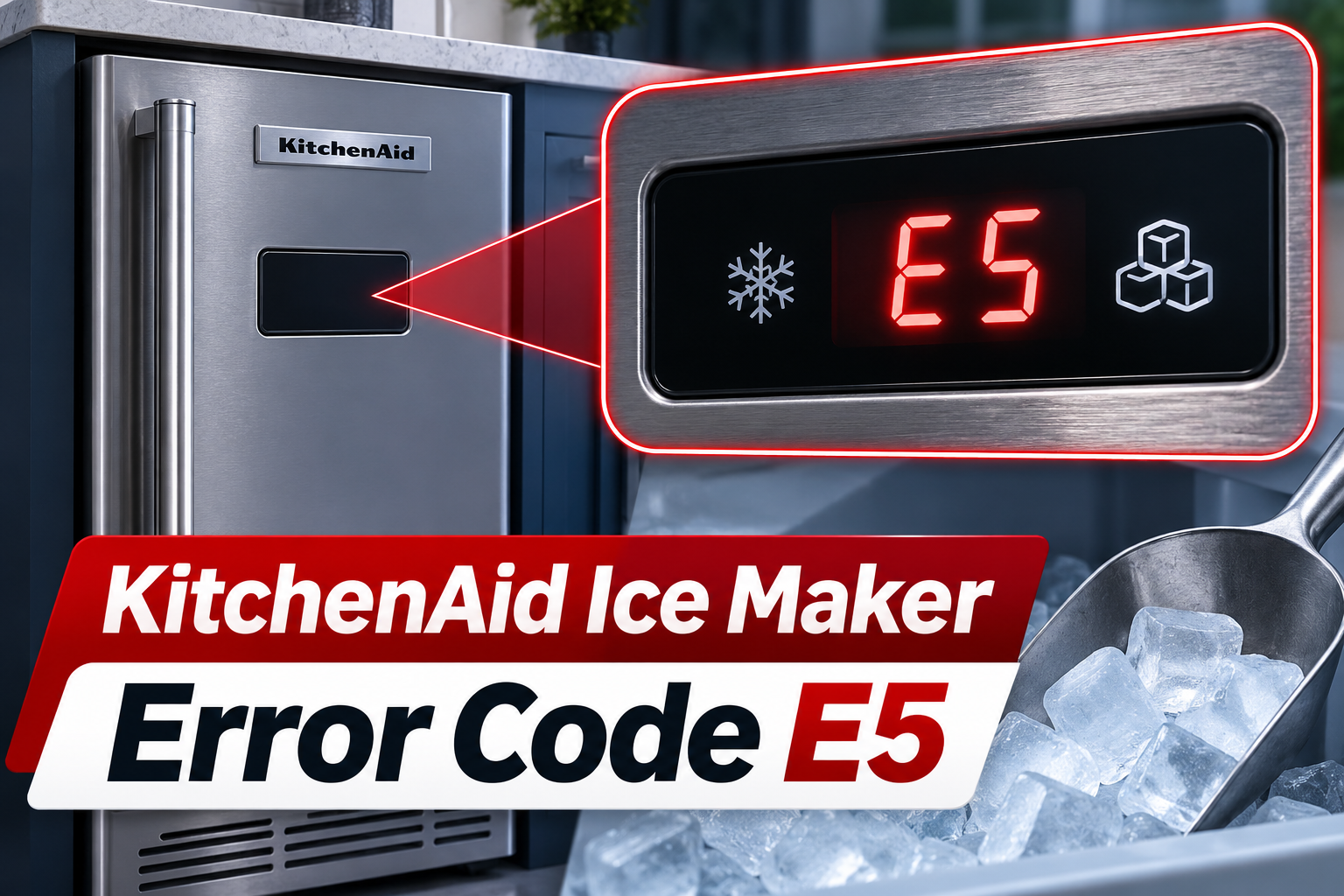
What Does the KitchenAid Ice Maker Error Code E5 Mean?
On certain KitchenAid refrigerators, the E5 error code indicates a possible ice maker thermistor problem. A thermistor is a temperature sensor that helps the refrigerator determine when the ice mold has reached the required temperature. Some KitchenAid service documents describe E5 as a condition where the ice mold remains in its frozen state longer than expected, even though the ice storage compartment has reached its required temperature.
Other KitchenAid refrigerator models identify E5 as “Timed Ice Making” during Service Test 56. This means the control system has detected a condition involving the ice making cycle and its timing. The code doesn’t automatically confirm that a particular component has failed.
During normal operation, the ice maker fills its mold with water and allows the water to freeze. Temperature information helps the control system determine when to begin harvesting, which is the process of releasing frozen cubes into the storage bin. If the temperature readings are incorrect or the expected operating conditions aren’t detected, the ice making sequence may be affected.
You might notice slower ice production, cubes remaining in the mold, or an ice maker that stops producing ice. However, E5 can have a different meaning in other diagnostic modes, including a heater fault in certain manufacturing tests. Always confirm the code using the technical information for your specific KitchenAid model.
KitchenAid Ice Maker Error Code E5: Common Causes
Several problems can interfere with the temperature monitoring and timing required for normal ice production. The following five causes are worth considering, particularly when E5 appears during the refrigerator’s ice maker diagnostic test.
1. Faulty Ice Maker Thermistor
A defective thermistor is one of the main possible causes of E5 on KitchenAid models that identify the code as an ice mold temperature fault. The thermistor monitors temperature changes and provides information that helps the control system manage the ice making cycle.
As the ice mold cools, the thermistor’s electrical resistance changes. The control board interprets this change to determine the temperature. If the sensor becomes defective, it may provide incorrect readings or stop providing a usable signal. Consequently, the refrigerator might not recognize that the ice has reached the expected condition.
You may notice that the ice maker takes an unusually long time to release cubes or produces ice inconsistently. Sometimes, the mold contains fully frozen cubes even though harvesting hasn’t started. However, a slow cycle doesn’t prove the thermistor has failed. A technician must check the sensor’s readings using the correct diagnostic procedure.
2. Loose or Damaged Thermistor Wiring
The ice maker thermistor depends on electrical connections to communicate with the refrigerator’s control system. If a wire becomes damaged or a connector develops a poor connection, the control board may receive incorrect temperature information.
Electrical connection problems can result from damaged wires, loose terminals, corrosion, or previous repairs that left a connector improperly seated. A completely broken connection can prevent the sensor signal from reaching the control board. An intermittent connection may cause the temperature reading to become unreliable.
One possible clue is inconsistent ice production, where the appliance occasionally completes a cycle but later records the same error. However, wiring faults aren’t always visible from outside the ice maker. A qualified technician should inspect the internal connections and determine whether the thermistor or its wiring is responsible.
3. Ice Mold or Harvesting Problems
The ice mold holds water while it freezes into cubes. Once the freezing stage is complete, the harvesting mechanism releases the cubes into the storage bin. If ice becomes stuck or the harvesting process doesn’t work correctly, normal production can be interrupted.
On models equipped with a mold heater, the heater briefly warms the mold to help release frozen cubes. Problems with the heater, excessive ice buildup, or damaged harvesting components can prevent the ice from leaving the mold. Depending on the refrigerator’s control system, this may result in abnormal operating times or a separate harvesting error.
You might notice frozen cubes remaining inside the mold, repeated clicking sounds, or an ice maker that attempts to release cubes without completing the process. However, KitchenAid uses other error codes, including E2 and E3 on certain models, for specific motor and heater faults. These symptoms should therefore be investigated separately rather than automatically attributed to E5.
4. Incorrect Freezer Temperature or Restricted Airflow
Your KitchenAid ice maker depends on sufficiently cold conditions to freeze water properly. If the freezer temperature rises or cold airflow becomes restricted, ice production can slow considerably.
Warm air entering through a poorly closed refrigerator door, blocked air vents, or a malfunctioning cooling fan can affect the temperature around the ice maker. Excessive frost may also interfere with airflow in certain refrigerator designs. These conditions can make it difficult for the appliance to maintain consistent freezing temperatures.
You may notice soft ice, partially frozen cubes, or longer intervals between batches. However, cooling problems aren’t the primary meaning of E5 on models that identify it as a thermistor fault. Some KitchenAid refrigerators use E1 for ice maker cooling problems. Checking the temperature is still useful because it helps separate a genuine sensor fault from a wider refrigeration problem.
5. Malfunctioning Refrigerator Control Board
The refrigerator’s electronic control board receives information from temperature sensors and coordinates the ice maker’s operation. It uses these signals to manage different stages of ice production.
If the board develops an internal electronic fault, it may misinterpret the thermistor’s readings or fail to control the ice making cycle correctly. Damaged electronic components or problems with the sensor input circuit can interfere with normal operation.
A control board fault may produce symptoms similar to those of a defective thermistor, including delayed harvesting and inconsistent ice production. However, control boards are relatively involved components to diagnose, and replacing one without verifying the sensor and wiring can lead to unnecessary repair costs. Professional testing is needed to confirm this cause.
KitchenAid Ice Maker Error Code E5: How to Fix
Start with simple troubleshooting methods that don’t involve opening the refrigerator’s electrical compartments. These checks can help identify temporary control problems, ice obstructions, and temperature issues before more involved repairs become necessary.
1. Confirm the E5 Error Code for Your Refrigerator
Before replacing any component, confirm what E5 means on your particular KitchenAid refrigerator. The manufacturer uses different ice maker designs and diagnostic systems, so the same code can describe different conditions.
Locate the model number on the refrigerator’s identification label. On many models, the label is inside the fresh food compartment. Use this number to find the appropriate technical documentation.
Pay attention to the diagnostic test displaying E5. For example, certain KitchenAid refrigerators identify the code as an ice maker thermistor problem during Service Test 56, while others describe it as timed ice making. A separate manufacturing diagnostic test may use E5 for a heater fault.
Identifying the correct meaning helps prevent unnecessary troubleshooting. If your model associates E5 with the thermistor, the temperature sensor and its connections should receive particular attention during professional diagnosis.
2. Reset Your KitchenAid Ice Maker
A reset may resolve a temporary electronic problem that has interrupted the ice making cycle. It allows the refrigerator’s controls to restart and may restore normal operation if the fault wasn’t caused by a damaged component.
Follow these steps to reset your KitchenAid ice maker.
-
Turn off the ice maker using its designated control.
-
Unplug the refrigerator or switch off its circuit breaker.
-
Leave the power disconnected for one minute.
-
Restore power and allow the refrigerator to restart.
-
Turn the ice maker back on if necessary.
-
Allow a few hours for ice production and check whether the problem returns.
Some KitchenAid refrigerators have a dedicated ice maker reset control. If yours does, follow the reset instructions in the owner’s manual because the procedure varies between models.
After the reset, check whether the ice maker begins producing cubes normally. A successful cycle suggests that the appliance can operate, but it doesn’t guarantee that an intermittent problem has disappeared.
If E5 returns, avoid resetting the refrigerator repeatedly. A defective thermistor or damaged electrical connection won’t be repaired by disconnecting power.
3. Check for Ice Buildup Around the Mold
Ice buildup can interfere with the harvesting mechanism and prevent cubes from dropping into the storage bin. Although this isn’t the main cause of a thermistor related E5 error, checking for obstructions can help eliminate a separate problem affecting ice production.
Start by turning off the ice maker and disconnecting refrigerator power. Remove the ice storage bin according to your appliance’s instructions, then inspect the accessible area around the ice mold.
If you notice an obstruction, follow these steps.
-
Look for loose cubes trapped around the visible harvesting mechanism.
-
Remove any ice that is safely accessible without forcing the moving parts.
-
Use a plastic utensil if necessary.
-
Avoid touching or bending the ejector arms.
-
Reinstall the ice bin correctly before restoring power.
If ice is tightly frozen around the mechanism, don’t attempt to break it apart with a knife or screwdriver. Sharp tools can damage the mold and surrounding components.
Also, avoid pouring boiling water onto the ice maker or using a hair dryer to melt ice. Excessive heat can damage plastic parts and electrical components.
After clearing accessible obstructions, restore power and observe whether the ice maker resumes normal operation. If E5 remains active, the temperature sensor or another internal component may still need attention.
4. Check the Freezer Temperature and Airflow
The freezer must maintain suitable temperatures for the ice maker to produce cubes consistently. Before assuming the thermistor is defective, check whether the refrigerator is cooling normally.
For many KitchenAid refrigerators, the recommended freezer setting is approximately 0°F (-18°C). KitchenAid also identifies 0°F to 5°F as a suitable freezer temperature range for ice production on certain models.
Start by checking the temperature setting on the refrigerator’s control panel. If necessary, adjust it according to your model’s instructions. Allow sufficient time for the temperature to stabilize before evaluating ice production.
Next, inspect the refrigerator for obvious airflow problems.
-
Make sure food packages aren’t blocking the interior air vents.
-
Check that the refrigerator doors close completely.
-
Inspect the visible door gaskets for dirt, damage, or gaps.
-
Look for unusual frost buildup around the ice maker compartment.
-
Avoid overcrowding areas where the appliance needs space for airflow.
If you find dirt around the door gasket, clean it using a soft cloth and mild soapy water. Dry the gasket and check that the door closes securely.
If the freezer continues running too warm, the refrigerator may have a cooling problem requiring professional diagnosis. However, if the temperature is normal and E5 keeps returning, the ice mold thermistor and its associated circuit become more relevant suspects.
5. Observe Ice Production and Check for Recurring Errors
After completing the basic checks, allow the ice maker to operate normally and observe whether it produces and releases cubes.
Make sure the ice maker is switched on, the storage bin is correctly installed, and the refrigerator doors are closed. Avoid touching the harvesting mechanism while the appliance is operating.
Listen for the usual sounds of ice dropping into the bin. You can also check whether cubes are being produced at regular intervals once the refrigerator has reached its normal operating temperature.
If the ice maker produces cubes but E5 continues appearing in the diagnostic system, there may still be an intermittent sensor or control problem. A single successful cycle doesn’t necessarily mean the underlying fault has been resolved.
Certain KitchenAid refrigerator models include Service Test 58, which allows technicians to check the ice maker heater and thermistor status. Depending on the model, the test can identify whether the thermistor circuit is open or shorted.
These diagnostic procedures vary between appliances. Avoid attempting unfamiliar service commands, particularly those that activate heaters, motors, or water valves.
If E5 continues returning, record when it appears and whether the ice maker is producing ice. This information will help a technician identify the problem more accurately.
6. Contact a Qualified KitchenAid Appliance Technician
If the E5 error persists after resetting the refrigerator and completing the safe checks, professional diagnosis is the next step.
A qualified appliance technician can examine the ice mold thermistor, inspect its wiring, and check the relevant control circuits. On models equipped with the appropriate diagnostic system, the technician can use manufacturer service tests to determine whether the sensor is providing valid temperature information.
If the thermistor is defective, it may need replacing. On some KitchenAid refrigerators, the sensor is part of a larger ice maker assembly, so the available repair options depend on the appliance’s design.
A technician may also investigate the control board if the thermistor and wiring test correctly. Replacing the control board should generally follow proper diagnosis rather than being the first repair attempted.
Before scheduling service, gather your refrigerator’s model number, the E5 error details, and a description of the symptoms. Mention whether the ice maker produces any cubes, how frequently it operates, and whether the error returns after a reset.
If the refrigerator is still covered by a warranty, check the repair terms before purchasing replacement parts.
Wrap-Up
The KitchenAid ice maker E5 error code commonly relates to ice mold temperature monitoring or timed ice making, depending on the refrigerator model. A defective thermistor, damaged wiring, or a control problem may interfere with normal ice production.
Begin by confirming the code’s meaning, resetting the appliance, and checking for visible ice obstructions or temperature problems. If E5 continues appearing, have the thermistor and related electrical components professionally tested. Identifying the actual fault before replacing parts can help you avoid unnecessary expenses and restore reliable ice production.