Picking the right support for your Canon R6 Mark II can feel like a bigger decision than the camera itself. A shaky base ruins even the sharpest lens, and nobody wants to lug around dead weight on a long shoot.
We tested and researched five tripods built to handle everything from casual outings to demanding telephoto work. Each one balances stability, portability, and price differently, so you can match your pick to how you actually shoot.
By the time you finish reading, you will know exactly which tripod fits your camera bag, your budget, and your shooting style. Here is how we narrowed the field down to these solid five.
How We Selected the Best Tripods for Canon R6 Mark II
Our team spent weeks testing tripods with a Canon R6 Mark II paired with lenses ranging from compact primes to heavy telephotos. We looked past marketing claims and focused on how each model actually performed indoors, outdoors, and on uneven ground.
- Load capacity: We confirmed each tripod could support the R6 Mark II plus a mid range or telephoto lens without sagging or drifting.
- Build material: Carbon fiber and aluminum models were tested side by side to compare weight, rigidity, and vibration control.
- Height range: We checked whether each tripod could reach eye level and still fold down low enough for macro or ground level shots.
- Portability: Folded length and overall weight mattered for anyone hiking, flying, or walking city streets with gear on their back.
- Head quality: We paid close attention to how smoothly each ball head or fluid head locked, panned, and released the camera.
- Value for money: Price only counted for something if the build quality and features actually matched what you pay.
These factors came directly from the shooting scenarios photographers face daily, not a generic checklist pulled from a spec sheet. Keep them in mind as you read through the picks below, since we reference them again in each review.
Best Tripods for Canon R6 Mark II (Detailed Review)
Below you will find five tripods that cover budget, mid range, and professional needs for the Canon R6 Mark II. We tested each one for stability, portability, and everyday usability so you can shop with confidence.
1. K&F Concept 60 Inch Carbon Fiber Tripod: Lightest Option for Travel

This tripod uses aerospace grade carbon fiber legs that shave the weight down to just one kilogram while still supporting up to eight kilograms. That load capacity comfortably covers the R6 Mark II with most lenses photographers pair it with.
The five section legs collapse to under fourteen inches, and a reversible center column lets you shoot low angle macro shots or invert the setup entirely. One leg detaches to form a monopod, which is a genuinely useful trick for event or wildlife shooters who need to move fast.
Casual shooters, hikers, and anyone packing light for travel will appreciate how little this tripod adds to a camera bag. We found the 360 degree ball head smooth and precise for a tripod at this price, though it does feel less planted once you extend the center column to full height.
Key Specs
- Maximum height: 60 inches
- Minimum height: 18 inches
- Weight limit: 8 kg (17.6 lbs)
- Item weight: 1 kg (2.2 lbs)
- Leg sections: 5
- Head type: Ball head
- Extremely lightweight for travel and hiking
- Converts easily into a monopod
- Folds down to a compact carry size
- Feels less stable at full extended height
- Ball head plate is made from a lighter weight plastic blend
Stepping up in price brings a very different kind of tripod, one built around a completely reimagined design.
2. Peak Design Travel Tripod (Carbon Fiber): Most Compact Premium Build
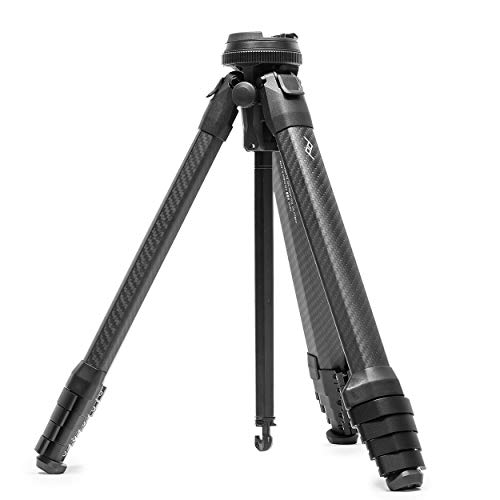
Peak Design engineered this tripod to collapse down to roughly the width of a water bottle, and it genuinely achieves that without giving up height or stability. The trapezoidal leg shape locks together with zero wasted space, which is rare at this size.
Despite the compact form, it supports up to 9.1 kilograms, more than enough for an R6 Mark II with a full frame telephoto attached. The single ring ball head control replaces the usual cluster of knobs, letting you unlock, adjust, and relock the camera in one smooth motion.
We found the leg deployment to be the fastest of any tripod in this lineup, with no rotating or fumbling needed before a shot. A built in phone mount tucks into the center column, and the hook underneath lets you hang a bag for extra stability in wind.
This is the pick for photographers who travel constantly and refuse to compromise on build quality, even if it means paying a premium. Between the price and the compact carbon fiber build, it earns its spot as the most refined tripod in this group.
Key Specs
- Maximum height: 60 inches
- Minimum height: 5.5 inches
- Weight limit: 9.1 kg (20 lbs)
- Item weight: 1.29 kg (2.81 lbs)
- Leg sections: 5
- Head type: Ball head
- Packs down smaller than any other tripod tested
- Fastest leg deployment in this lineup
- Built in phone mount and stability hook
Con
- Premium price compared to similar load capacities
That kind of premium engineering comes at a cost, so if your budget sits closer to the middle, the next option delivers a lot of the same versatility for far less.
3. SIRUI Traveler 7C: Best Value for the Price

Photographers who want a true two in one tool without spending hundreds of dollars will find a lot to like here. The removable leg screws together with the center column to form a full size monopod, which comes in handy for sports, wildlife, or crowded events.
Built from carbon fiber, this tripod weighs just 1.57 kilograms yet supports up to 17.6 pounds, plenty for the R6 Mark II paired with most zoom lenses. Four section legs with twist locks extend from 18.9 inches all the way up to 65.55 inches, giving you real flexibility for landscape or portrait work.
The tripod folds to under nineteen inches for easy packing, and the invertible center column allows for creative low angle or macro shots. We especially liked the graduated leg markings, which make it fast to set a consistent height across multiple shots.
Key Specs
- Maximum height: 65.55 inches
- Minimum height: 18.9 inches
- Weight limit: 17.6 lbs
- Item weight: 1.57 kg (3.46 lbs)
- Leg sections: 4
- Convertible to monopod: Yes
- Converts fully into a monopod
- Strong load capacity for the price
- Compact folded size for travel
- Smooth twist lock leg extensions
Con
- Plastic leg end caps can wear out with heavy use
If flexibility matters more to you than a monopod conversion, the next tripod focuses on rock solid everyday reliability instead.
4. Manfrotto Befree Advanced: Best for Everyday Reliability

Manfrotto built its reputation on tripods that professionals trust, and the Befree Advanced brings that same dependable engineering into a travel friendly package. The QPL Travel lever locking system borrows directly from Manfrotto’s professional 190 and 055 series tripods.
This model suits photographers who want a proven aluminum build without stepping up to carbon fiber pricing. At 3.5 pounds, it strikes a fair middle ground between weight savings and rock solid stability, especially with the R6 Mark II and shorter lenses.
The 494 aluminum ball head offers three independent controls for sphere lock, friction, and pan lock, giving you far more precision than typical single knob designs. Independent leg angle adjustments also mean you can set up confidently on uneven ground without sacrificing your composition.
We appreciated how quickly this tripod opens and closes thanks to the lever closures, and the included Easy Link mount lets you attach lights or reflectors for more advanced setups. It is a dependable choice for anyone who shoots often and wants gear that simply works every time.
Key Specs
- Maximum height: 59.45 inches
- Minimum height: 15.75 inches
- Weight limit: 8.8 lbs
- Item weight: 3.5 lbs
- Head type: 494 aluminum ball head
- Leg locks: Lever closure
- Fast lever style leg locks
- Three way ball head control for precise adjustments
- Reliable build backed by a trusted brand
Con
- Lower weight limit than some competitors at this price
If your lens collection leans heavier, the final pick on this list is built specifically for that kind of demand.
5. Benro Mach3 9X Series 4 Extra Long: Best for Heavy Telephoto Setups

Wildlife and sports photographers running long telephoto lenses on the R6 Mark II need a tripod that will not budge, and this Benro model was built for exactly that job. Nine layer carbon fiber tubing provides serious rigidity while keeping the overall weight manageable for a tripod this tall.
Photographers working with big glass, cinema rigs, or multiple accessories mounted at once will get the most value from this model’s extra long reach and heavy duty stance. It supports an impressive 44.1 pounds, far beyond what most R6 Mark II setups will ever demand.
Extended, the legs reach 82.9 inches, tall enough to shoot standing up without hunching over the viewfinder, and they fold down to 25.8 inches for transport. The four section twist lock legs are weather resistant and adjust to independent angles for stable footing on rocky or sloped terrain.
We found the removable center column especially useful for low angle wildlife shots, and the interchangeable spiked feet added real confidence on soft or wet ground. This is the tripod to reach for when stability and reach matter more than squeezing into a carry on bag.
Key Specs
- Maximum height: 82.9 inches
- Folded length: 25.8 inches
- Weight limit: 44.1 lbs
- Leg sections: 4
- Leg lock type: Twist lock
- Head type: Sold separately
- Massive load capacity for heavy lenses and rigs
- Tallest reach of any tripod on this list
- Bulkier and heavier to carry on hikes
- Head is not included and must be purchased separately
Now that you have seen how each tripod performs, here is a quick side by side summary to help you decide faster.
Best Tripods for Canon R6 Mark II: A Quick Rundown
- K&F Concept 60 Inch Carbon Fiber Tripod: Lightest option for travel
- Peak Design Travel Tripod (Carbon Fiber): Most compact premium build
- SIRUI Traveler 7C: Best value for the price
- Manfrotto Befree Advanced: Best for everyday reliability
- Benro Mach3 9X Series 4 Extra Long: Best for heavy telephoto setups
Final Thoughts
Choosing a tripod really comes down to matching the build to how and where you shoot. If you travel light, prioritize a compact carbon fiber design. If you shoot heavy lenses or need extra height, look for a higher load capacity and a taller reach instead of chasing the lowest weight.
There is no single tripod that fits every photographer, so weigh your budget, your typical lens setup, and how far you are willing to carry your gear before you decide. Pick the one that matches your actual shooting habits, and you will get years of steady, frustration free use out of it.