Your outboard motor is only as reliable as the battery powering it. You can have the best motor on the water, but if the battery can’t hold a charge or dies mid-trip, none of that matters. Picking the right battery is one of the most important decisions you’ll make for your boat.
The options out there are genuinely overwhelming. AGM, lithium, deep cycle, dual purpose — the terminology alone is enough to make most people grab whatever is cheapest and hope for the best. That approach tends to end with a dead boat at the worst possible time.
This guide breaks down five of the top-rated batteries for outboard motors, covering what each one does well, who it’s best suited for, and what to watch out for before you buy. By the time you finish reading, you’ll know exactly which battery fits your setup.
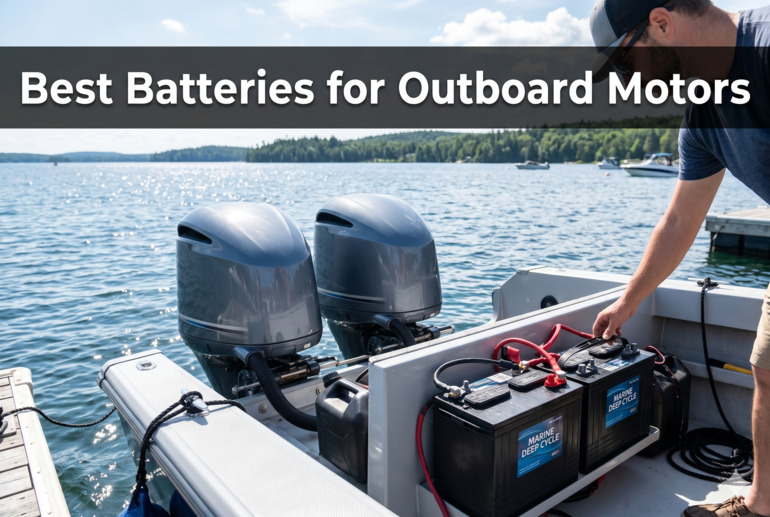
How We Selected the Best Batteries for Outboard Motors
We evaluated dozens of marine batteries based on real-world performance indicators and the specific demands that outboard motor use places on a battery. Our shortlist came down to products with proven track records, clear specs, and the kind of reliability that matters when you’re far from shore.
Here are the key factors that guided our selection:
- Cranking Power: We looked at cold cranking amps (CCA) and marine cranking amps (MCA) to ensure each battery can fire up an outboard motor reliably, even under load.
- Battery Type and Chemistry: AGM and lithium (LiFePO4) batteries handle marine environments far better than standard flooded lead-acid, and we prioritized both.
- Vibration Resistance: Boats generate constant vibration. We focused on batteries built to withstand that punishment without degrading quickly.
- Weight and Portability: Especially for smaller boats and kayaks, weight directly affects performance on the water.
- Reserve Capacity and Cycle Life: A battery that lasts for hours and survives hundreds of charge cycles is far more valuable than one that looks good on paper but fades fast.
- Maintenance Requirements: Sealed, maintenance-free designs made our list because they eliminate the hassle of checking electrolyte levels and reduce the risk of spills.
- Versatility of Use: We gave extra consideration to batteries that can handle both starting and deep cycle duties, since many boaters need one battery to do it all.
Every pick on this list held up to scrutiny across all of these factors. You can trust that each recommendation is backed by real specifications and performance data, not marketing copy.
Best Batteries for Outboard Motors (2026 Expert Review)
Five batteries made our final cut, ranging from premium AGM options to a genuinely impressive lithium entry that changes what you expect from a marine starting battery. Here is what each one brings to the table.
1. OPTIMA 34M BLUETOP: The Gold Standard for Marine Starting Power

When boaters argue about the best marine battery on the market, the OPTIMA 34M BLUETOP keeps coming up. It is a dedicated starting battery built specifically for boats and RVs, and it shows in every spec. The 800 CCA and 1000 MCA ratings mean it has serious grunt when you need to fire up an outboard motor, even in cold or damp conditions.
What separates this battery from the pack is OPTIMA’s proprietary SpiralCell Technology. Instead of flat plates, the internal design uses tightly wound 99.99% pure lead cells that increase surface area and deliver a more consistent power output. We found this design also contributes to significantly faster recharge times compared to conventional marine batteries.
The 34M is rated as 15 times more vibration-resistant than standard flooded batteries. On a boat, that is not just a spec on paper — it directly translates to longer life, because vibration is one of the biggest killers of marine batteries over time. The sealed, spill-proof construction means you can mount it in virtually any position without worry.
With a reserve capacity of 100 minutes and a 50 Ah C20 capacity, this battery offers real staying power. One of our reference units was still performing well after 10 years of boat use, which speaks to just how durable this construction truly is.
Key Specs:
- Voltage: 12V
- Cold Cranking Amps: 800 CCA / 1000 MCA
- Capacity: 50 Ah (C20)
- Reserve Capacity: 100 minutes
- Weight: 38.4 lbs
- Dimensions: 10.06″ L x 6.88″ W x 7.94″ H
- Exceptional vibration resistance for long-term durability
- SpiralCell Technology delivers fast recharge and consistent power
- Proven long service life, with documented 10-year use cases
- Starting-only design means it should not be used for deep cycle applications
- Premium price point
2. Newport 12V 50Ah Deep Cycle Marine Battery: Best Budget-Friendly Deep Cycle Pick

Not every boater needs to spend top dollar to get reliable performance. The Newport 12V 50Ah punches well above its price point for anyone running a trolling motor on a kayak, small aluminum boat, or compact fishing vessel. It is a sealed AGM lead-acid battery purpose-built for deep cycle marine use.
At just 32 pounds, this battery is noticeably lighter than many competing deep cycle options, which matters a lot when you’re loading and unloading gear from a vehicle. The built-in carry handle makes transport easy, and the sealed construction eliminates any risk of leaks or acid spills during handling.
Performance in the field is genuinely solid for the capacity. We saw reports of 4 or more hours of moderate runtime on a 55-pound thrust trolling motor, and one user ran a small outboard on an estuary for 6 hours with more than half the charge remaining. That kind of efficiency suggests the 50 Ah rating is honest.
The battery handles repeated deep discharge and recharge cycles without notable degradation over normal use periods. It also holds up to physical abuse better than you might expect — one documented case showed a unit surviving a tumble from a moving truck bed with no swelling, leaks, or output issues.
Key Specs:
- Voltage: 12V
- Capacity: 50 Ah
- Battery Type: Sealed AGM Lead-Acid
- Terminal: Marine Terminal
- Weight: 32 lbs
- Lightweight and easy to carry compared to similar capacity batteries
- Honest 50 Ah capacity with stable voltage under load
- Durable sealed construction handles rough treatment well
- Strong value for the price
- No built-in charge level indicator
3. VMAX MR127 12V 100Ah AGM Deep Cycle: Best for High-Demand Trolling Motor Use
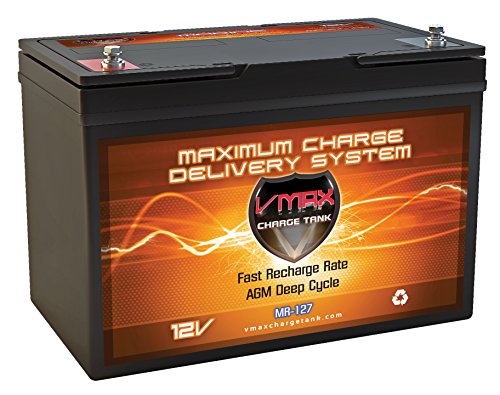
If you are running a 40 to 100-pound thrust trolling motor and need a battery that won’t quit on a long day on the water, the VMAX MR127 is built for exactly that. This Group 27 AGM battery delivers 100 Ah of capacity, which gives you serious runtime before you need to think about recharging.
The VMAX electrolyte suspension system uses high-porosity absorbed glass mat (AGM) technology that completely absorbs the electrolyte — no silica gels, no contaminants. The result is a battery classified as non-spillable and non-hazardous, which also means it can be used safely in enclosed spaces. The heavy-duty lead-tin alloy grids add extra performance margin in both float and cyclic applications.
We were particularly impressed by how this battery handles deep discharge situations. Even when drained more aggressively than recommended, it showed strong recovery during recharging. One user ran twin trolling motors (a 40-pound and a 55-pound thrust) simultaneously for over 5 hours, then put the battery on a charger only to find it still showing a 95% charge reading.
Two of these batteries can be wired in series to create a 24V system, which makes this an excellent building block for more advanced multi-motor setups. At 68 pounds, it is heavy, but that weight reflects the serious construction and capacity inside.
Key Specs:
- Voltage: 12V
- Capacity: 100 Ah
- Battery Type: AGM Lead-Acid
- Group Size: Group 27
- Number of Cells: 6
- Weight: 68 lbs
- 100 Ah capacity for extended trolling motor runtime
- Series-wirable for 24V, 36V, or 48V configurations
- Non-spillable and non-hazardous AGM construction
- Very heavy at 68 lbs, which makes repositioning difficult
- Avoid draining completely to prevent charger compatibility issues
4. OPTIMA D27M BLUETOP Dual Purpose: Best All-in-One Starting and Deep Cycle Battery

The OPTIMA D27M BLUETOP sits in a different category from the starting-only 34M reviewed above. This is the dual-purpose BLUETOP, meaning it is a true deep cycle battery that also delivers high cranking power. That combination makes it an excellent choice for boaters who want one battery handling both engine starting and accessory loads.
The 800 CCA and 1000 MCA ratings are identical to the 34M, so you are not giving up any starting grunt. But the D27M steps things up significantly in reserve capacity, offering 140 minutes versus 100 on the starting-only model. The 66 Ah C20 capacity also exceeds the 34M, giving you more energy available for running lights, electronics, and other onboard accessories between charges.
SpiralCell Technology returns here, delivering the same 99.99% pure lead construction and the same 15x vibration resistance advantage over flooded batteries. The dual SAE and 5/16-inch stainless steel stud posts give you more connection options, which is handy if you’re running multiple accessories. We found this battery holds charge impressively well during off-season storage, with documented cases of returning to full charge in under an hour after two months of sitting.
This battery makes the most sense for boaters who run substantial electrical accessories alongside their outboard, or who use their vessel in conditions where a dedicated starting battery and a separate deep cycle battery would be impractical.
Key Specs:
- Voltage: 12V
- Cold Cranking Amps: 800 CCA / 1000 MCA
- Capacity: 66 Ah (C20)
- Reserve Capacity: 140 minutes
- Dual SAE and 5/16″ Stainless Steel Posts
- Weight: 53.8 lbs
- True dual-purpose capability for starting and deep cycling
- 140-minute reserve capacity outperforms the starting-only 34M
- Dual terminal posts for flexible connection options
- Excellent charge retention during storage
- Higher price than single-purpose options
- Requires AGM-compatible charger for best results
5. Litime 12V 20Ah Marine Starting Lithium Battery: Best Lightweight Lithium Option

The Litime 12V 20Ah is the only lithium battery on this list, and it earns its place by doing something no AGM battery can match: delivering 650 to 800 CCA of cranking power in a package that weighs just 9.68 pounds. For small outboard motor applications, kayak fishing setups, and anyone obsessed with keeping weight off their boat, this changes the math entirely.
The LiFePO4 (lithium iron phosphate) chemistry gives this battery a cycle life rated at 5,000 or more charges, which is roughly 10 times what you can expect from a standard sealed lead-acid battery. That longevity argument becomes even more compelling when you factor in how much less often you’ll need to replace it. The upgraded BMS includes low-temperature cut-off protection, 30-second overload recovery, and resistance to moisture and salt spray.
One important compatibility note: this battery is not designed for Yamaha outboards due to voltage sensitivity in that brand’s charging systems. It is, however, well-suited to most other marine outboard engines and lawnmower starters. We confirmed solid cranking performance on a Yamaha 60 2-stroke in user testing, though Litime’s own documentation advises against Yamaha compatibility.
At BCI Group U1 size — measuring just 7.76 x 5.2 x 6.69 inches — this battery frees up meaningful storage space in tight engine compartments. For boaters who have been carrying heavy AGM batteries for years, the weight and size reduction alone can feel like a genuine upgrade.
Key Specs:
- Voltage: 12V
- Capacity: 20 Ah
- Cold Cranking Amps: 650 to 800 CCA
- Battery Type: LiFePO4 Lithium
- Cycle Life: 5,000+ cycles
- Weight: 9.68 lbs
- Dimensions: 7.76″ x 5.2″ x 6.69″
- Dramatically lighter than any AGM equivalent
- 5,000+ cycle lifespan reduces long-term replacement costs
- Compact Group U1 size fits tight spaces
- Advanced BMS with moisture and salt spray resistance
- Not compatible with Yamaha outboard motors
- Lower Ah capacity (20 Ah) limits use as a deep cycle or accessory battery
Best Batteries for Outboard Motors: A Quick Rundown
- OPTIMA 34M BLUETOP: Best dedicated starting battery for outboard motors with elite vibration resistance
- Newport 12V 50Ah: Best budget-friendly deep cycle option for small boats and kayak setups
- VMAX MR127 100Ah: Best for high-thrust trolling motor use with maximum runtime capacity
- OPTIMA D27M BLUETOP: Best dual-purpose battery for boaters who need starting power and deep cycle capability in one unit
- Litime 12V 20Ah Lithium: Best lightweight lithium starting battery for weight-conscious boaters
Final Thoughts
Choosing a battery for your outboard motor comes down to three things: what you’re powering, how long you need it to last on a single charge, and how much weight you can afford to carry. A dedicated starting battery suits those who just need reliable engine ignition. A dual-purpose option makes more sense if your boat runs heavy electronics alongside the motor. And if weight reduction is a priority, lithium technology has matured to the point where it’s a legitimate choice for starting applications.
Whatever direction you go, don’t cheap out on the chemistry. AGM and lithium batteries outperform flooded lead-acid options in marine conditions by a wide margin, and the longer service life typically justifies the higher upfront investment. Pick the battery that fits your actual use case, not just the one with the biggest number on the label.