VR racing has changed what it means to feel behind the wheel. With a headset strapped on, every corner, every chicane, every long straight feels like it’s happening around you in real space. But if you’re still using a gamepad to control that experience, you’re leaving a huge chunk of the immersion on the table.
The right steering wheel closes the gap completely. It puts your hands exactly where your eyes expect them to be, and suddenly that virtual cockpit stops feeling like a screen trick and starts feeling like a real car. We tested and researched the options across a range of platforms and budgets to put this list together.
What you’ll find below is a clear-eyed breakdown of five steering wheels that genuinely deliver in VR. Whether you’re just getting started or ready to invest in something serious, there’s a pick here that fits where you are.
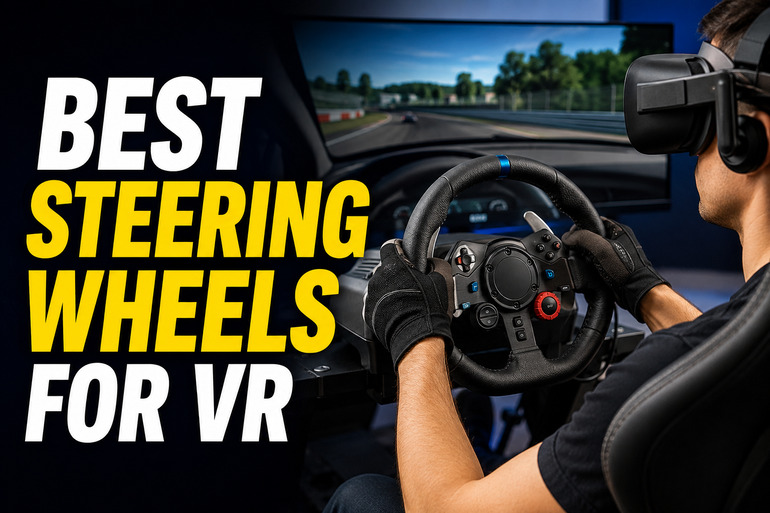
How We Selected the Best Steering Wheels for VR
Our team spent time evaluating steering wheels across different price tiers, platform setups, and sim racing use cases. We focused on how each wheel performs specifically in VR contexts, where physical feel and spatial accuracy matter more than they do on a flat screen. Beyond technical specs, we looked at real-world usability and long-term reliability.
Here are the key factors we used to evaluate each option:
- Force Feedback Quality: How accurately does the wheel simulate road texture, understeer, oversteer, and traction loss? This is the most important factor for VR immersion.
- Build Quality: Materials, pedal construction, and wheel durability all affect how long the setup holds up under daily or intensive use.
- Platform Compatibility: VR setups vary. We considered which consoles and PC configurations each wheel supports and how well integration works in practice.
- Rotation Range: The degree of lock-to-lock rotation directly shapes how natural the driving feel is. More rotation generally means more realistic control.
- Pedal Precision: Good pedals make braking and acceleration feel like driving. We looked at responsiveness, resistance, and adjustability.
- Mounting and Stability: A wheel that slides or flexes during hard cornering ruins immersion fast. We assessed how well each product stays secure during use.
- Setup and Customization: Software support, button mapping, and adjustable settings affect how quickly you can get racing and how fine-tuned the experience becomes.
Every pick on this list passed through these filters. You can trust that what made the cut genuinely earns its place.
Best Steering Wheels for VR (Expert Ranking & Review)
The five wheels below cover everything from budget-friendly entry points to serious direct drive technology. Each one offers something distinct, and knowing what sets them apart will help you pick the one that fits your setup.
1. Logitech G920 Driving Force: The Go-To Xbox and PC VR Wheel

The Logitech G920 Driving Force is one of the most trusted starting points in sim racing, and it earns that reputation by delivering where it counts most: force feedback and build quality. For Xbox and PC VR setups, this wheel gives you a genuinely physical driving experience at a price that doesn’t require a second mortgage.
The dual-motor force feedback system uses anti-backlash helical gears, which means the steering action is quiet, smooth, and tight. In VR, that matters a lot. The moment you clip a curb or push into understeer, the wheel responds with the kind of resistance and pull that makes your hands react instinctively, not just consciously.
Build quality is a real standout. The wheel is wrapped in hand-stitched leather, the paddle shifters are stainless steel, and the pedal unit is built with automotive-grade rolled steel. We found the overall feel far more premium than the price would suggest. It genuinely looks and handles like something from a higher tier.
The 900-degree lock-to-lock rotation covers more than two full turns, which replicates the steering range of an actual car. Pair that with the pressure-sensitive nonlinear brake pedal and adjustable pedal faces, and the physical feedback loop you get in VR becomes difficult to distinguish from the real thing. It also includes 16 buttons directly on the wheel, so you can manage in-game menus without ever removing the headset.
Key Specs:
- Rotation: 900 degrees (lock-to-lock)
- Feedback: Dual-motor force feedback with helical gearing
- Pedals: 3-pedal set (throttle, brake, clutch) with pressure-sensitive brake
- Compatible Platforms: Xbox Series X/S, Xbox One, PC, Mac
- Connectivity: USB (wired)
- Buttons: 16
- Smooth, quiet force feedback that holds up well over time
- Premium hand-stitched leather grip and stainless steel paddles
- Solid 900-degree rotation range for natural driving feel
- No PlayStation compatibility
- Brake pedal is notably stiff out of the box
2. Logitech G29 Driving Force: The PlayStation VR Sim Racing Standard
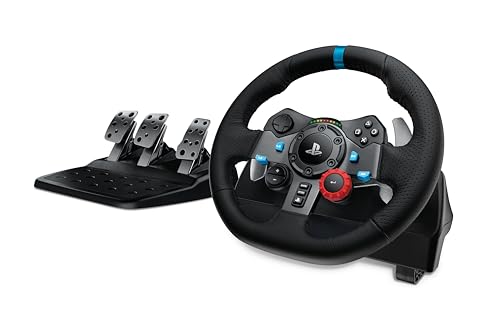
If your VR setup runs through a PlayStation console, the G29 Driving Force is the wheel we’d point you toward first. It is essentially the PlayStation counterpart to the G920, sharing the same core engineering, but tuned and officially supported for PS5, PS4, and PC. The two wheels are so closely matched in construction that choosing between them often comes down to which platform you’re on.
The G29 features the same dual-motor helical gear feedback system, the same hand-stitched leather wheel, and the same stainless steel paddle shifters and floor pedals. Where it differs is in its console-specific controls. The wheel includes a D-pad, PlayStation face buttons, a share button, and a 24-point selection dial, all of which let you navigate in-game menus without pulling the headset off. There are also RPM shift indicator LEDs built into the wheel face, which allow you to time gear changes by feel and light rather than audio cues.
In VR, the G29’s force feedback performs remarkably well for its price tier. We found the steering response in Gran Turismo 7 to be particularly satisfying, with the wheel communicating surface changes and cornering forces in a way that makes the VR visuals feel grounded and physical. The pedal unit is the same solid floor-mounted design with a pressure-sensitive brake and clutch, and like the G920, the brake resistance can feel heavy at first, but most drivers adapt quickly.
Key Specs:
- Rotation: 900 degrees (lock-to-lock)
- Feedback: Dual-motor force feedback with helical gearing
- Pedals: 3-pedal set (throttle, brake, clutch) with pressure-sensitive brake
- Compatible Platforms: PS5, PS4, PC, Mac
- Connectivity: USB (wired)
- Buttons: 16 plus 24-point dial and RPM LEDs
- Officially licensed for PS5 and PS4, with full native integration
- RPM shift indicator LEDs add a practical and immersive layer
- Strong build quality with leather grip and steel components
- No Xbox compatibility
- Clutch pedal feel is similar to the throttle, lacking distinct resistance
3. HORI Racing Wheel Apex: The Best Budget Option for PS5 and PC VR

Not every VR racing setup needs to cost $300 or more. The HORI Racing Wheel Apex is officially licensed by Sony, compatible with PS5, PS4, and PC, and comes in well under the price of the Logitech options. For anyone stepping into VR sim racing for the first time and wanting a wheel that works out of the box, this is a genuinely solid place to start.
The Apex does not have force feedback. That’s a fact worth knowing upfront. What it does have is a spring-loaded wheel mechanism that provides resistance and centers itself naturally. In practice, once you dial in the sensitivity settings through the HORI Device Manager app, the feel is more natural than you might expect. The app also lets you download firmware updates, adjust dead zones, switch pedal sensitivity, and save up to four custom profiles, which gives the wheel flexibility that its price doesn’t typically buy.
The wheel itself is full size and features 23 buttons, including a touchpad, making it one of the more button-rich options in its class. The turn radius is adjustable between 180 and 270 degrees, which lets you tune the response for different games or driving styles. We found the clamp system genuinely secure, and the full-size pedals feel substantial enough for the price tier.
Key Specs:
- Rotation: Adjustable 180 or 270 degrees
- Feedback: Spring-loaded (no force feedback)
- Pedals: 2-pedal set (throttle, brake)
- Compatible Platforms: PS5, PS4, PC
- Connectivity: USB (wired)
- Buttons: 23
- Officially licensed by Sony at a significantly lower price than competitors
- Adjustable turn radius and customizable settings via HORI Device Manager app
- 23 buttons including a touchpad for full in-game navigation
- No force feedback, which limits VR immersion compared to higher-tier options
4. Thrustmaster T248: A Step Up in Feedback for Xbox VR Setups
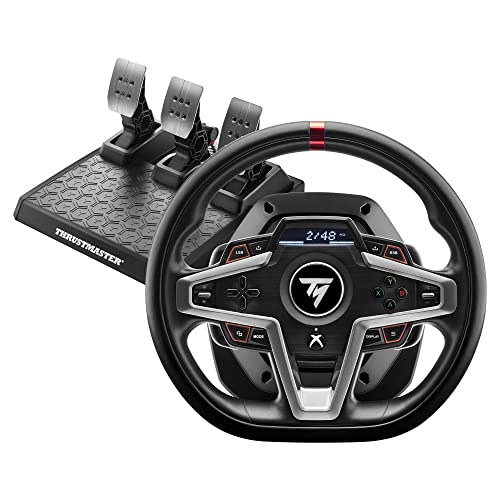
The Thrustmaster T248 sits at a higher price point than the Logitech G920, and it targets Xbox and PC players who want more feedback nuance than entry-level gear-based systems offer. With 24 programmable buttons and a hybrid force feedback system that combines magnetic and gear-based mechanisms, it brings noticeably more detail to the physical driving experience.
The T248 ships with an interactive display screen built into the wheel face, which shows game data in real time. In a VR context, you’re unlikely to look at it, but the underlying controls and feedback system it serves are what matter here. The magnetic paddle shifters are responsive and precise, and the wheel’s overall feedback quality gives you a more layered sense of what the car is doing beneath you. Cornering forces, surface feedback, and braking resistance all come through with more granularity than what a dual-motor gear system typically delivers.
We appreciated the pedal set, which includes a textured rubber brake pedal with a conical brake mod for adjustable resistance. The inclusion of T-LCM-style progressive feedback in the brake pedal is something you notice immediately when pushing hard into a braking zone in VR. The wheel base is solidly built with a mix of metal and composite materials, and the USB connectivity is plug-and-play across Xbox Series X/S, Xbox One, and PC.
Key Specs:
- Rotation: 900 degrees
- Feedback: Hybrid magnetic and gear-based force feedback
- Pedals: 2-pedal set (throttle, brake) with adjustable brake resistance
- Compatible Platforms: Xbox Series X/S, Xbox One, PC
- Connectivity: USB (wired)
- Buttons: 24
- Hybrid feedback system delivers more nuanced road feel than standard gear wheels
- Built-in interactive display provides live game data
- Progressive brake resistance adds realistic braking feel in VR
- Paddle shifters produce noticeable noise during use
- No PlayStation compatibility
5. Fanatec Gran Turismo DD Pro: The Premium Direct Drive VR Experience

The Fanatec Gran Turismo DD Pro is a different category of product from everything else on this list. It is a direct drive wheel, which means the motor connects to the steering shaft without any gears or belts in between. The result is a level of force feedback clarity, speed, and linearity that gear-based systems simply cannot match. For serious VR sim racing on PlayStation or PC, this is the wheel that closes the gap between simulation and reality.
The base motor delivers 5 Nm of torque out of the box, engineered by Fanatec in Germany using patented FluxBarrier technology. That technology improves motor efficiency and smoothness by reducing magnetic flux losses, meaning the feedback you feel is not just strong, it’s precise. Every detail of what the car is doing, the moment a tire starts to lose grip, the exact point where understeer sets in, comes through the wheel with a directness that makes VR feel viscerally real. An optional Boost Kit (sold separately) unlocks up to 8 Nm for even greater force.
The steering wheel itself was designed by Polyphony Digital specifically for Gran Turismo. It features an OLED display, a diffused RevLED strip, and four five-way directional sticks mapped to GT7’s rapid-access adjustments for traction control, brake balance, torque split, and fuel mapping. All of that gives you real-time race data and in-game adjustments without breaking immersion in VR. The base is housed in aluminum with composite end caps, which acts as a passive heat sink and keeps temperatures managed during long sessions.
The included pedal set uses hall sensors for precise throttle tracking and is built from heavy steel construction. Firmware setup on PC is required before first use on PS5, but once calibrated correctly, the integration is seamless.
Key Specs:
- Rotation: Unlimited (direct drive)
- Feedback: 5 Nm direct drive (FluxBarrier motor, upgradeable to 8 Nm)
- Pedals: 2-pedal set with hall sensors (throttle, brake)
- Compatible Platforms: PS5, PS4, PC (Xbox compatible with licensed wheel attachment)
- Connectivity: USB
- Wheel Diameter: 280 mm
- Direct drive technology delivers unmatched feedback clarity and precision
- Polyphony Digital-designed wheel with OLED display and RevLED strip
- Aluminum base acts as passive heat sink for extended sessions
- Officially licensed for PlayStation with full GT7 integration
- Requires PC firmware update before first PS5 use
- Mounting hardware not included in the box
Best Steering Wheels for VR: A Quick Rundown
- Logitech G920 Driving Force: Best for Xbox and PC VR players who want proven force feedback and premium build quality at a mid-range price
- Logitech G29 Driving Force: Best for PlayStation VR setups, with full PS5 and PS4 support, RPM indicator LEDs, and rock-solid construction
- HORI Racing Wheel Apex: Best budget option for PS5, PS4, and PC, with Sony licensing, app-based customization, and easy entry-level setup
- Thrustmaster T248: Best step-up pick for Xbox VR players seeking more feedback detail and a hybrid magnetic force feedback system
- Fanatec Gran Turismo DD Pro: Best premium direct drive wheel for PlayStation and PC VR, with professional-grade precision and GT7 optimization
Final Thoughts
Choosing a VR steering wheel comes down to three things: the platform you’re on, the level of realism you’re after, and how much you’re willing to invest. Force feedback quality has the single biggest impact on VR immersion, so prioritize that above everything else when your budget allows. Build quality and pedal feel come next, because those are the things you interact with every session and the things that degrade first if they’re not up to the task.
Pick the wheel that fits where you are right now, not the one you think you might want someday. A well-matched setup at any price level will give you more driving enjoyment than an overpowered one you’re not ready to use. The right wheel won’t just make your laps faster. It’ll make every session feel worth strapping in for.