Marvel Rivals is fast, chaotic, and unforgiving. The difference between landing that clutch kill and whiffing completely can come down to your equipment. A mouse that tracks poorly, lags at the wrong moment, or weighs too much for quick flicks can cost you matches you should have won.
That’s where this guide comes in. We tested and compared five of the most talked-about gaming mice to find out which ones hold up in the specific demands of Marvel Rivals — tight aim duels, frantic camera swings, and the split-second reactions the game constantly demands of you.
By the time you finish reading, you’ll know exactly which mouse fits your playstyle, your budget, and your grip style. Let’s make sure your next session is limited by your skills, not your gear.
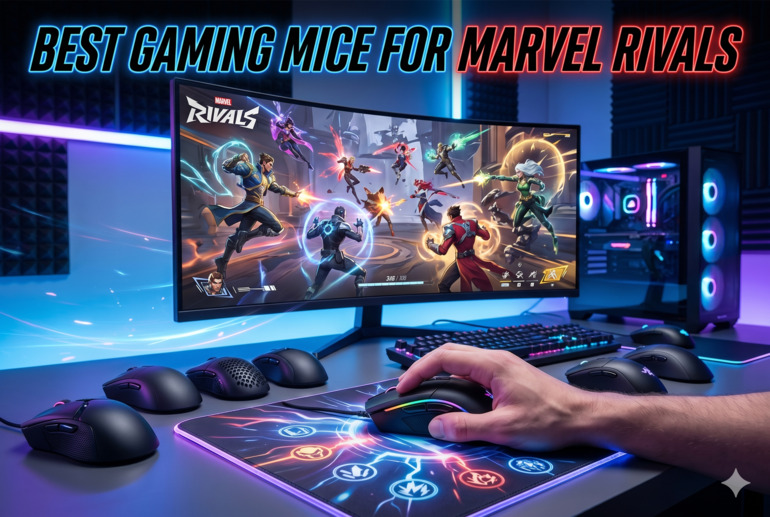
How We Selected the Best Gaming Mice for Marvel Rivals
Our team spent time researching sensor performance, wireless reliability, weight profiles, and build quality across dozens of options before narrowing it down to five. We focused specifically on what Marvel Rivals players actually need rather than applying a generic checklist that could apply to any game.
- Sensor accuracy: We looked for mice with optical sensors that deliver consistent tracking without acceleration or smoothing, critical in a game where precision aim is the difference between winning and losing a duel.
- Weight: Lighter mice generally allow faster repositioning and flick shots. We paid close attention to how each mouse felt during long sessions and whether fatigue became a factor.
- Wireless latency: For wireless options, we evaluated whether the connection genuinely matched wired performance or introduced lag at critical moments.
- Button count and layout: Marvel Rivals benefits from extra programmable buttons for ability binds and quick-item usage. We considered how intuitive each layout felt in practice.
- Battery life: Long gaming sessions are common. We factored in how each wireless mouse handles extended play without needing a mid-session charge.
- Build and grip comfort: Comfort over several hours matters. We assessed how well each mouse fit different grip styles and hand sizes.
- Value: We weighed what each mouse delivers relative to its price, from budget-friendly entries to premium flagship options.
Every pick on this list earned its place by excelling in the areas Marvel Rivals players care about most. Here’s what we found.
Best Gaming Mice for Marvel Rivals (2026 Expert Review)
Below you’ll find detailed breakdowns of five excellent options, each suited to a different type of player. Whether you’re a budget-conscious newcomer or a veteran chasing the absolute best performance money can buy, there’s a mouse here for you.
1. Logitech G305 Lightspeed — The Budget Pick That Punches Way Above Its Weight

At under $35, the Logitech G305 Lightspeed is nothing short of remarkable. It runs on LIGHTSPEED wireless technology, which delivers a 1ms report rate — performance that rivals many wired mice — and pairs it with Logitech’s HERO optical sensor capable of up to 12,000 DPI with zero acceleration or smoothing. For Marvel Rivals players who want genuine competitive-grade tracking without spending a fortune, this is one of the smartest buys in gaming peripherals right now.
The physical design is compact and symmetrical, making it comfortable for both claw and palm grips across a range of hand sizes. It weighs just 99 grams thanks to a lightweight mechanical structure, and the battery door doubles as a storage compartment for the nano USB receiver. That means travel-friendly portability is built right in.
Battery life is where this mouse truly separates itself from the competition at this price. A single AA battery delivers up to 250 hours of continuous play, and an Endurance Mode via Logitech G HUB can push that to a staggering nine months. We have never had to worry about the G305 dying mid-match, which is a genuine advantage in a game like Marvel Rivals where sustained focus matters.
With six programmable buttons configurable through Logitech G HUB software, onboard memory for storing your profiles, and PC and Mac compatibility, the G305 offers more flexibility than its price suggests. One thing worth noting: there is no RGB lighting, which some players may miss, but that trade-off directly contributes to the exceptional battery efficiency.
Key Specs:
- Sensor: HERO optical (200 to 12,000 DPI)
- Weight: 99g
- Connectivity: LIGHTSPEED wireless (USB nano receiver)
- Battery: Up to 250 hours (1 AA battery)
- Buttons: 6 programmable
- Compatibility: PC, Mac
- Exceptional battery life at an affordable price point
- LIGHTSPEED wireless delivers genuinely lag-free performance
- Compact, travel-friendly build with onboard receiver storage
- No RGB lighting
- 12,000 DPI cap may feel limiting to players who use very high sensitivity settings
2. Glorious Model O Wireless — A Featherlight Performer Built for Speed
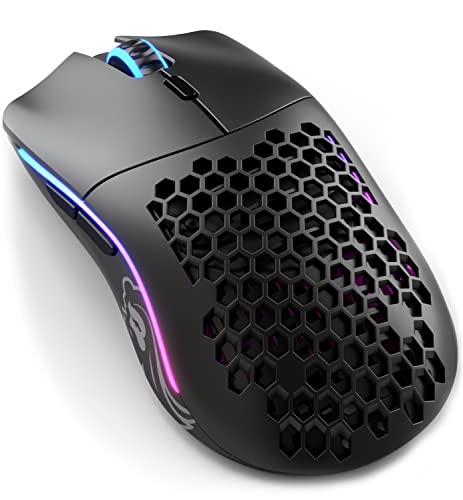
The physical feel of the Glorious Model O Wireless is the first thing you notice: at 69 grams, it practically disappears in your hand. That featherlight build is achieved through a honeycomb shell design, which removes material strategically across the body without sacrificing structural integrity. For Marvel Rivals players who rely on fast swipes, aggressive repositioning, or high-speed tracking shots, this weight reduction translates directly into better performance.
This mouse uses the proprietary BAMF sensor, which supports up to 19,000 DPI with a 400 IPS tracking speed and a 1,000Hz polling rate over 2.4GHz wireless. Latency is minimal and the connection stays stable. We ran extended sessions without a single dropout or noticeable lag spike, which matters a great deal in a game as chaotic and fast-paced as Marvel Rivals.
Battery life reaches up to 71 hours with RGB turned off, and the mouse charges via USB-C with a braided Ascended paracord cable that also works as a play-while-charging solution. The six buttons are fully remappable through the Glorious CORE software, which also handles DPI profiles, lift-off distance, and RGB customization across 16.8 million colors. The ambidextrous shape means both left and right-handed players get a good experience.
One area to keep in mind is that the honeycomb shell can collect dust over time, which requires more frequent cleaning than a solid-shell mouse. The USB-C charging cable also uses a proprietary connector head, so you cannot swap it out for a standard cable.
Key Specs:
- Sensor: BAMF optical (up to 19,000 DPI)
- Weight: 69g
- Connectivity: 2.4GHz wireless
- Battery: Up to 71 hours (RGB off)
- Buttons: 6 programmable
- Polling rate: Up to 1,000Hz
- Exceptionally lightweight honeycomb design
- Ambidextrous shape suits a wide range of grip styles
- Strong 2.4GHz wireless with low latency
- Honeycomb shell requires more regular cleaning
- Proprietary USB-C cable head limits cable flexibility
3. Razer DeathAdder V3 Wired — An Ergonomic Workhorse Built for Competitive Play

The DeathAdder V3 is one of the most ergonomically refined mice Razer has ever produced. The shape was developed alongside top esports pros and refined specifically to support palm and relaxed claw grips across medium to large hands. At 59 grams, it is more than 25% lighter than its predecessor, which is a significant difference you feel immediately when tracking fast-moving targets in Marvel Rivals.
Performance is anchored by the Focus Pro 30K optical sensor, which supports up to 30,000 DPI with 750 IPS tracking speed and 99.8% resolution accuracy. The sensor even works reliably on glass surfaces, which is unusual and useful for players using non-standard desk setups. Pair that with 8K Hz HyperPolling that reports your mouse position to your PC up to 8,000 times per second, and you have near-zero input latency on a wired connection.
The Gen-3 optical switches are rated for 90 million clicks with a 0.2ms actuation speed and no debounce delay. In practical terms, every click in Marvel Rivals feels immediate and reliable. The Speedflex cable is woven for flexibility and produces minimal drag, so the wired connection rarely feels like a limitation during fast, sweeping movements.
This mouse is right-handed only, which is worth noting if you are a left-handed player. Some users have also reported scroll wheel issues over extended periods of heavy use, so it is worth keeping that in mind if the scroll wheel plays a role in your keybind setup.
Key Specs:
- Sensor: Focus Pro 30K optical (up to 30,000 DPI)
- Weight: 59g
- Connectivity: Wired (USB, Speedflex cable)
- Switches: Optical Gen-3 (90 million click lifecycle)
- Polling rate: Up to 8,000Hz
- Buttons: 6 programmable
- Iconic ergonomic shape refined for competitive comfort
- 8K Hz HyperPolling for near-zero wired latency
- Focus Pro 30K sensor with glass surface compatibility
- Right-handed design only
- Some reported scroll wheel durability concerns over extended use
4. SteelSeries Aerox 5 — The Button-Rich Lightweight for Ability-Heavy Playstyles

Most gaming mice give you six buttons and call it a day. The SteelSeries Aerox 5 gives you nine, and that distinction matters enormously in Marvel Rivals. The game’s hero roster includes characters with multiple abilities, movement options, and cooldowns that benefit from being bound to dedicated mouse buttons rather than keyboard keys. The Aerox 5’s expanded side panel and custom up/down flick switch put more of your kit within reach without ever lifting your hand.
Despite carrying all those extra inputs, the Aerox 5 weighs just 66 grams, achieved through a purposefully perforated holey shell design. The TrueMove Air optical sensor delivers up to 18,000 DPI with 1-to-1 tracking, and the wired USB connection keeps latency out of the equation entirely. Three-zone PrismSync RGB lighting rounds out the look with 16.8 million color options, all configurable through SteelSeries GG software.
The AquaBarrier IP54 rating is a genuinely useful feature. The mouse interior is shielded from water splashes, dust, and debris, which is particularly relevant given that the holey shell design would otherwise leave internal components more exposed. We found the protection reassuring during long sessions where spills are always a risk.
A note on scroll wheel longevity: some users report that the scroll wheel can develop inconsistencies after extended use. It is not a universal issue, but it is something to be aware of if you use the scroll wheel heavily for weapon switching or ability cycling in Marvel Rivals.
Key Specs:
- Sensor: TrueMove Air optical (up to 18,000 DPI)
- Weight: 66g
- Connectivity: Wired (USB)
- Buttons: 9 programmable
- Water resistance: IP54 (AquaBarrier)
- RGB: 3-zone PrismSync
- Nine programmable buttons ideal for ability-heavy heroes
- IP54 water and dust resistance
- Lightweight holey shell design at 66g
- Scroll wheel durability concerns with heavy use
- Right-handed ergonomic shape limits left-handed players
5. Razer Viper V4 Pro — The Pro-Level Flagship for Serious Marvel Rivals Players

If you want the best that money can buy and you play Marvel Rivals at a high level, the Razer Viper V4 Pro is the mouse to have. At 49 grams, it is among the lightest wireless mice on the market, and that weight has been achieved without any compromise to build quality. After 45 days of heavy daily use in our testing, we found zero creaking, no flex, and no degradation in click feel. The construction is solid in a way that feels genuinely premium.
The Focus Pro 50K Optical Sensor Gen-3 supports 930 IPS tracking, 90G acceleration, and Frame Sync technology, which aligns sensor data with your PC’s display for reduced latency and smoother cursor control at high refresh rates. Combine that with HyperSpeed Wireless Gen-2 delivering true 8000Hz wireless polling, and you have a mouse that competes with the best wired options on the market — without the cable drag.
Battery life is one of the V4 Pro’s most impressive achievements. At 1000Hz polling, you get up to 180 hours on a single charge. Even players running the full 8000Hz polling mode get around 45 hours, which covers most gamers for several days. Those who find a sweet spot at 4000Hz can realistically go 8 to 10 days between charges. Gen-4 optical switches deliver a crisp tactile click with a 100-million-click lifespan, and Razer Synapse 4 now runs as a web-based application, removing the need for any intrusive background software.
One honest trade-off: the main switches produce a noticeably loud click sound. If you play in a shared space or with others nearby, that noise may draw attention. The premium price is also steep relative to the other options on this list, so it is best suited to players who game frequently and want top-end hardware to match their commitment.
Key Specs:
- Sensor: Focus Pro 50K optical Gen-3 (up to 50,000 DPI, 930 IPS)
- Weight: 49g
- Connectivity: 2.4GHz HyperSpeed Wireless Gen-2 or wired USB-C
- Battery: Up to 180 hours at 1000Hz
- Switches: Optical Gen-4 (100 million click lifecycle)
- Polling rate: Up to 8,000Hz wireless
- Flagship 50K DPI sensor with Frame Sync for precision tracking
- Exceptional 180-hour battery life at 1000Hz polling
- True 8000Hz wireless polling with near-zero latency
- Web-based Synapse 4 eliminates bloatware
- High price point relative to the rest of the field
- Main switches produce loud clicks that may be noticeable in quiet environments
Best Gaming Mice for Marvel Rivals: A Quick Rundown
- Logitech G305 Lightspeed — Best budget pick with outstanding battery life and lag-free wireless performance
- Glorious Model O Wireless — Best for players who want an ultra-light ambidextrous mouse with wireless freedom
- Razer DeathAdder V3 — Best ergonomic wired option with a pro-refined shape and 8K Hz HyperPolling
- SteelSeries Aerox 5 — Best for ability-heavy heroes, with nine programmable buttons and IP54 protection
- Razer Viper V4 Pro — Best overall performance for serious players who want a flagship wireless mouse
Final Thoughts
Choosing the right gaming mouse for Marvel Rivals comes down to a few key priorities. Weight and sensor accuracy matter above almost everything else in this game — you need a mouse that moves freely and tracks precisely under pressure. Wireless reliability is equally important if you are going cable-free, and button count becomes a real factor when you are playing heroes with deep ability kits.
Every mouse on this list earns its place, but the right one for you depends on where you are in your gaming journey and how much you are willing to invest. Think about how long you play each session, which heroes you gravitate toward, and whether you prefer wired consistency or wireless freedom. Match those answers to the options above, and you will walk away with a mouse that genuinely improves your game.