Seeing the F9E1 error code on your KitchenAid dishwasher can be frustrating, especially when the wash cycle stops unexpectedly or dirty water remains at the bottom. Sometimes, the dishwasher may also make unusual draining noises or refuse to complete its cycle.
Fortunately, several common drainage problems can be resolved without expensive repairs. However, the correct solution depends on your dishwasher model and what’s preventing it from operating normally.
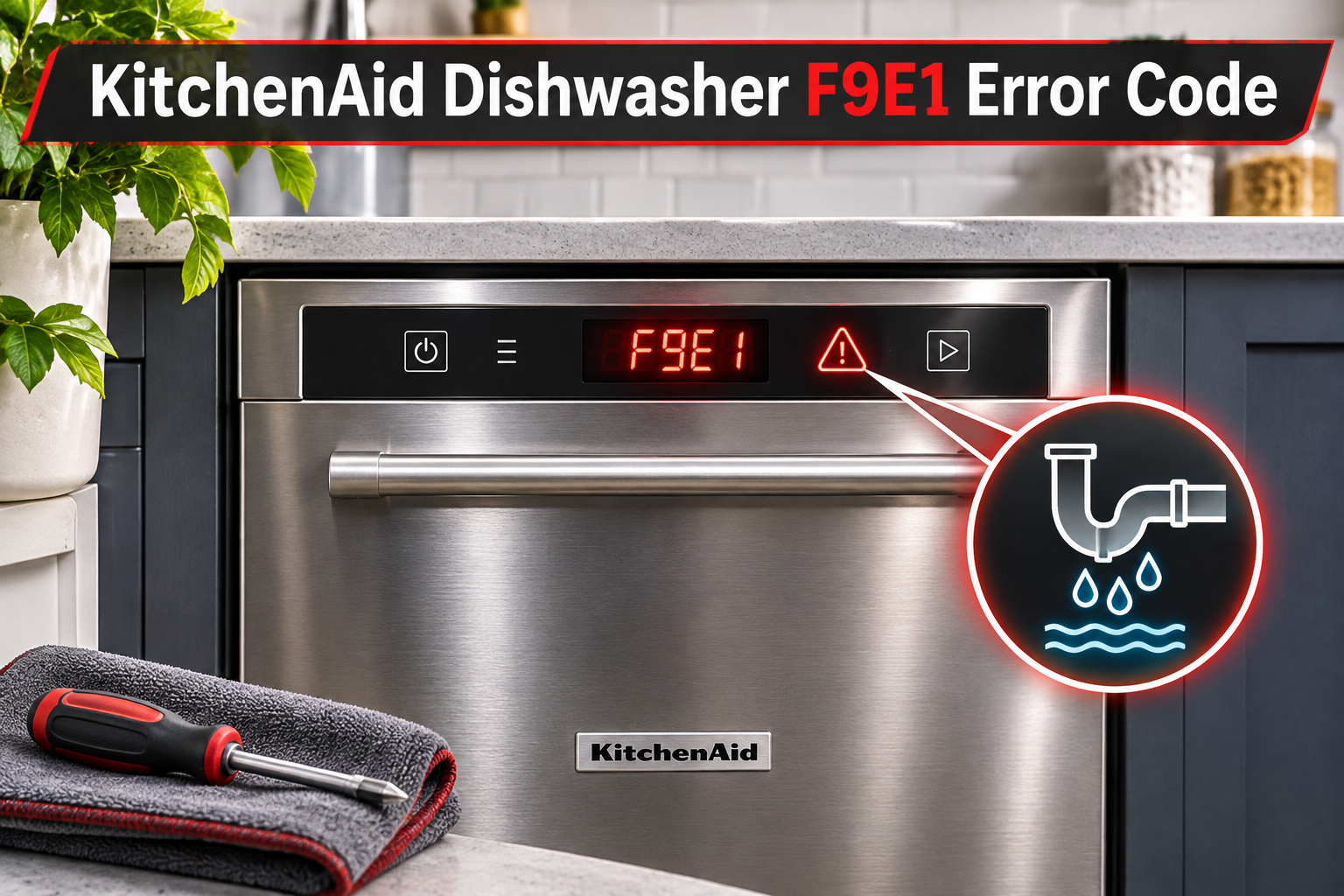
What Does the F9E1 Error Code Mean on a KitchenAid Dishwasher?
On many newer KitchenAid dishwashers, the F9E1 error code indicates a long drain condition. This means the dishwasher cannot drain water properly within the time expected by its control system. Consequently, the appliance may stop its wash cycle and display the error.
During normal operation, the dishwasher uses a drain pump to push wastewater through a hose connected to your kitchen plumbing. Food particles are collected by the filtration system, while the remaining water flows into the sink drain or garbage disposal. When something interrupts this process, water may remain inside the dishwasher.
You might notice standing water covering the bottom of the tub, an interrupted wash cycle, or repeated attempts to drain. Some models display F9E1 directly, while others communicate the fault through nine flashes, a pause, and one additional flash. However, a small amount of water remaining inside the recessed filter area can be normal and doesn’t necessarily indicate a drainage problem.
There’s also an important difference between KitchenAid dishwasher generations. Some older KitchenAid service manuals identify F9E1 as a diverter position fault. The diverter controls which spray arms receive water, so this fault requires different troubleshooting. Check your model’s documentation before assuming the code always means a blocked drain.
KitchenAid Dishwasher F9E1 Error Code [FIXED]: Common Causes
Several problems can interfere with your dishwasher’s drainage system and trigger the F9E1 error. Understanding the likely causes helps you identify the fault without replacing parts unnecessarily.
1. Clogged Dishwasher Filter
Food residue, grease, and other debris can accumulate inside your dishwasher’s filtration system. Over time, this buildup may restrict water movement or allow debris to collect around the drain inlet.
The filter normally traps food particles to p