In many cases, the issue involves communication between the oven’s electronic controls and the relay control board. Understanding what triggers the error can help you identify safe troubleshooting steps before arranging a repair.
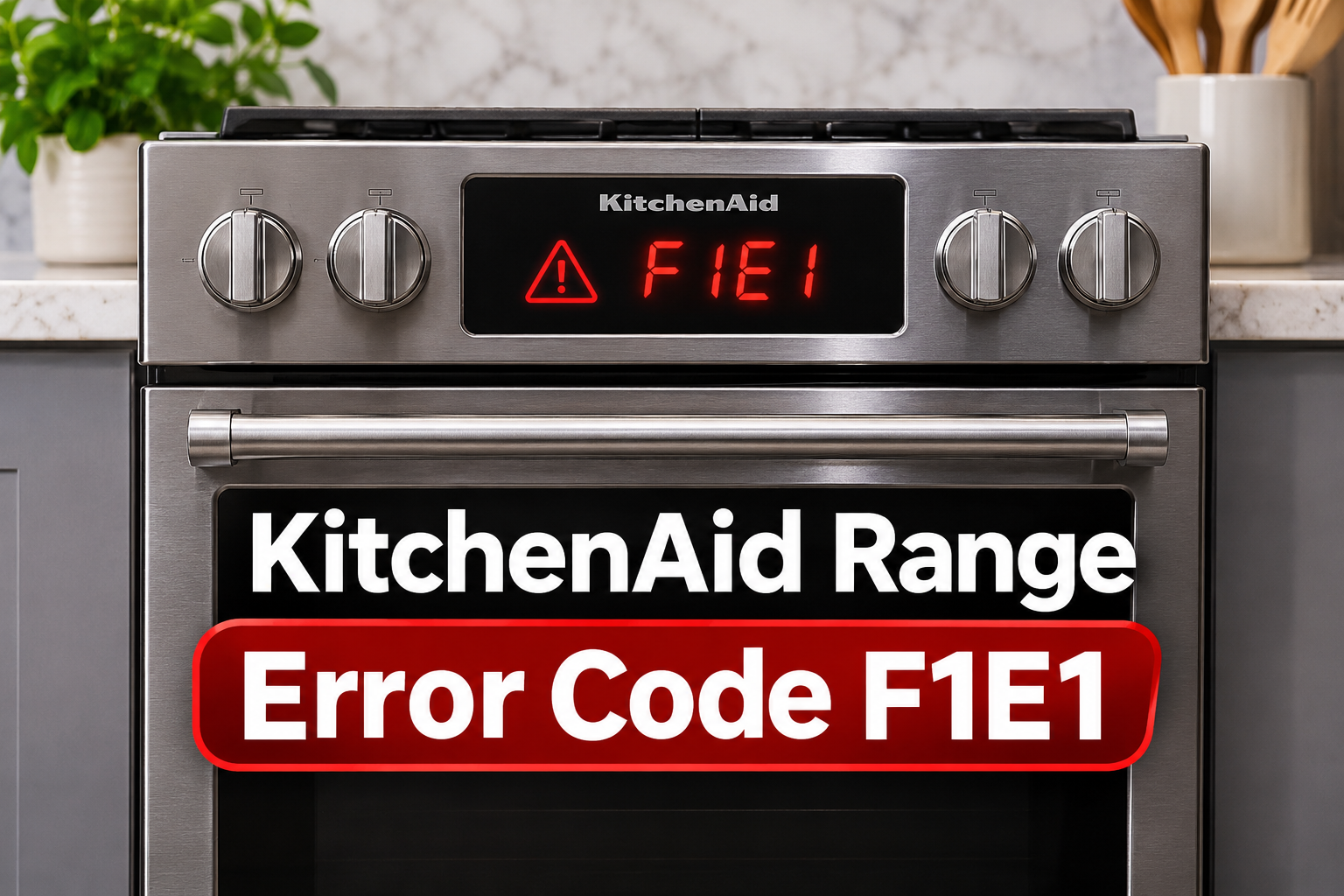
What Does the KitchenAid Range F1E1 Error Code Mean?
The F1E1 error code generally indicates an electronic control or communication problem within the range. On certain KitchenAid models, it specifically identifies an EEPROM communication error involving the control relay board.
EEPROM stands for Electrically Erasable Programmable Read-Only Memory. It’s a type of memory chip that stores information needed by electronic controls. The range relies on this stored information to manage its operating functions.
When the control system encounters an unexpected event or cannot communicate correctly with the relevant electronic component, it may display F1E1.
The control relay board plays an important role in operating the oven. It receives instructions from the electronic control system and manages electrical power to components such as the heating elements. If the board cannot process or communicate the required information, normal oven operation may be interrupted.
Depending on your KitchenAid range model, you may notice several symptoms:
-
The F1E1 code appears on the control panel.
-
The oven stops responding to certain commands.
-
The display becomes unresponsive or behaves unexpectedly.
-
The oven fails to start a cooking cycle.
-
The error returns after resetting the appliance.
-
Some cooking functions become unavailable.
The symptoms can vary because KitchenAid uses different electronic control systems across its range models. Certain double oven models specifically associate F1E1 with a control relay board EEPROM communication error.
Important: F1E1 should not automatically be treated as proof that the entire control board has failed. A wiring problem or another fault within the control system may produce a similar result.
KitchenAid Range Error Code F1E1: Common Causes
Several electrical and electronic problems can trigger the F1E1 error on a KitchenAid range. The following are the main areas that may require attention during diagnosis.
1. Faulty Electronic Control Board
A faulty electronic control board is one of the main possibilities when your KitchenAid range displays F1E1.
The control board manages important appliance functions, processes commands, and coordinates communication between electronic components. It also relies on stored information to carry out its operations correctly.
Over time, an internal electronic fault can affect the board’s ability to process or exchange information. A damaged memory chip or an internal communication failure may prevent the control system from operating as expected.
You may notice that the display becomes unresponsive, cooking functions stop working, or the F1E1 code returns shortly after a reset. These symptoms can point to a control board problem, although further testing is necessary to confirm it.
2. Damaged or Loose Wiring Connections
The electronic control system depends on wiring harnesses and electrical connectors to exchange signals between components.
If a connector becomes loose, a wire becomes damaged, or a connection develops an electrical fault, communication between the control board and other components may become unreliable.
Heat exposure, vibration, previous repair work, and deterioration of electrical connections can contribute to wiring problems.
A damaged connection may cause intermittent symptoms. For instance, your range might operate normally for some time before displaying F1E1 again.
A qualified technician can inspect the relevant connectors and wiring harnesses to identify loose connections, damaged insulation, or other electrical problems.
3. Control Relay Board Failure
The control relay board is responsible for switching electrical power to various operating components in the range.
It works with the main electronic control system to manage functions such as oven heating. Relays are electrically operated switches that allow the control system to regulate power to different components.
If the relay board develops an internal fault, it may fail to respond correctly to control instructions. Depending on the appliance design, this can interfere with normal communication and trigger an error.
Some relay-related failures may also affect heating performance. The oven might fail to heat, stop during operation, or behave unpredictably.
However, a heating problem alone does not confirm that the relay board is defective. Proper diagnosis is necessary before replacing the component.
4. Electrical Supply or Power Interruption
KitchenAid ranges rely on a suitable electrical supply to operate their electronic control systems.
An interruption in power, an electrical fault, or an unstable supply can interfere with the normal operation of electronic components.
For example, a sudden power interruption may cause a control system to restart unexpectedly. In some circumstances, the appliance may display an error after power is restored.
However, this does not mean every F1E1 error results from a power interruption. The precise cause depends on the control system fitted to your appliance.
If the error appeared immediately after a power outage, this information is useful when diagnosing the problem.
5. Internal Communication or Memory Failure
Some KitchenAid range control systems depend on electronic memory and communication circuits to coordinate appliance functions.
An internal memory error can prevent the control system from accessing or exchanging information correctly.
On certain KitchenAid models, F1E1 specifically identifies an EEPROM communication error involving the control relay board. The oven control system and associated wiring may also require investigation.
This type of fault may persist even when the external wiring appears normal.
A technician may need to perform diagnostic tests on the control board to determine whether the problem involves its internal circuitry, memory functions, or communication connections.
KitchenAid Range Error Code F1E1: How to Fix
The right solution depends on what triggered the error in your appliance. Fortunately, there are a few safe checks you can perform before arranging professional repairs.
Start with the basic troubleshooting methods below. Avoid opening the control panel or handling internal electrical components unless you’re qualified to do so.
1. Reset the KitchenAid Range
A power reset is a sensible first step when your range displays F1E1.
Electronic controls can sometimes become temporarily unresponsive following an unexpected operating event. Disconnecting power allows the control system to restart.
Follow these steps:
-
Turn off the oven and make sure all cooking functions are inactive.
-
Locate the circuit breaker that supplies power to your KitchenAid range.
-
Switch the breaker to the OFF position.
-
Leave the appliance disconnected from power for approximately one minute.
-
Switch the breaker back ON.
-
Allow the control panel to restart.
-
Observe the display to see whether F1E1 returns.
KitchenAid recommends a one-minute power reset for its commercial-style range F1E1 troubleshooting procedure.
If the error disappears, check whether the controls respond normally. You can also verify that the oven operates correctly using an appropriate cooking function.
If F1E1 returns, avoid repeatedly resetting the appliance. A persistent error may indicate an underlying electronic or wiring fault that requires further diagnosis.
2. Check the Circuit Breaker and Electrical Supply
An interrupted electrical supply can affect the operation of your range’s electronic controls.
Start by checking the circuit breaker. Make sure it hasn’t tripped and that the appliance has a stable power supply.
If the breaker has tripped, you can reset it once if there are no signs of electrical damage, burning, or other hazards. However, if it trips again, stop using the appliance and contact a qualified electrician.
You should also consider whether the error appeared after a power outage or other electrical interruption.
Do not remove the range’s electrical connection cover or attempt to measure voltage at its terminals. These procedures require appropriate electrical safety precautions and qualified assistance.
3. Turn the Temperature Control Knob to OFF
This method applies specifically to KitchenAid commercial-style ranges with the relevant temperature knob controls.
According to KitchenAid’s troubleshooting instructions, turning the temperature knob to the OFF position can cancel the displayed error and allow appliance use to resume.
Here’s what to do:
-
Locate the oven temperature control knob.
-
Turn it completely to OFF.
-
Allow the control system to respond.
-
Check whether the error disappears.
-
Observe the display for any signs that the error has returned.
If the code remains, proceed with the recommended power reset.
This procedure is model-specific. Ranges with different control arrangements may not have the same reset option.
4. Check for Visible Signs of Electrical or Control Damage
If the error continues after resetting the range, look for external signs that may help identify the problem.
You don’t need to remove any panels or expose electrical components to perform this check.
Pay attention to:
-
A display that repeatedly goes blank or restarts.
-
Unusual burning smells around the control panel.
-
Visible signs of scorching near accessible external surfaces.
-
A circuit breaker that repeatedly trips.
-
Controls that stop responding during operation.
These observations can help a technician understand what happened before the error appeared.
If you notice a burning smell, smoke, sparks, or signs of overheating, disconnect power at the breaker if it is safe to do so. Stop using the range and arrange professional assistance.
Do not attempt to repair damaged electrical wiring or electronic boards yourself.
5. Confirm Your KitchenAid Range Model Number
KitchenAid uses different control boards and electronic systems across its range products. This means the troubleshooting procedure for one model may not apply to another.
Before purchasing replacement parts or arranging repairs, identify your range’s complete model number.
You can usually find the model and serial number label around the oven door frame, behind the storage drawer, or in another location specified in your appliance documentation. The exact position varies by model.
Once you have the model number, use it to locate the correct KitchenAid owner’s manual or technical documentation.
This helps establish:
-
Which electronic control system your range uses.
-
What F1E1 means for that particular model.
-
Which control board or wiring components are involved.
-
Which diagnostic procedures apply.
-
Which replacement parts are compatible.
Avoid purchasing a replacement control board based solely on the F1E1 code. The same error code can have different meanings across KitchenAid appliance generations and control designs.
6. Contact a Qualified Appliance Repair Technician
If the error remains after the recommended reset and basic checks, professional diagnosis is the appropriate next step.
A qualified appliance technician can inspect the control system, test relevant wiring connections, and determine whether the main control board or relay board has failed.
For certain KitchenAid range models, diagnosing the fault involves accessing internal components, checking electrical connections, and performing resistance or voltage measurements.
Such work requires appropriate tools and electrical safety precautions.
When arranging a repair, provide the technician with your full model number, the F1E1 error code, and any symptoms you observed before the fault appeared.
This information can help narrow down the problem and reduce unnecessary component replacements.
Wrap-Up
The KitchenAid range F1E1 error code generally points to a problem within the appliance’s electronic control system. Depending on your model, the fault may involve the control relay board, main control board, associated wiring, or internal communication circuits.
Start with the recommended power reset and other safe checks. If the code returns, arrange a proper diagnosis rather than replacing electronic components without confirmation.
Identifying the actual source of the fault is the most reliable way to restore normal operation and avoid unnecessary repair expenses.