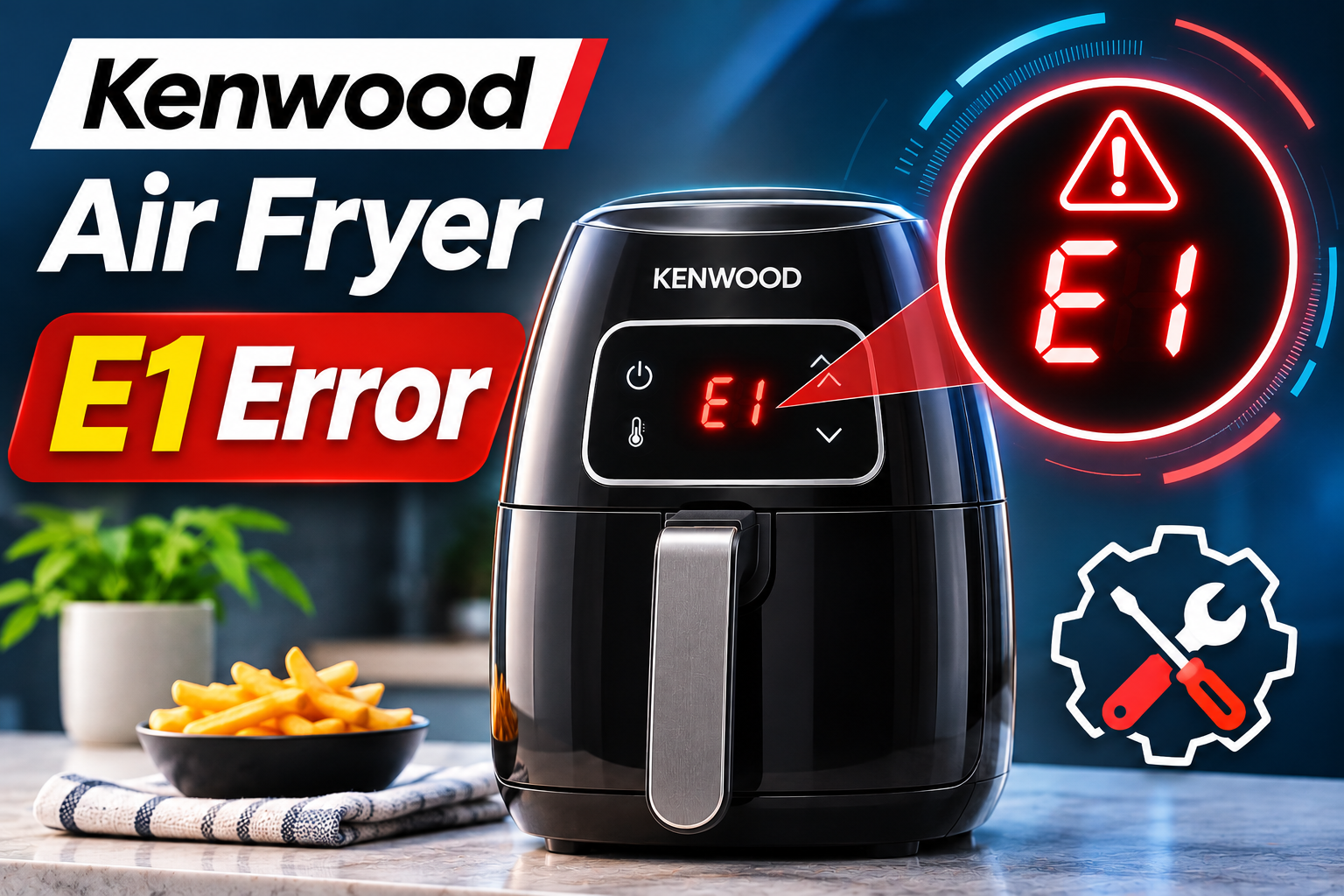
The Kenwood air fryer E1 error can interrupt your cooking without warning. You might notice the code appearing as soon as you switch on the appliance or while preparing a meal. Sometimes, the display remains illuminated, but the air fryer stops heating or refuses to start another cooking cycle.
This error generally indicates an internal electrical problem, although its exact meaning varies between Kenwood models. Understanding the possible causes and performing a few safe checks can help you determine whether the appliance needs professional repair.
What Does the E1 Error Mean on a Kenwood Air Fryer?
The E1 error on a Kenwood air fryer indicates an internal fault that may involve an open or short circuit, depending on the model. For example, the Kenwood MOS40 air fryer oven manual identifies E1 as an open circuit or short circuit condition within the appliance.
Other Kenwood models describe the error less specifically. The GHF40 manual identifies E1 as an indication that the appliance is damaged, while the HFV11 manual recommends contacting an authorized service center when E1 appears.
Your air fryer uses electronic controls to manage its heating elements, cooking timer, and temperature monitoring system. Temperature sensors help the control board determine how hot the cooking chamber has become. If a sensor circuit or another electrical component malfunctions, the appliance may interrupt cooking and display an error.
An open circuit means an electrical connection has been interrupted, while a short circuit occurs when electricity follows an unintended path. Either condition can prevent electronic components from operating correctly.
You might notice that E1 appears immediately after connecting the air fryer to power, during preheating, or several minutes into cooking. However, E1 doesn’t automatically confirm that the temperature sensor has failed. The underlying fault may involve wiring, electronic connections, or another internal component.
If the error remains visible, stop using the air fryer until the cause has been identified. Kenwood recommends authorized service for E1 faults on the models mentioned above.
Kenwood Air Fryer E1 Error: Common Causes
Several electrical problems can interfere with your Kenwood air fryer’s control system and produce an E1 indication. Although the exact cause depends on your model, the following faults are possible explanations.
1. A Faulty Temperature Sensor
A defective temperature sensor is one possible cause of an E1 error when the underlying problem involves the temperature monitoring circuit.
Many air fryers use a thermistor to measure heat inside the cooking chamber. This electrical component changes its resistance as the temperature rises or falls, allowing the control board to estimate the cooking temperature.
If the thermistor develops an internal fault, the control board may receive an unexpected electrical reading. Depending on the design, a failed sensor can create an open circuit or short circuit condition that prevents normal temperature monitoring.
You might notice the error appearing immediately after switching on the appliance, even when the cooking chamber is completely cool. In other cases, the fault may become noticeable after the appliance begins heating.
Repeated temperature changes, electrical damage, and component defects can contribute to sensor failure.
However, Kenwood’s published E1 descriptions don’t identify the temperature sensor as the failed component on every model. A damaged wire or electronic control circuit can produce similar symptoms.
Therefore, replacing the sensor without confirming the fault may not resolve the error.
2. Loose or Damaged Internal Wiring
Electrical wires connect the temperature monitoring components, heating controls, and other parts of your Kenwood air fryer.
If one of these connections becomes damaged, the appliance may develop an electrical fault that prevents it from operating normally.
For example, a broken wire can interrupt the electrical path, creating an open circuit. Damaged insulation may also allow wires to make unintended contact, potentially causing a short circuit.
Heat exposure, physical impacts, vibration, and manufacturing defects can contribute to wiring problems.
You may notice that E1 appears intermittently. The appliance might operate normally during one cooking session but stop unexpectedly during another. An error that returns as the appliance heats up may also suggest a fault affected by temperature changes.
However, these observations don’t prove that the wiring is damaged. Sensor failure and control board problems can produce similar behavior.
Since the wiring is located inside the housing, confirming the fault requires professional inspection. Don’t remove the protective panels or attempt to reconnect internal wires yourself. The appliance contains electrical components that can cause shock, burns, or fire if handled incorrectly.
3. Moisture Around Electrical Components
Water can interfere with the electrical circuits responsible for operating your Kenwood air fryer.
Although removable cooking baskets and accessories can be cleaned according to the manufacturer’s instructions, the main appliance housing contains electronic components that must remain dry.
Moisture may enter through accidental spills, improper cleaning, or excessive water around ventilation openings. If it reaches electrical connectors or the control board, it can interfere with normal operation.
Water exposure may also contribute to corrosion, which can damage electrical connections over time.
You might suspect moisture damage if E1 appeared shortly after liquid spilled onto the appliance or water entered its housing during cleaning.
Other warning signs can include unusual display behavior, repeated shutdowns, or visible moisture around accessible electrical areas.
However, properly washing and drying removable cooking accessories shouldn’t damage the internal electrical system.
If water may have entered the main housing, unplug the appliance and avoid reconnecting it until a qualified technician has inspected it. Allowing the exterior to dry doesn’t guarantee that internal electrical components are safe.
4. A Malfunctioning Electronic Control Board
The electronic control board manages your Kenwood air fryer’s cooking programs, timer, heating functions, and temperature regulation.
It receives information from different components and uses that information to control the appliance. If one of its electrical circuits becomes damaged, the air fryer may stop responding correctly.
A malfunctioning circuit could also cause the board to report an electrical fault even when an external component, such as the temperature sensor, is functioning properly.
Electrical component failure, damaged circuit connections, and moisture exposure are possible contributors.
You may notice additional symptoms alongside E1, including an unresponsive touchscreen, unstable display, or unexpected shutdowns.
However, these symptoms aren’t enough to confirm that the control board needs replacing.
A qualified technician should examine the relevant sensors, wiring, and electrical connections before deciding whether the board itself is defective.
5. Heat Damage to Internal Electrical Connections
Kenwood air fryers operate at high cooking temperatures, so their electrical components and wiring must withstand regular exposure to heat.
If abnormal overheating occurs, excessive temperatures can damage wiring insulation, connectors, or other internal parts.
Restricted ventilation, excessive grease buildup, and certain electrical faults can contribute to overheating. However, these conditions don’t directly establish the cause of E1.
For example, the Kenwood MOS40 manual identifies E3 as an overheating error, while E1 concerns an open or short circuit condition. This distinction matters because different error codes can require different solutions.
You might notice a burning smell, smoke, melted plastic, or unusual heat around the housing before the appliance stops working.
These symptoms require immediate attention. Switch off the air fryer and unplug it if it’s safe to do so.
Cooling may reduce the appliance’s temperature, but it won’t repair damaged wiring or electrical components. Any signs of heat damage should be assessed by a qualified technician before the air fryer is used again.
Kenwood Air Fryer E1 Error: How to Fix
Because E1 can indicate an internal electrical fault, home troubleshooting should focus on safe checks that don’t require opening the appliance. These methods may help identify an operating issue or temporary interruption, but they cannot repair a confirmed short circuit or broken internal connection.
1. Switch Off the Air Fryer and Allow It to Cool
If E1 appears during cooking, stop using the appliance immediately.
Press the power or Start/Stop button if the controls respond, then unplug the air fryer from the electrical outlet.
Allow it to cool completely before touching the basket, cooking chamber, or removable accessories.
The exact cooling period depends on the model and how long the appliance was operating. Wait until the housing and accessible cooking components are no longer hot before inspecting them.
While the appliance cools, note when the error appeared.
If E1 appeared immediately after switching on the appliance, the electronic system may be detecting a persistent fault before cooking begins.
If it appeared after several minutes of heating, a problem affected by temperature changes may be involved.
Once the appliance is cool, inspect the exterior for discoloration, melting, cracks, or unusual damage.
If you notice a strong electrical smell, smoke damage, or signs of overheating, don’t reconnect the appliance.
Cooling is an important safety measure, but it doesn’t repair a damaged sensor, broken wire, or control board fault.
2. Confirm the Error Code Using Your Model Number
Before trying to resolve E1, identify your exact Kenwood air fryer model.
This matters because Kenwood uses different electronic systems across its air fryer range, and the meaning of an error code can vary.
For example, the Kenwood MOS40 manual identifies E1 as an open or short circuit condition and recommends contacting an authorized service center.
The GHF40 and HFV11 manuals also direct owners to authorized service when E1 appears, without identifying one particular component as the cause.
To find your model number, follow these steps.
- Unplug the appliance and allow it to cool completely.
- Locate the rating label, usually underneath or on the rear of the housing.
- Record the model number and any type designation.
- Find the troubleshooting section in the instruction manual supplied with your appliance.
- Check the exact description and recommended action for E1.
Don’t confuse E1 with other codes such as E2 or E3. On certain Kenwood models, these errors refer to different electrical or temperature problems.
If your manual instructs you to contact an authorized service center, follow that advice rather than attempting repeated cooking cycles.
3. Check the Power Cord and Electrical Outlet
Although an incorrect power connection isn’t the documented meaning of E1 on the Kenwood models discussed above, inspecting the external electrical supply can help identify a separate safety concern.
Start with the appliance unplugged.
Examine the power cord and plug for visible damage, including cracked insulation, exposed wires, discoloration, or melted areas.
If you notice any of these problems, don’t reconnect the appliance.
Next, check whether the electrical outlet matches the voltage and frequency requirements printed on the air fryer’s rating label.
Kenwood sells appliances for different electrical markets, so you shouldn’t assume that every model uses the same voltage.
Also, make sure the appliance is connected to a suitable grounded outlet when required by its instructions. Avoid overloaded power strips, loose adapters, and extension cords that aren’t approved for the appliance.
You can check whether the outlet works using another suitable electrical device, provided the outlet shows no signs of damage.
However, if E1 has already appeared and the manual identifies it as an internal electrical fault, don’t continue testing the air fryer simply because the outlet works.
A normal power supply doesn’t rule out a damaged sensor circuit or another internal electrical problem.
4. Clean the Cooking Accessories and Check Ventilation
Grease and food particles can accumulate inside an air fryer during regular cooking. Although this buildup isn’t a confirmed direct cause of E1, keeping the appliance clean helps prevent other operating problems.
Start by unplugging the appliance and allowing it to cool completely.
Remove the cooking basket, tray, or other detachable accessories according to your model’s instructions.
Wash the removable parts using warm water, mild dish soap, and a soft sponge where permitted by the manufacturer.
For accessible surfaces inside the cooking chamber, use a soft, slightly damp cloth. Avoid applying excessive water or allowing liquid to reach the electrical housing.
Next, inspect the exterior ventilation openings.
Remove loose dust or debris from accessible surfaces using a soft, dry brush. Don’t push tools through the vents or attempt to reach internal components.
Also, make sure there’s enough space around the appliance for proper airflow. The Kenwood GHF40 manual specifies at least 15 cm of clearance from nearby walls, furniture, or other appliances. Other models may have different requirements.
Once the removable accessories are clean and dry, reinsert them correctly.
For example, the Kenwood HFV11 manual explains that an incorrectly positioned basket can prevent normal operation. However, an improperly inserted basket is a separate operating problem and isn’t established as the cause of E1.
If E1 persists, further cleaning is unlikely to repair the internal electrical fault.
5. Perform a Basic Power Restart if Appropriate
A power restart may help determine whether the appliance experienced a temporary interruption in its electronic controls.
However, Kenwood recommends authorized service for E1 on several models, so restarting should never be used to override a persistent error or avoid a required repair.
Only consider a basic restart if the appliance shows no signs of electrical damage and the instructions for your particular model permit it.
If a restart is appropriate, follow these steps.
- Switch off the air fryer using its power control.
- Unplug it from the electrical outlet.
- Leave it disconnected for several minutes.
- Make sure the appliance has cooled completely.
- Confirm that the power cord and housing show no signs of damage.
- Reconnect the appliance and observe the display without starting a cooking cycle.
If the display returns to normal, the electronic controls may have recovered from a temporary interruption.
However, the disappearance of E1 doesn’t confirm that the original electrical problem has been resolved. An intermittent fault may return during another cooking session.
If E1 reappears, disconnect the appliance and arrange professional inspection.
Avoid repeatedly unplugging and reconnecting the air fryer or attempting to force it into a cooking program. A persistent error requires proper diagnosis.
6. Contact an Authorized Kenwood Service Technician
If your Kenwood air fryer continues displaying E1, professional diagnosis is the appropriate solution.
Kenwood’s instructions for the MOS40, GHF40, and HFV11 models recommend contacting an authorized service center when this error appears.
A qualified technician can inspect the relevant electrical components, including the temperature monitoring system, wiring, connectors, and electronic control board.
Depending on the model and confirmed fault, the appliance may require a replacement sensor, damaged wiring repair, or another electrical component.
However, replacing parts without testing can increase repair costs without resolving the problem.
Before contacting support, locate the appliance’s model number and keep your purchase receipt available.
Explain when E1 first appeared, whether it occurred during cooking or immediately after switching on, and whether the display responds to normal controls.
Also, mention any unusual smells, visible damage, or recent moisture exposure.
If the appliance is under warranty, contact Kenwood or the authorized retailer before arranging independent repairs.
Repair costs and replacement part availability vary between models. A technician can help determine whether repairing the air fryer is practical or whether replacing it would be the better choice.
Most importantly, don’t attempt to bypass temperature monitoring components, reconnect internal electrical wiring, or replace the control board yourself. These repairs involve electrical hazards and should be handled by qualified professionals.
Wrap-Up
The Kenwood air fryer E1 error generally indicates an internal electrical fault, although its exact meaning depends on the model. Possible causes include a damaged temperature sensor circuit, broken wiring, moisture exposure, or a malfunctioning control board.
Start by switching off the appliance, allowing it to cool, and checking the instructions for your model. You can also inspect accessible exterior parts for visible damage. However, if E1 persists, avoid further cooking attempts and contact an authorized Kenwood technician to identify the fault and recommend a safe repair.