Fortunately, this error doesn’t always mean your air fryer is damaged. Something as simple as storing it in a cold environment could be responsible. Understanding the possible causes will help you determine the appropriate solution.
What Does Error 1 Mean on a Philips Air Fryer?
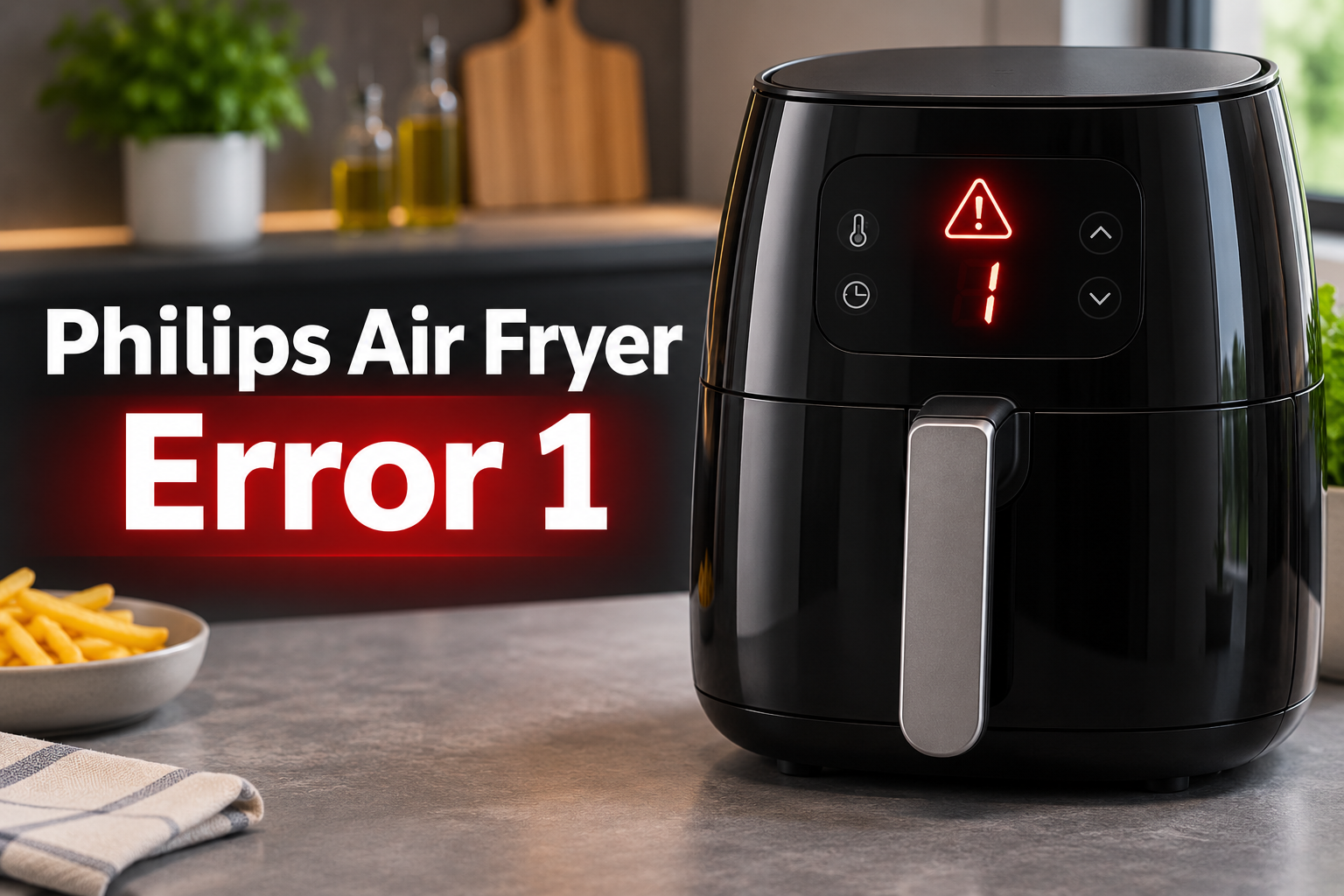
The E1 error code on a Philips air fryer generally indicates that the appliance’s internal temperature is too low or that it has developed a fault. According to Philips, the error can occur when the appliance has been exposed to unusually cold temperatures. Some models may also display the equivalent error code, 0x1002.
Your air fryer relies on a heating element, a fan, a temperature sensor, and an electronic control system to cook food. The temperature sensor monitors heat levels inside the appliance and provides information that helps the control system regulate the heating element.
If the appliance detects an unusually low temperature, it may prevent normal operation and display E1. However, an internal electrical or electronic fault could also interfere with its ability to monitor temperature correctly.
Pay attention to when the error appears. If it occurs immediately after bringing the appliance out of cold storage, the surrounding temperature is a strong suspect. Conversely, an error that repeatedly appears at normal room temperature deserves closer attention, as it could indicate a defective component.
Philips Air Fryer Error 1 [FIXED]: Likely Causes
Several conditions can cause your Philips air fryer to report an unusually low temperature and display E1. The following are the main possibilities, although internal component faults require professional diagnosis to confirm.
1. Exposure to Cold Temperatures
Cold storage is the primary cause identified by Philips for the E1 error. If you keep your air fryer in an unheated garage, basement, or storage room during winter, its internal components may become too cold for normal operation.
This can also happen with a newly purchased air fryer that has spent several hours in a cold delivery vehicle or warehouse. Although your kitchen may be comfortably warm, the appliance’s internal components might still be cold when you plug it in.
In this situation, the temperature sensor may be working perfectly. Your air fryer simply needs enough time to adjust to its new surroundings before it can operate normally.
2. A Faulty Temperature Sensor
Many digital Philips air fryers use a temperature sensing component called an NTC thermistor. Its electrical resistance changes as the temperature rises or falls, allowing the control board to monitor heat levels inside the appliance.
If the sensor deteriorates or develops an electrical fault, it could send inaccurate temperature information to the control board. Depending on the model and how the fault is detected, the appliance might interpret the reading as an abnormally low temperature.
You may suspect a temperature sensing fault if the error persists even after the appliance has spent several hours in a warm room. However, E1 alone cannot establish that the sensor needs replacing.
3. Damaged Internal Wiring or Loose Connections
The temperature sensor communicates with the air fryer’s electronic control system through electrical connections. For example, the Philips HD9240 series uses a temperature sensor connected to its electronic circuit board.
Damage to these connections can interfere with the transmission of temperature information. Physical impacts, deteriorating connectors, or damaged wires are potential sources of such problems.
Unlike cold storage, an electrical connection fault generally won’t disappear simply because the appliance reaches room temperature. You might also experience intermittent errors, although these symptoms can occur with other electronic faults.
4. A Defective Electronic Control Board
The control board receives information from various components, processes your cooking selections, operates the display, and manages the heating system.
If the section responsible for processing temperature readings develops a fault, the air fryer may struggle to interpret information from an otherwise functional sensor. The appliance could then report an error or prevent a cooking cycle from starting.
Other symptoms of electronic problems may include an unresponsive control panel, unexpected shutdowns, or irregular display behavior. Philips doesn’t identify a defective control board as a universal cause of E1, so a technician should rule out other possibilities before replacing it.
Philips Air Fryer Error 1 [FIXED]: DIY Fixes
Resolving the E1 error begins with ruling out cold exposure and checking the appliance’s operating conditions. If those checks don’t help, the remaining possibilities may require specialized testing and repairs.
1. Allow Your Air Fryer to Reach Room Temperature
Start by moving your air fryer to a comfortably warm, dry room. This is particularly useful if you’ve recently retrieved it from storage or received it through a delivery service during cold weather.
Follow these steps:
-
Switch off the air fryer and disconnect it from the electrical outlet.
-
Place it on a stable, dry kitchen countertop.
-
Leave it unplugged for at least 30 minutes.
-
Allow extra time if the appliance is still noticeably cold.
-
Plug it back in and switch it on.
Although some Philips air fryer manuals recommend a minimum adjustment period of 15 minutes, allowing 30 minutes follows the more conservative guidance provided by Philips support.
Avoid using a hair dryer, space heater, or another external heat source to speed up the process. Let the appliance warm up naturally to prevent unnecessary damage to its components.
2. Restart Your Philips Air Fryer
If your air fryer is already at room temperature, try disconnecting it from its power supply. Restarting the appliance allows its electronic control system to begin a fresh operating cycle.
Turn the appliance off, remove the plug from the wall outlet, and leave it disconnected for 30 minutes. Afterward, reconnect it and check whether the display returns to its usual cooking controls.
If the E1 message immediately reappears, repeatedly restarting the appliance is unlikely to provide a lasting solution. Also, avoid performing a factory reset unless Philips specifically recommends it for your model and circumstances.
3. Check for Moisture Around the Appliance
Moving an extremely cold appliance into a warm room can cause condensation to form on its surfaces. Although Philips doesn’t specifically identify condensation as an E1 trigger, moisture around electrical components presents a separate concern that deserves attention.
Inspect the exterior of your air fryer, particularly around the control panel, power cord, air openings, and cooking compartment. If you notice surface moisture, leave the appliance unplugged in a dry, ventilated location until it has dried completely.
However, if you suspect that water has entered the electronic components, don’t reconnect the appliance. Have it examined by a qualified technician instead. You should never immerse the main body of your Philips air fryer in water.
4. Check the Power Supply and Operating Conditions
While an electrical supply problem isn’t an established cause of E1, checking your power connection can help rule out separate operating problems that might complicate troubleshooting.
Philips air fryers consume considerable electricity during operation. Connecting several demanding kitchen appliances to the same outlet can create electrical problems and interfere with normal operation.
With the appliance unplugged, examine the power cord and plug for visible damage, discoloration, or melted plastic. If everything appears normal, connect the air fryer directly to a suitable wall outlet that meets the electrical specifications printed on its rating label.
Keep the air fryer away from damp locations, unusually cold drafts, and obstructed ventilation openings. If the plug is damaged, the outlet shows signs of burning, or the appliance repeatedly trips your circuit breaker, discontinue use and seek professional assistance.
5. Check the User Manual for Your Specific Model
Philips produces several air fryer models with different electronic systems, cooking functions, and error codes. Consequently, instructions that apply to one model may be unsuitable for another.
You can usually find your appliance’s model number on a label underneath its base. Examples include HD9252, HD9270, and HD9285, often followed by additional numbers that identify the exact version.
Once you’ve located the number, visit the Philips support website and search for your model. Download its user manual and read the troubleshooting section for E1. Following the manufacturer’s instructions will help you avoid unnecessary adjustments or repairs based on another appliance’s error codes.
6. Contact a Qualified Appliance Repair Technician
If your Philips air fryer continues to display E1 after reaching room temperature and being restarted, an internal defect becomes a greater concern.
At this stage, repairing the appliance may involve examining its temperature sensor, electrical connections, and electronic control board. These components require appropriate diagnostic equipment and knowledge of the appliance’s electrical system.
Depending on the findings, a technician may recommend one of the following repairs:
-
Temperature sensor replacement: If testing confirms that the sensor provides incorrect readings.
-
Wiring or connector repairs: If damaged electrical connections interfere with temperature monitoring.
-
Control board replacement: If the electronic control system cannot correctly process temperature information.
Avoid purchasing replacement components before the underlying fault has been identified. Otherwise, you could spend money replacing a perfectly functional part without resolving the error.
If your air fryer is still under warranty, contact Philips customer support before arranging independent repairs. Have your model number, proof of purchase, and details of when the error occurs available to help the support representative assess the problem.
Wrapping Up
The E1 error on a Philips air fryer often has a relatively simple explanation, particularly if the appliance has recently been exposed to cold temperatures. Giving it sufficient time to reach room temperature can restore normal operation without requiring replacement parts or expensive repairs.
However, a persistent error deserves proper attention. Resist the temptation to dismantle the appliance or bypass its temperature monitoring system. Once you’ve ruled out cold exposure and other basic operating problems, professional diagnosis is the safest way to identify the fault and determine whether a repair is worthwhile.