An E4 error on your Philips air fryer can appear unexpectedly, preventing you from starting or completing a cooking cycle. The appliance may stop heating, become unresponsive, or continue displaying the error whenever you switch it on.
Fortunately, Error 4 doesn’t always mean your air fryer needs replacing. A simple restart may restore normal operation in some cases. However, if the message persists, understanding the possible underlying faults will help you determine the appropriate solution.
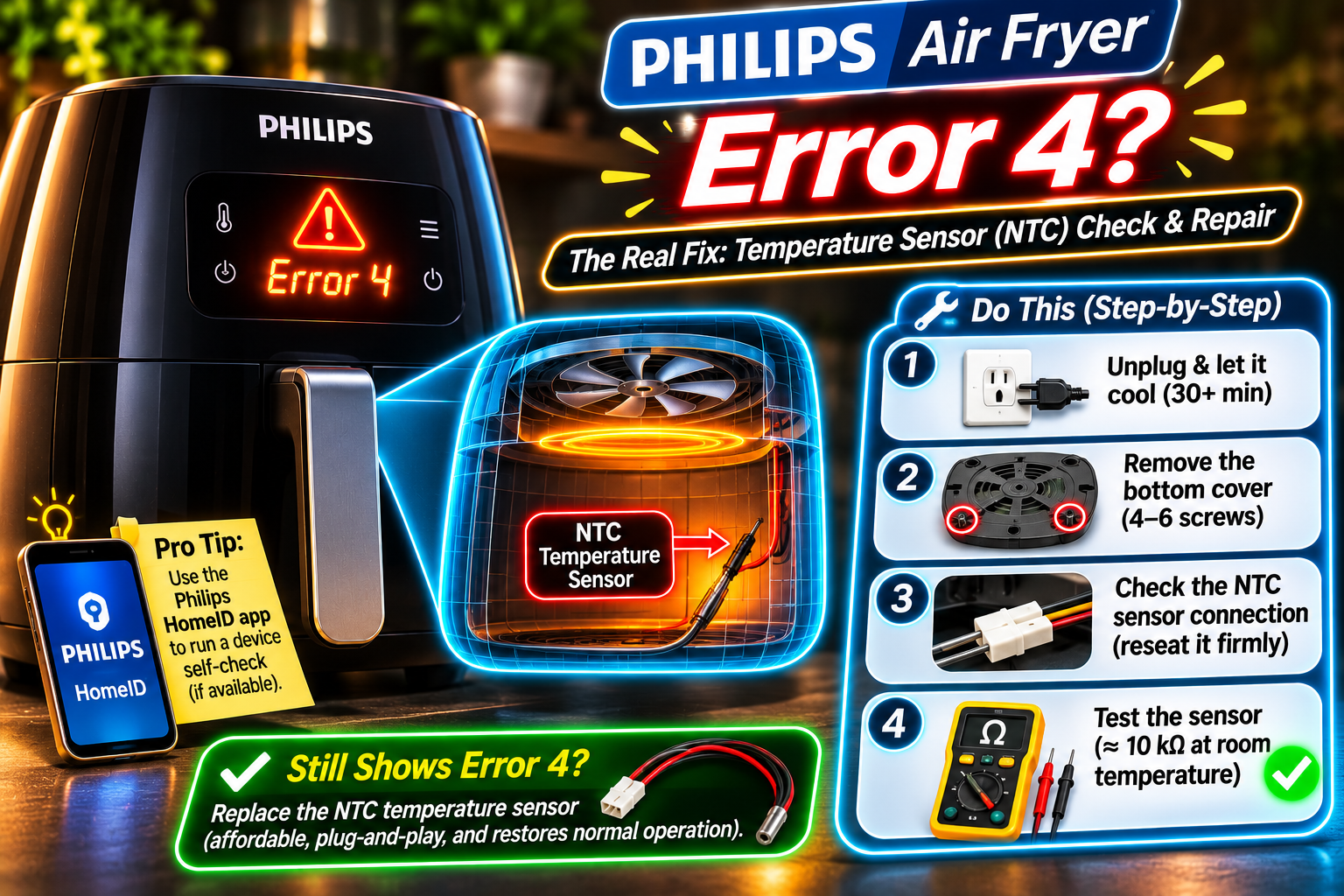
What Does Error 4 Mean on a Philips Air Fryer?
Error 4, commonly displayed as E4, indicates that your Philips air fryer has encountered an internal malfunction. According to the Philips 5000 Series HD9285 user manual, the error means the appliance has developed a defect that requires attention from customer support.
However, Philips doesn’t publicly identify a specific component responsible for E4 across all its air fryer models. Therefore, you shouldn’t automatically assume that the temperature sensor, heating element, or control board needs replacing.
Your air fryer contains an electronic control system that manages temperature regulation, cooking time, and the operation of its heating element and fan. If something interferes with these functions, the appliance may interrupt cooking and display an error message.
According to the Philips error code troubleshooting guide, disconnecting the appliance and reconnecting it may resolve E4. However, if the error remains on the display, the manufacturer recommends contacting customer support.
Philips Air Fryer Error 4: Likely Causes
Several electrical and electronic problems can interfere with your Philips air fryer’s operation. Although Philips doesn’t specify the exact causes of E4, the following faults are possible explanations for an internal appliance malfunction.
1. A Temporary Electronic Malfunction
Your Philips air fryer relies on electronic components to process cooking instructions and coordinate its internal functions. Occasionally, the control system may encounter a temporary problem that prevents it from operating correctly.
This could happen following an unexpected power interruption or an abnormal startup. You might notice that the display becomes unresponsive, the cooking controls stop working, or the appliance refuses to begin heating despite receiving electricity.
Since Philips recommends disconnecting and reconnecting the appliance when E4 appears, restarting it is a reasonable first step on compatible models. However, if the error repeatedly returns, the problem may involve something more serious than a temporary electronic malfunction.
2. A Defective Temperature Sensor
The temperature sensor monitors the heat inside your air fryer’s cooking chamber. It supplies information to the electronic control board, allowing the appliance to adjust its heating element and maintain your selected cooking temperature.
Many digital air fryers use a temperature sensing component called a thermistor. Its electrical resistance changes according to the surrounding temperature. If the component deteriorates or develops an electrical fault, the readings it produces may become inaccurate.
A temperature monitoring problem is worth investigating if your air fryer previously burned food at ordinary cooking temperatures, struggled to maintain consistent heat, or stopped heating unexpectedly. However, E4 alone doesn’t confirm that the temperature sensor is defective.
3. Damaged Internal Wiring or Electrical Connections
Several electrical wires connect your Philips air fryer’s heating element, temperature sensor, fan motor, and electronic control board. These connections must remain intact for the appliance’s components to communicate and function correctly.
Repeated exposure to heat, physical damage, or deteriorating electrical connectors can interrupt these connections. A loose wire may cause intermittent operating problems, while a completely damaged connection could prevent the appliance from starting. Since these faults occur inside the electrical housing, professional inspection is necessary to identify them.
4. Moisture Inside the Air Fryer
Although your Philips air fryer’s removable cooking accessories can be washed, its main electrical housing must remain dry. Water entering the appliance can interfere with its electronic components and electrical connections.
This could happen if you accidentally spill liquid onto the control panel, spray cleaning solutions into ventilation openings, or use excessive water when cleaning the cooking chamber. Moisture can contribute to corrosion and short circuits. If E4 appears shortly after cleaning, leave the appliance disconnected until the possibility of internal water damage has been addressed.
5. A Malfunctioning Electronic Control Board
The electronic control board manages your Philips air fryer’s cooking programs, temperature settings, timer, and heating system. It also receives information from internal sensors and coordinates the operation of different components.
If part of the board develops a fault, the appliance may stop responding to cooking instructions or display unexpected error messages. Electrical damage, moisture exposure, and gradual component deterioration can contribute to such problems. Since control board faults can produce symptoms similar to those of damaged sensors or wiring, proper testing is necessary before replacing the board.
Philips Air Fryer Error 4: DIY Fixes
Resolving Error 4 begins with checking your appliance’s model and ruling out temporary operating problems. While the following methods can help identify straightforward issues, persistent internal faults require professional diagnosis.
1. Restart Your Philips Air Fryer
Disconnecting your Philips air fryer from its power supply allows its electronic system to shut down completely. This is the first troubleshooting method Philips recommends for E4 in its general error code guide.
Follow these steps:
- Switch off the air fryer using its power button.
- Remove the plug from the electrical outlet.
- Allow the appliance to cool completely if it was recently cooking.
- Inspect the appliance for visible signs of damage.
- Reconnect it to the electrical outlet.
- Switch it on and check whether the error has disappeared.
Philips doesn’t specify a universal waiting period for restarting an air fryer displaying E4. However, allowing a previously hot appliance to cool completely is a sensible precaution.
If the error disappears and the appliance operates normally, a temporary electronic problem may have been responsible. If E4 returns, avoid repeatedly restarting the appliance. Also, follow your particular model’s instructions if its manual recommends contacting customer support directly.
2. Confirm Your Air Fryer’s Model and Error Code
Philips produces several air fryer ranges with different electronic controls and troubleshooting instructions. Identifying your exact model will help you determine whether the manufacturer recommends a restart or immediate professional assistance.
The following table highlights the recommended responses to E4 on several Philips air fryer models.
| Philips air fryer model | Meaning of E4 | Recommended action |
|---|---|---|
| 5000 Series HD9285 | Appliance defect | Contact customer support |
| 2000 Series NA230 | Appliance malfunction | Disconnect and reconnect |
| 2000 Series NA231 | Appliance malfunction | Disconnect and reconnect |
| 4000 Series NA462 | Internal appliance error | Restart and contact support if necessary |
You can usually find your air fryer’s model and serial numbers on a sticker underneath its base. Remove any loose cooking accessories before carefully positioning the cooled appliance to examine the label.
Visit the Philips support website and search for the corresponding user manual. Pay particular attention to the troubleshooting section, as instructions intended for another Philips model may be unsuitable for your appliance.
3. Inspect the Power Cord and Electrical Outlet
Your Philips air fryer requires a suitable electrical supply to operate its heating element and electronic components. Although power supply problems aren’t specifically documented as causes of E4, checking the external connection can help eliminate separate operating and safety concerns.
With the appliance unplugged, carefully examine its power cord and plug. Look for cracks, exposed wires, damaged insulation, melted plastic, or dark marks around the electrical pins. Check the wall outlet for similar signs of damage.
If everything appears normal, make sure the outlet meets the electrical requirements printed on your air fryer’s rating label. Philips also explains that connecting too many appliances to one outlet can interfere with normal operation.
Avoid using overloaded power strips or unsuitable voltage adapters. If your air fryer repeatedly trips the circuit breaker or causes its electrical outlet to become unusually hot, discontinue use and contact a qualified electrician.
A damaged power cord should be replaced by Philips or an appropriately qualified repair technician rather than repaired with electrical tape.
4. Improve Ventilation and Clean the Air Fryer
Your Philips air fryer generates substantial heat during cooking. Adequate ventilation helps prevent excessive heat from accumulating around its internal components.
For example, the Philips NA230 and NA231 user manuals recommend leaving at least 4 inches (10 cm) of free space behind, above, and along both sides of the appliance. Check your model’s instructions, as clearance requirements may differ.
Once the appliance is disconnected and completely cool, move it to an open area of your kitchen countertop. Remove nearby objects that could obstruct its air intake or exhaust openings.
You should also clean the cooking basket, pan, and accessible interior surfaces. Philips recommends washing removable cooking accessories using hot water, dish soap, and a soft sponge. For stubborn food residue, soaking the affected components for five to ten minutes can make cleaning easier.
Avoid using metal brushes, abrasive cleaning materials, or excessive amounts of water around the heating element. Allow everything to dry thoroughly before reassembling the appliance. Although cleaning and improved ventilation won’t repair defective electronic components, these measures help eliminate maintenance problems that could interfere with normal operation.
5. Check for Moisture and Water Damage
If Error 4 appeared shortly after cleaning your Philips air fryer or following an accidental spill, examine the appliance for signs of moisture exposure.
With the air fryer disconnected, remove its cooking basket and pan. Check the accessible interior surfaces, control panel, and ventilation openings for visible moisture. Wipe away surface water using a clean, dry cloth and leave the appliance in a dry location with adequate ventilation.
Avoid placing the appliance beside a radiator or using a hair dryer to accelerate the drying process. Excessive external heat could damage its plastic housing and electronic components.
However, if you suspect that water has entered the main electrical housing, don’t reconnect the appliance simply because its exterior appears dry. Moisture may remain trapped around internal connections. Have the appliance professionally inspected before attempting to use it again.
6. Check for Signs of Internal Component Failure
If Error 4 continues appearing despite the appropriate troubleshooting steps, an internal electrical fault may require further investigation. Consider any unusual symptoms you noticed before the error first occurred.
For example, food that consistently burned at moderate cooking temperatures might indicate a temperature regulation problem. Unexpected shutdowns, unresponsive controls, or irregular display behavior could suggest an electronic malfunction.
A qualified technician can examine your air fryer’s temperature sensor, internal wiring, electrical connectors, heating system, and electronic control board. Appropriate diagnostic equipment can help establish whether a component has failed or an electrical connection has become damaged.
If testing confirms that the temperature sensor is defective, installing a compatible replacement may restore normal operation. Alternatively, repairing a damaged electrical connection could resolve the problem without requiring an expensive control board replacement.
Avoid opening the appliance or purchasing replacement components based solely on the E4 error. Philips doesn’t identify a universal component failure associated with this code, so replacing parts without proper diagnosis could result in unnecessary expenses.
7. Contact Philips Customer Support or an Appliance Repair Technician
If your Philips air fryer continues displaying Error 4, contacting customer support is the manufacturer’s recommended course of action. This is particularly necessary if the appliance refuses to heat, repeatedly shuts down, or displays the error immediately after startup.
Before contacting Philips, gather the following information:
- Your air fryer’s model and serial numbers.
- A photograph of the E4 error message.
- Your original purchase receipt.
- Details of when the error first appeared.
- The cooking function and temperature you were using.
- Any unusual noises, smells, or heating problems.
- The troubleshooting methods you’ve already attempted.
You can visit the Philips customer support website to find the appropriate assistance and repair services for your country.
If your air fryer is still under warranty, contact Philips before arranging independent repairs. Depending on the nature of the fault and the applicable warranty terms, you may qualify for a repair or replacement appliance.
For older air fryers, request a repair estimate before authorizing expensive component replacements. Repairing a damaged electrical connection may be economical, whereas extensive control board damage could make purchasing a replacement more practical.
Never attempt to bypass the temperature monitoring system or modify the appliance’s electrical circuits to clear the error. These components are essential for maintaining safe cooking conditions.
Wrapping Up
Error 4 on a Philips air fryer indicates an appliance malfunction that may involve its electronic controls or internal electrical components. Although restarting the appliance can sometimes restore normal operation, recurring errors require further attention.
Start by following the troubleshooting instructions for your particular model and examining the appliance’s external condition. If the error persists, avoid attempting internal repairs without the necessary technical knowledge. Contacting Philips with your model number and a detailed description of the symptoms can help you obtain an accurate diagnosis, prevent further damage, and determine whether repairing the appliance is worthwhile.