However, E5 doesn’t mean the same thing on every air fryer. Depending on the brand and model, it may indicate overheating, an electronic fault, or another operating problem that requires a specific solution.
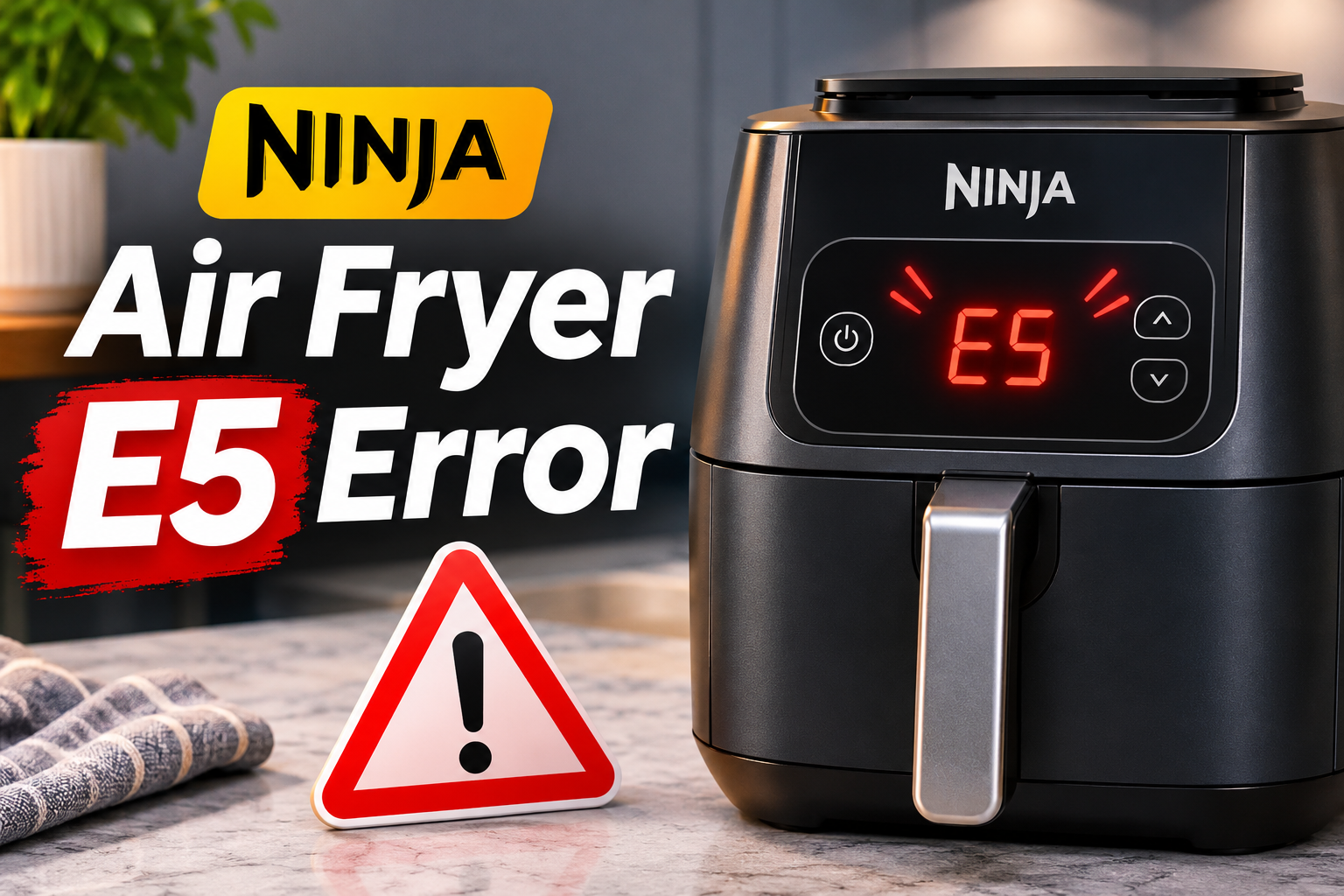
What Does the E5 Error Mean on an Air Fryer?
The E5 error code indicates that your air fryer has detected a condition that may prevent normal operation. Its exact meaning depends on the manufacturer’s error code system, which can differ considerably between brands and models.
For example, the Ninja CRISPi DualZone DD100 series identifies E5 as overheating in Zone 1. However, Philips groups E5 with several error codes that may require restarting the appliance or contacting customer support. Certain Cosori air fryer ovens use E5 to indicate that the appliance has been stored at an extremely low temperature.
These differences matter because the appropriate solution depends on what the warning actually represents. An overheating warning may require cooling and ventilation checks, while an internal electrical fault may require professional repair. Simply unplugging the appliance won’t necessarily resolve every condition.
Your air fryer normally uses a heating element, fan, temperature sensor, and electronic controller to maintain the selected cooking temperature. If the control system detects an operating condition outside its expected limits, it may interrupt cooking and display an error. Consequently, identifying your exact model is essential before attempting any fix.
Air Fryer E5 Error [FIXED]: Common Causes
Several conditions can trigger an E5 warning, but they don’t all apply to every air fryer. Understanding the established explanations for different models will help you identify which cause is relevant to your appliance.
1. Overheating Inside the Air Fryer
Some air fryers display E5 when their temperature monitoring system detects excessive heat. For example, Ninja identifies E5 as a Zone 1 overheating warning on its CRISPi DualZone DD100 series.
During normal cooking, the heating element produces heat while the fan circulates hot air around the food. The control system monitors temperature and regulates heating to maintain the selected setting. If the appliance detects temperatures outside its permitted operating range, it may stop the affected cooking function.
Overheating can be associated with restricted ventilation, excessive heat exposure, or problems involving the heating and temperature control systems. However, the E5 warning alone doesn’t identify which of these conditions caused the temperature to rise.
You may notice that cooking stops unexpectedly or that the appliance feels unusually hot. If the error appears after prolonged use, overheating becomes an important possibility to investigate on models where E5 has that documented meaning.
Nevertheless, you shouldn’t assume that every air fryer showing E5 has overheated. Other manufacturers use the same code for entirely different problems.
2. Software or Electronic Control Problems
Modern air fryers use electronic control systems to manage their cooking functions. These systems process your temperature settings, monitor internal components, and coordinate the fan and heating element.
Sometimes, a temporary electronic fault can interfere with normal operation. Certain Philips Airfryer models, including the HD9875, identify E5 among error codes that may indicate a software issue.
A software problem can interrupt communication between the appliance’s control functions and prevent a cooking cycle from continuing as expected. The display may remain on the error code rather than showing the normal temperature or cooking time.
Philips recommends disconnecting and reconnecting affected models to check whether the warning clears. However, this method is specific to the manufacturer’s instructions and doesn’t establish that all E5 errors are temporary software faults.
If the error returns immediately after restarting, there may be a persistent problem that requires customer support.
3. Exposure to Extremely Low Temperatures
An air fryer stored in a very cold environment may develop an error when its internal temperature falls outside the range expected by the control system.
For example, the Cosori 26-quart Ceramic Air Fryer Oven models CCO-R252-SUS and CCO-R252-WUS use E5 when the appliance has been stored below -7°F (-22°C).
This situation is most relevant to appliances kept in extremely cold storage areas or transported through severe winter conditions. The internal components may need time to reach normal room temperature before the appliance can operate correctly.
Unlike an overheating warning, this particular E5 error can appear even when the appliance hasn’t been used for cooking. It reflects a low-temperature condition identified by the model’s control system.
The manufacturer’s recommended solution is to place the appliance at room temperature and try again. However, this explanation applies only to models whose documentation specifically identifies E5 as a low-temperature warning.
4. Problems With the Air Frying Lid
Some combination appliances use removable air frying lids that contain heating elements, fans, and electrical connections. These designs introduce additional components that can develop faults.
For example, the Emeril Lagasse Pressure AirFryer Y8D-AF-36 identifies E5 as an air fryer lid short circuit. Its troubleshooting instructions recommend contacting customer service.
A short circuit occurs when electrical current follows an unintended path. Depending on where it develops, this can interfere with the operation of a component and create electrical safety risks.
On an appliance with a removable air frying lid, the problem may involve internal electrical components or circuitry associated with that lid. However, the error doesn’t establish exactly which part has failed.
If your appliance identifies E5 as a lid short circuit, stop using it immediately. Avoid attempting to repair electrical connections or opening the lid housing because these components require professional diagnosis.
5. Faulty Temperature Monitoring or Control Components
Your air fryer depends on accurate temperature information to regulate cooking. The temperature sensor sends information to the electronic controller, which determines when the heating element should operate.
If the sensor or its associated circuitry becomes defective, the appliance may receive inaccurate temperature information or lose the ability to monitor heat correctly.
Possible causes include component deterioration, damaged internal connections, or failure of the electronic control system. These faults may cause cooking interruptions, abnormal heating, or error messages.
However, a defective temperature sensor isn’t a confirmed explanation for E5 across all air fryers. Some manufacturers assign sensor problems entirely different codes.
The important distinction is that similar symptoms can have different causes. An air fryer that stops heating may have a sensor problem, but it could also have a control board fault or a manufacturer-specific operating issue.
Confirming an internal component failure requires appropriate technical testing. For safety reasons, these checks should be performed by a qualified appliance technician rather than through DIY electrical repairs.
Air Fryer E5 Error [FIXED]: How to Fix
The best way to resolve an E5 error is to follow the instructions for your particular brand and model. Start with safe external checks, and avoid restarting the appliance if the manufacturer’s guidance identifies the warning as a serious electrical fault.
1. Identify Your Air Fryer Model and Check the Error Code
Before attempting any repair, find the exact model number of your air fryer. This is the most important step because E5 has different meanings across manufacturers.
First, read the display carefully to confirm that it shows E5 rather than E3, E6, or another similar code. Then switch off the appliance and disconnect it from power.
Once the unit is cool, examine its identification label. Depending on the design, this may be located underneath the appliance, behind the main housing, or near the power cord.
Look for the model number and compare it with the troubleshooting section of the owner’s manual.
Here are some documented examples.
| Air fryer model | Meaning of E5 |
|---|---|
| Ninja CRISPi DualZone DD100 series | Zone 1 overheating |
| Philips Airfryer HD9875 | Possible software issue |
| Cosori CCO-R252 series | Storage temperature below -7°F (-22°C) |
| Emeril Lagasse Y8D-AF-36 | Air fryer lid short circuit |
These examples demonstrate why a universal E5 repair procedure isn’t reliable.
If the manual identifies E5 as an electrical short circuit or another fault requiring service, stop troubleshooting and contact the manufacturer.
For models that provide a safe user procedure, follow those instructions before considering additional checks.
2. Turn Off the Air Fryer and Allow It to Cool
If your model identifies E5 as an overheating warning, begin by stopping the cooking cycle and allowing the appliance to cool.
Press the Stop or Power button if it responds, then carefully disconnect the plug from the wall outlet. Place the appliance on a stable, heat-resistant surface with its ventilation openings unobstructed.
Avoid immediately pulling out hot accessories or touching the main housing. The cooking basket, heating chamber, and surrounding surfaces may remain hot after the appliance stops.
Allow the unit to cool completely. The time required depends on its temperature and the manufacturer’s instructions.
While it cools, check for unusual smells, visible smoke, melting, or discoloration. If you notice these warning signs, don’t reconnect the appliance.
For compatible models, cooling may resolve a temporary overheating condition. However, the error can return if the underlying problem remains.
If a Ninja CRISPi DualZone displays E5, follow Ninja’s specific support guidance. Don’t repeatedly restart the affected zone simply to see whether it will continue cooking.
3. Check the Ventilation Openings and Clean Accessible Parts
Poor ventilation can contribute to excessive heat inside an air fryer. Therefore, checking its airflow openings is worthwhile when overheating is a documented concern.
Start by making sure the appliance is unplugged and completely cool. Examine the external air intake and exhaust openings for obvious obstructions.
Move away any items blocking the vents. Also, make sure the appliance has the clearance specified in its owner’s manual.
Avoid placing your air fryer directly against a wall, beneath hanging materials, or in an enclosed space that prevents hot air from escaping.
Next, inspect the removable basket, tray, or crisper plate for grease and accumulated food residue.
You can clean these parts using the following steps.
- Remove the basket and other approved removable accessories.
- Wash them using warm water, mild dish soap, and a soft sponge.
- Gently remove stubborn grease or food deposits.
- Rinse the parts thoroughly.
- Allow everything to dry before reinstalling it.
Wipe the accessible exterior using a suitable cloth. Don’t pour water into the main housing, insert cleaning tools into the vents, or attempt to dismantle the internal fan.
Cleaning and improving ventilation can address maintenance problems, but these actions aren’t guaranteed to clear E5.
If the warning returns after the manufacturer’s permitted troubleshooting, stop using the appliance until the fault has been investigated.
4. Allow the Appliance to Reach Room Temperature
If your air fryer was stored in extremely cold conditions, check whether its manual associates E5 with low temperature.
This step is particularly relevant to the Cosori CCO-R252 series, which documents E5 when the appliance has been stored below -7°F (-22°C).
Disconnect the appliance from electricity and move it to a dry indoor location at normal room temperature. Place it on a stable surface and allow sufficient time for the entire unit to warm naturally.
Don’t attempt to speed up the process using a hair dryer, space heater, oven, or another direct heat source. Excessive external heat could damage the appliance’s electrical components or housing.
If you notice condensation on the appliance after bringing it inside, leave it unplugged until it is completely dry. Moisture around electrical components creates additional risks.
Once the air fryer has reached room temperature, follow the manufacturer’s instructions for reconnecting it.
For the affected Cosori models, allowing the appliance to warm up may clear the E5 warning without any component replacement.
If the error remains, contact Cosori support rather than repeatedly starting cooking cycles.
5. Restart the Air Fryer if the Manufacturer Recommends It
A basic power restart may clear certain temporary electronic errors. However, this approach should only be used when the manufacturer’s troubleshooting instructions recommend it.
Philips, for example, advises users experiencing E5 on supported Airfryer models to unplug the appliance and reconnect it. If the error remains, the company recommends contacting customer support.
To perform a permitted restart, first stop the cooking function and disconnect the power plug. Check the appliance for signs of damage, unusual smells, or overheating.
If everything appears normal, reconnect it according to the instructions in the owner’s manual.
Check whether the usual controls and display return. If E5 disappears and the manufacturer permits normal operation, follow its guidance before beginning another cooking cycle.
However, if the warning immediately returns, don’t keep repeating the reset. A persistent error may require professional attention.
You should also avoid attempting undocumented button combinations or factory reset procedures found in unrelated air fryer instructions.
Different manufacturers use different electronic systems, and an incorrect reset procedure may not apply to your model.
Most importantly, never use a power restart as a substitute for professional attention when E5 indicates an electrical short circuit or another serious internal fault.
6. Contact the Manufacturer or a Qualified Appliance Technician
If your air fryer continues displaying E5 after the recommended troubleshooting, the safest next step is to contact the manufacturer.
This is especially important when the error indicates a short circuit, persistent overheating, or an internal component failure.
Before contacting support, gather your model number, serial number, and purchase information. Write down the exact error message and explain when it appeared.
For example, mention whether E5 appeared immediately after plugging in the appliance, during preheating, or after several minutes of cooking.
Also, describe any related symptoms, including unusual noises, burning smells, unexpected shutdowns, or abnormal heating.
These details may help the manufacturer determine whether the appliance needs inspection, repair, or replacement.
If your air fryer is still covered by a warranty, check the manufacturer’s service conditions before arranging an independent repair.
For appliances outside their warranty period, a qualified appliance technician can assess whether replacing the affected component is practical.
Avoid opening the main housing to inspect wiring, bypass safety controls, or replace electronic parts yourself. Air fryers contain components connected to household electricity, and unsafe repairs can create fire or electric shock hazards.
Professional diagnosis can also prevent unnecessary spending on replacement parts that may not address the actual problem.
Wrap-Up
An E5 error doesn’t have one universal meaning across all air fryers. Depending on your model, it may indicate overheating, a software problem, exposure to extreme cold, or an internal electrical fault. Identifying the manufacturer’s specific explanation is the key to choosing the correct solution.
Start with your owner’s manual and perform only the recommended safety checks. If the warning remains or the appliance shows signs of electrical damage, stop using it and contact a qualified professional. Taking the appropriate action early can help prevent further damage and restore safe operation.