An error code appearing on your air fryer can be frustrating, especially when it interrupts cooking without explaining what went wrong. Ninja air fryers may display an E7 error, while certain Philips Airfryers can show an E3 error that affects how the appliance works.
Although these warnings look similar, they can indicate different problems. Understanding what each code means, what might trigger it, and which troubleshooting steps are safe can help you avoid unnecessary repairs and further damage.
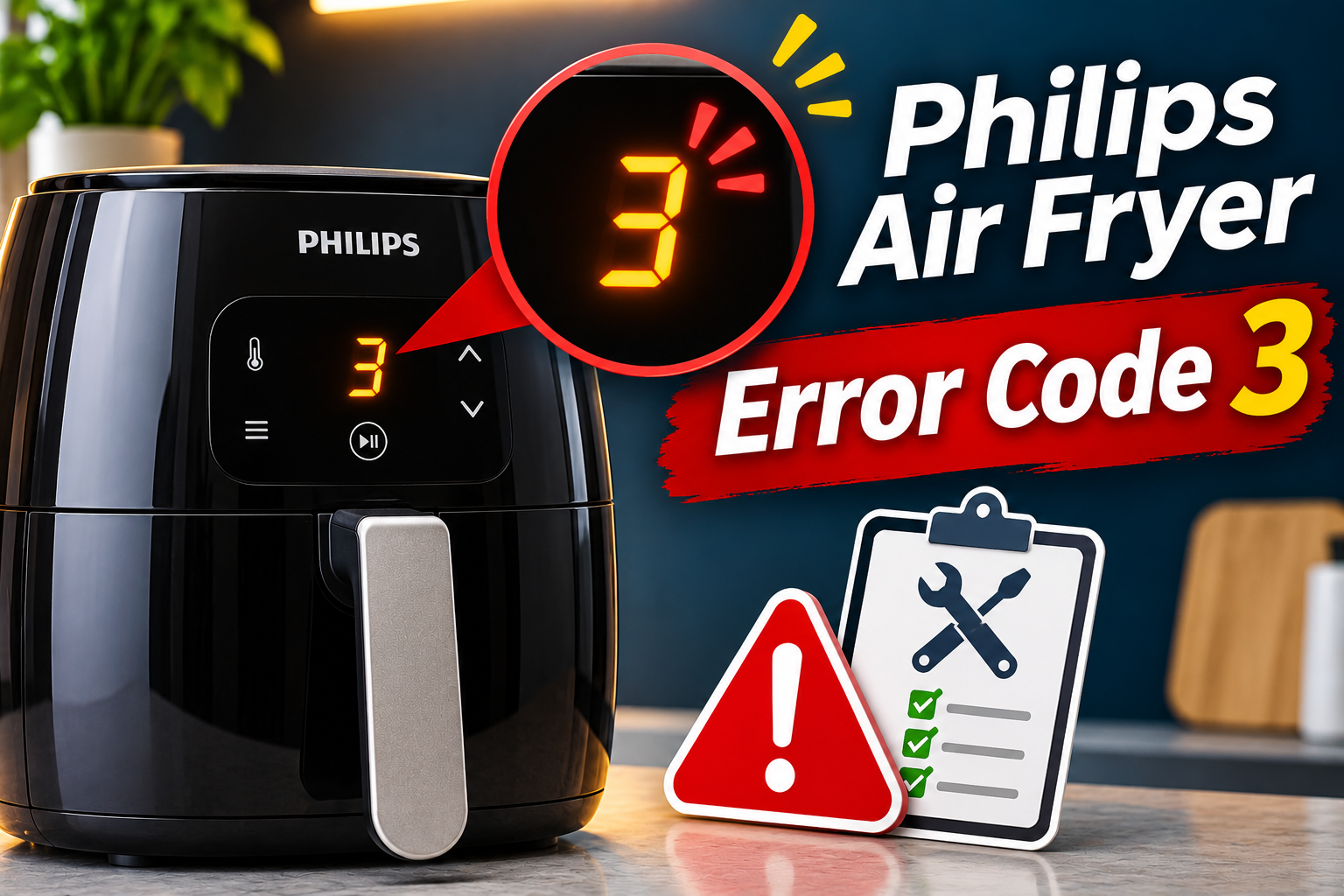
Understanding Ninja Air Fryer Error E7 and Philips Error Code 3
Air fryers use heating elements, fans, temperature sensors, and electronic controls to cook food. The heating element produces heat, while the fan moves hot air around the cooking chamber. Meanwhile, the control board manages cooking settings and monitors certain operating conditions. If the appliance detects a problem, it may display an error code and interrupt its normal operation.
Ninja error E7 has a documented meaning on certain models. According to Ninja’s official support information, E7 and E8 indicate internal circuit board overheating on the CRISPi DualZone DD100 series. However, this interpretation doesn’t automatically apply to every Ninja air fryer. Other models use different warning systems, and some manuals describe an E message simply as an appliance malfunction.
The Philips Airfryer E3 error, sometimes displayed as 0x4001, has a different meaning. Philips identifies it as a fault with the appliance’s connectivity feature on supported models. This feature allows compatible Airfryers to communicate with connected services. Philips states that affected appliances can still be used without the connectivity feature. An isolated number 3 on the display shouldn’t automatically be treated as E3 without checking the model’s manual.
These differences matter because a connectivity fault doesn’t require the same response as overheating electronics. A Ninja displaying E7 may need to remain switched off until the cause is addressed. Meanwhile, a Philips Airfryer with E3 may still perform ordinary cooking functions. However, unusual smells, damaged wiring, smoke, or repeated shutdowns should always be treated as warning signs that require you to stop using the appliance.
Ninja Air Fryer Error E7: Likely Causes
Several conditions can contribute to overheating or electronic problems in an air fryer. However, the exact cause depends on the model, and the code alone cannot identify every underlying fault.
1. Internal Circuit Board Overheating
The electronic circuit board is responsible for controlling important functions inside your air fryer. It processes information from sensors and helps regulate the appliance’s operation. Like other electronic components, it generates some heat during use, but excessive temperatures can interfere with its normal performance.
On the Ninja CRISPi DualZone DD100 series, E7 specifically indicates internal circuit board overheating. Ninja groups E7 and E8 under this fault category in its official DD100 series support information. The warning indicates that the appliance has detected an abnormal condition affecting the electronics.
You might see the error after the air fryer has been operating, although its timing alone cannot confirm what caused the overheating. If E7 appears repeatedly, even after the appliance has completely cooled, an internal problem becomes a stronger possibility. Continued attempts to operate the unit won’t establish whether the board, its temperature monitoring system, or another component needs attention.
2. Restricted Airflow Around the Appliance
Air fryers need adequate ventilation to release excess heat during cooking. Although hot air circulates inside the cooking chamber, the appliance also has openings that help manage heat around its internal components.
If the air outlets are obstructed by a wall, kitchen equipment, or other objects, heat can accumulate around the housing. This may contribute to unfavorable operating conditions, particularly when the appliance runs for extended periods.
Restricted ventilation is a reasonable condition to check when investigating overheating. However, it shouldn’t be treated as a confirmed cause of E7 without further evidence. You may notice unusually hot surrounding surfaces or that the appliance has very little space around its vents. These observations make checking the installation worthwhile.
3. A Fault Within the Internal Electronics
Sometimes, an air fryer develops an error even when its ventilation is clear and it hasn’t been operating for long. This can suggest that the problem lies within the appliance rather than its position on the countertop.
Electronic control components can deteriorate or malfunction over time. A fault affecting temperature monitoring or the internal circuitry may also interfere with the appliance’s ability to operate normally. However, the E7 code doesn’t establish which individual component has failed, and there is no reliable way to identify a damaged circuit board through the display alone.
One useful clue is when the same warning appears immediately after the appliance is switched on while it is still cool. This behavior makes ordinary heat accumulation from the current cooking session less convincing as the sole explanation.
Even so, the fault may involve several internal components. Testing them requires electrical knowledge and appropriate equipment, so opening the casing or attempting to test the board at home isn’t recommended.
4. A Defective Connectivity Feature in Philips Airfryers
For compatible Philips Airfryers, E3 or 0x4001 indicates a problem with the connectivity feature. This is the system that supports communication between the appliance and compatible connected services.
A connectivity fault may prevent you from using certain smart functions even when the basic cooking controls remain available. Philips doesn’t identify one universal, user-repairable component responsible for every E3 occurrence. Therefore, it’s difficult to determine the exact failure without model-specific diagnosis.
It’s also useful to distinguish E3 from an ordinary connection setup problem. Philips lists incorrect Wi-Fi credentials under E2 on applicable models. Consequently, changing your wireless password or repeatedly reconnecting your router isn’t an established repair for E3. The manufacturer’s guidance is to use the appliance without connectivity if possible or request support.
Ninja Air Fryer Error E7: How to Fix
Troubleshooting should begin with simple checks that don’t expose you to electrical components or excessive heat. The following methods cover the Ninja E7 warning and Philips E3 error separately where their solutions differ.
1. Confirm the Exact Error Code and Model Number
Before attempting any repair, check the characters appearing on the display. An E7 warning, an E3 message, and a standalone number 3 may have completely different meanings.
For Ninja appliances, identify the model number on the product label. On certain models, such as the AF100, this information is found near the power cord. The exact location can differ across products. You can then consult the corresponding manual or Ninja support information.
For Philips Airfryers, the model number is commonly printed on a label underneath the appliance. Make sure the unit is unplugged and completely cool before checking. Secure or remove any loose cooking accessories so they cannot fall out when the appliance is moved.
Write down the model number and the complete error code. If the code flashes briefly, taking a picture can help you identify it accurately. This information is particularly valuable when the problem is intermittent or you need to contact customer support.
2. Turn Off the Air Fryer and Allow It to Cool
If your Ninja air fryer displays E7, stop cooking and switch off the appliance. Unplug it from the wall outlet, provided the plug and surrounding area are safe to touch.
Place the unit in a suitable location with adequate ventilation and let it cool completely. Avoid touching the hot cooking chamber or placing your hands near the exhaust outlet. If you were preparing food, remove it only when you can do so safely using the appropriate handles or oven mitts.
Cooling is especially relevant to Ninja DD100 models because E7 is associated with circuit board overheating. Nevertheless, the manufacturer doesn’t establish a universal cooling period that guarantees the error will clear. Allow enough time for the appliance to return to room temperature rather than relying on an arbitrary number of minutes.
Once the unit has cooled, check whether its vents are clear and whether there are signs of damage. Follow the instructions for your exact model before attempting to operate it again. If E7 returns, discontinue use and contact Ninja rather than repeatedly resetting the appliance.
3. Improve Ventilation Around Your Ninja Air Fryer
Air fryers release considerable heat during operation, so their position on the countertop matters. A unit placed directly against a wall or surrounded by other appliances may have difficulty releasing heat into the surrounding air.
With the air fryer switched off, unplugged, and cool, examine the space around it. Check the rear exhaust outlet and any other ventilation openings identified in your owner’s manual.
For the Ninja CRISPi DualZone DD100 series, Ninja specifies at least 15 cm, approximately 6 inches, of clearance above and around the unit. You can use this guidance for the supported DD100 models, but follow your own manual if your air fryer belongs to another series.
Place the appliance on a stable, heat-resistant surface, away from objects that could block its vents. Avoid positioning it beneath low cabinets where heat and steam may collect.
Also, keep other heat-producing appliances away from its ventilation openings. If the warning was related to poor placement, improving airflow may help reduce unnecessary heat buildup. However, better ventilation won’t repair a defective circuit board or faulty internal temperature monitoring system.
4. Clean Accessible Vents and Removable Cooking Parts
Grease, crumbs, and food residue can accumulate around an air fryer during regular use. Although ordinary residue isn’t proof of an E7 fault, keeping the appliance clean helps maintain suitable operating conditions and reduces other cooking problems.
Unplug the unit and allow it to cool completely before cleaning. Remove the cooking containers or baskets according to the owner’s manual. Wash approved removable parts using warm water, mild dish soap, and a soft sponge, then dry them thoroughly.
Check the outside of the ventilation openings for visible dirt. Gently remove loose surface debris using a dry, soft brush or cloth, taking care not to push anything through the openings.
Never pour water into the main unit, insert cleaning tools into its internal parts, or remove the casing to reach the fan. If the vents appear damaged or there is a buildup you cannot safely remove from the outside, seek professional assistance. Cleaning may address a maintenance problem, but it isn’t a guaranteed solution for an electronic overheating warning.
5. Use Your Philips Airfryer Without Connectivity When Possible
If your Philips Airfryer displays E3 or 0x4001, the manufacturer’s guidance is different from the advice for Ninja E7. Philips states that affected models may continue operating without the connectivity feature.
First, check whether the ordinary controls still respond and whether the appliance allows you to select a manual cooking function. Consult the product manual to confirm which functions remain available. Don’t assume that every Philips model supports the same cooking controls or offline features.
If the appliance operates normally without connected services, you may be able to continue cooking using its local controls. However, the connectivity problem itself may remain unresolved.
You shouldn’t repeatedly reset your router, reinstall applications, or change network settings in the expectation that these steps will repair defective hardware. For persistent E3 warnings, follow Philips’ official error code guidance and contact the manufacturer’s support team if you need the connectivity feature restored.
If your Airfryer displays an isolated 3 rather than E3, consult the model-specific manual before applying this advice. The exact message must be identified before its meaning can be confirmed.
6. Contact a Qualified Appliance Repair Professional
Some air fryer problems cannot be resolved through cooling, cleaning, or correcting the appliance’s position. If your Ninja repeatedly displays E7 after you have completed the appropriate safe checks, contact Ninja customer support or an authorized repair provider.
Explain when the warning occurs, whether the appliance had been cooking beforehand, and whether the error remains after cooling. Providing these details can help the support team determine what further assessment is appropriate for your model.
For a Philips E3 error, contact Philips support if you need the connected functions restored or if normal operation is affected. Have your model number, serial number, and proof of purchase available, particularly if the appliance may still be covered by a warranty.
Stop using either appliance immediately if you notice smoke, a strong electrical burning smell, visible cord damage, repeated breaker trips, or signs of melting. Don’t attempt to open the housing, bypass a safety device, repair internal wiring, or replace circuit board components yourself.
A qualified technician can assess whether repair is appropriate and whether the required parts are available. Depending on the appliance’s condition, age, and warranty coverage, the manufacturer may recommend repair or replacement.
Wrap-Up
Ninja E7 and Philips E3 errors require different responses, even though both appear as short messages on an air fryer’s display. Recognizing the exact code and checking the model-specific guidance helps you understand whether the issue involves overheating electronics or a connectivity feature.
Start with safe checks that apply to your appliance, and pay attention to warnings that return after troubleshooting. If the problem persists, manufacturer support is the sensible next step. Addressing the fault promptly can help protect your appliance and prevent a minor inconvenience from becoming a more serious safety concern.