Although the error may indicate an internal temperature sensing problem, some basic checks can help you rule out temporary operating issues. Understanding what the warning might mean, along with the safest troubleshooting steps, can help you avoid unnecessary repairs and further damage.
What Does Error E1 Mean on a Pigeon Air Fryer?
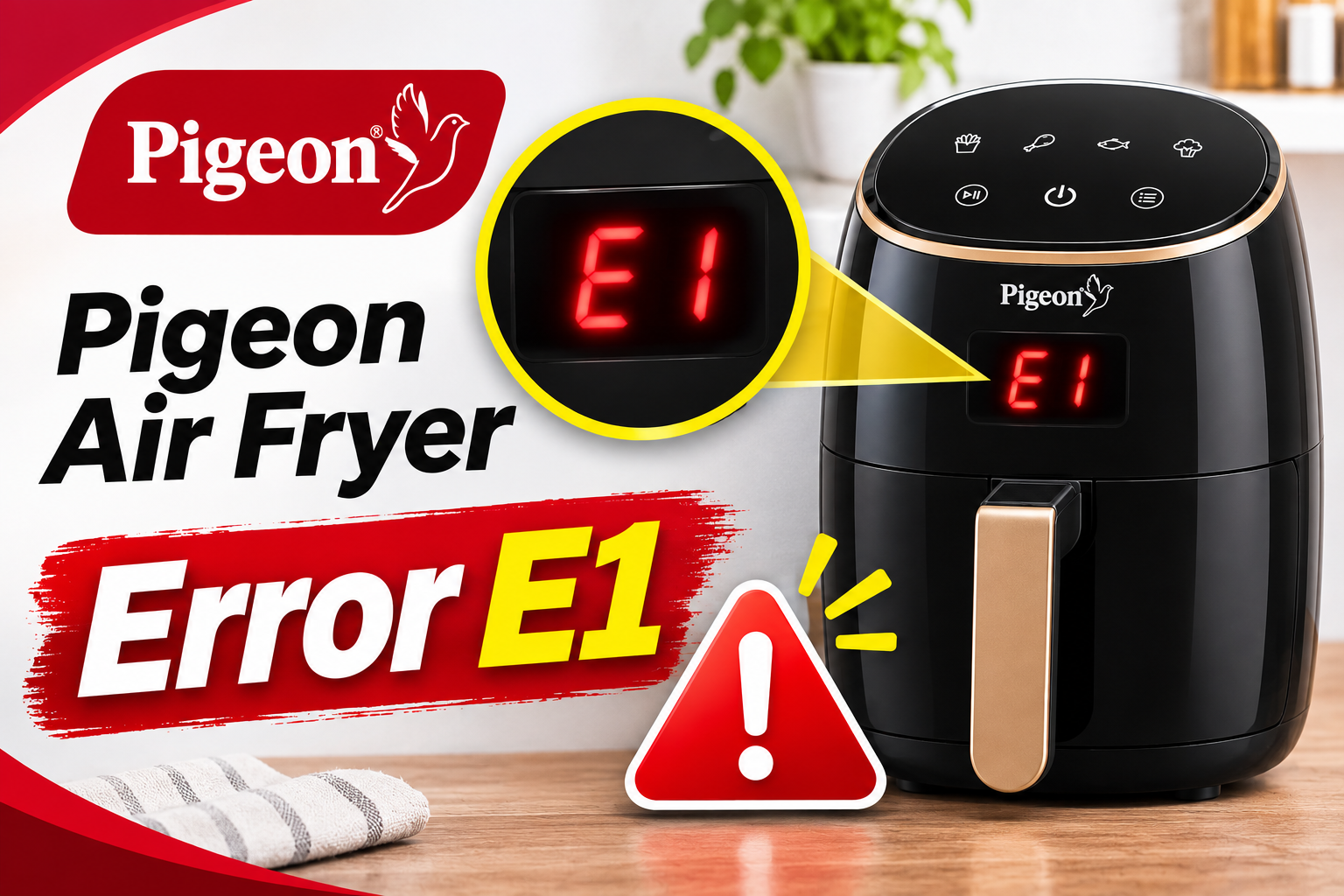
The E1 error on a Pigeon Air Fryer may indicate a problem with its temperature sensing system or electronic controls. However, Pigeon has not published a universal E1 code definition covering all its air fryer models. Therefore, the exact meaning should be confirmed using your model’s instructions or the manufacturer’s support service.
Digital air fryers use temperature sensors to monitor heat inside the cooking chamber. These sensors send information to the electronic control board, which uses the readings to regulate the heating element. If the system cannot obtain reliable temperature information, the appliance may display an error and interrupt cooking.
Temperature sensing faults are associated with E1 on several other air fryer brands. For instance, some manufacturers use this code to identify a disconnected temperature sensor. That makes sensor failure a reasonable possibility to investigate, although it doesn’t confirm the same diagnosis for every Pigeon model.
You may notice E1 immediately after switching on the air fryer or while preparing food. Depending on the model and fault, the heating element may stop working, the control buttons may become unresponsive, or the appliance may refuse to begin another cooking cycle.
It’s also worth checking which Pigeon Air Fryer you own. Models such as the Healthifry Digital have electronic displays, while manual models use physical temperature and timer knobs. A model without a digital display cannot show an E1 warning, so its troubleshooting requirements will be different.
If the error remains visible, avoid forcing the appliance to continue cooking. A persistent temperature sensing fault could prevent the control system from regulating heat correctly.
Pigeon Air Fryer Error E1: Likely Causes
Several problems can affect an air fryer’s temperature monitoring and electronic controls. While an internal sensor fault is one possibility, other conditions may produce similar operating symptoms.
1. Faulty Temperature Sensor
A defective temperature sensor is one possible explanation for the E1 error.
Most electronically controlled air fryers use a temperature sensing component called a thermistor. This component changes its electrical resistance as the surrounding temperature changes, allowing the control board to monitor heat.
If the thermistor becomes defective, its electrical readings may fall outside the expected range. The control system could interpret this as a fault and prevent the air fryer from operating normally.
Sensor failures can develop because of component deterioration, physical damage, or other electrical problems. However, a specific sensor failure cannot be confirmed simply by seeing E1 on the display.
One possible clue is an error that appears immediately after powering on the appliance, even when the cooking chamber is completely cool.
Another is a warning that returns consistently after the air fryer has been unplugged and restarted. If ordinary troubleshooting doesn’t change the behavior, an internal sensing problem becomes more likely.
Confirming the fault requires professional testing. Replacing the sensor without diagnosis could be ineffective if the problem actually involves its wiring or control circuit.
2. Loose or Damaged Sensor Wiring
Your air fryer’s temperature sensor depends on electrical connections to communicate with the control board. A damaged wire or unreliable connector can interrupt that communication.
For example, a functioning sensor may send an incorrect or incomplete signal if one of its wires becomes disconnected. The control board may then detect an electrical fault even though the sensing component itself is still working.
Heat exposure, physical damage, or deterioration of electrical connections can contribute to wiring problems in appliances.
These faults may produce symptoms similar to those of a defective temperature sensor. The air fryer might show E1 immediately after starting, or the warning may appear intermittently.
If the error appeared after the appliance was dropped or suffered another impact, internal connection damage is another possibility worth mentioning to a repair technician.
However, don’t attempt to open the air fryer and reconnect its internal wiring yourself. The appliance contains electrical components that can create a shock or fire risk if handled incorrectly.
3. Defective Electronic Control Board
The electronic control board manages several important air fryer functions, including cooking settings, heating regulation, and information displayed on the control panel.
When the board receives a temperature reading, it processes that information and controls the heating system accordingly.
If a component within the board fails, the appliance may be unable to interpret sensor readings correctly. Depending on the model, this could result in an error message, interrupted cooking, or unresponsive controls.
Electrical faults, damaged circuit components, and other internal defects can affect the board’s operation.
You might suspect a control system problem if the display behaves unpredictably, the appliance switches off unexpectedly, or E1 continues appearing after the basic checks have been completed.
Still, these symptoms don’t prove that the entire board needs replacement. A sensor or electrical connection problem could produce similar behavior.
A technician should examine the relevant components before recommending an expensive repair.
4. Excessive Heat or Restricted Airflow
Air fryers produce considerable heat while cooking, so proper airflow is essential for normal operation.
The appliance uses a fan to circulate hot air through the cooking chamber. It also has ventilation openings that allow air to enter or leave the housing.
If those openings become blocked, heat may accumulate around internal components. Restricted airflow can contribute to overheating, unusual shutdowns, and poor cooking performance.
Placing an air fryer too close to a wall, covering its vents, or operating it near another heat source can interfere with ventilation.
Likewise, excessive grease buildup may contribute to airflow and heating problems.
However, restricted ventilation has not been confirmed as a universal cause of Pigeon E1 errors. It is a separate operating condition worth checking, especially if the warning appeared while the appliance was unusually hot.
A useful clue is whether the problem happens after prolonged cooking rather than immediately after switching on the appliance.
If the air fryer has been operating in a crowded kitchen space, check its placement and allow it to cool before attempting a restart.
Pigeon Air Fryer Error E1: DIY Fixes
Before considering replacement parts, there are several safe checks you can perform. These methods won’t repair a damaged sensor or control board, but they can help eliminate temporary problems and identify when professional attention is necessary.
1. Unplug the Air Fryer and Allow It to Cool
The first step is to disconnect the air fryer from electricity and allow it to cool naturally.
If the appliance has become unusually hot, switching it off prevents further heating while you inspect its operating conditions.
A power restart can also clear some temporary electronic errors. However, it won’t correct a sensor that has become permanently damaged or disconnected.
Follow these steps.
-
Switch off the air fryer using its power button, if it responds.
-
Unplug the power cord from the wall outlet.
-
Leave the appliance on a stable, heat resistant surface.
-
Allow it to cool completely. This may take 30 minutes or longer if it was recently operating.
-
Check that the exterior is dry and the ventilation openings are unobstructed.
-
Reconnect the appliance and observe the display.
If E1 disappears, the appliance may have recovered from a temporary operating problem.
However, a disappearing warning doesn’t necessarily prove that the underlying issue has been resolved.
If the error returns immediately or appears again during cooking, stop using the air fryer and arrange professional diagnosis.
Avoid repeatedly unplugging and reconnecting the appliance in an attempt to force the warning to disappear.
2. Check the Air Fryer’s Ventilation
Poor placement can expose your air fryer to unnecessary heat, especially when it’s surrounded by other kitchen appliances.
Pigeon air fryers need adequate space around their ventilation openings. If the vents are blocked, the appliance may struggle to release heat from its housing.
Begin by examining where the air fryer normally sits.
Make sure its ventilation openings aren’t pressed against a wall, covered by objects, or blocked by kitchen equipment. Keep it away from curtains, towels, and other materials that could interfere with airflow.
Place the appliance on a flat, stable, heat resistant countertop. Follow the clearance instructions in your model’s manual rather than assuming that all Pigeon models require the same amount of space.
It’s also sensible to avoid positioning the air fryer immediately beside an operating gas burner or another strong heat source.
Once the appliance has cooled, check the external vents for visible dust or grease.
You can remove loose surface dirt with a soft, dry cloth or brush. Don’t insert objects through the ventilation openings or pour cleaning liquid into them.
If the warning was accompanied by overheating symptoms, improved ventilation may help prevent the same operating conditions from recurring.
However, if E1 persists despite proper placement, restricted airflow is unlikely to be the only problem.
3. Clean the Basket and Remove Excess Grease
Grease and food residue can accumulate inside an air fryer after repeated cooking sessions.
This is especially noticeable when preparing fatty foods such as chicken wings, sausages, or marinated meat. As the fat heats up, some of it may collect underneath the cooking basket.
Over time, leftover grease can produce unpleasant smells, smoke, and additional cleaning problems.
Although grease buildup isn’t an established direct cause of Pigeon E1 errors, keeping the cooking chamber clean can help prevent other overheating and performance issues.
Start by unplugging the appliance and allowing it to cool completely.
Remove the cooking basket and any removable tray or separator. Wash these parts using warm water, mild dish soap, and a soft sponge, following your model’s cleaning instructions.
Avoid steel wool and harsh cleaning tools that could damage the nonstick coating.
For stubborn grease, allow the removable parts to soak briefly in warm, soapy water before cleaning them gently.
Wipe accessible interior surfaces with a slightly damp cloth, taking care to keep moisture away from electrical openings.
Don’t immerse the main air fryer body in water or spray cleaning liquid into the fan, heating assembly, or electronic controls.
Allow all cleaned components to dry completely before reinstalling them.
Once everything is clean, place the basket back into its normal position.
If E1 continues appearing, further cleaning is unlikely to solve an internal electrical fault.
4. Check the Power Supply and Basket Position
A poor power connection can cause operating problems that may appear alongside an error message.
Although a faulty outlet isn’t a confirmed cause of E1, checking the power supply helps rule out other reasons the air fryer might behave unexpectedly.
Begin by unplugging the appliance and examining its power cord.
Look for cracked insulation, discoloration, damaged plug pins, or signs of overheating.
If you notice any damage, don’t reconnect the air fryer. A damaged power cord should be examined or replaced through an appropriate service provider.
If the cord appears normal, verify that the wall outlet works properly using another suitable household appliance.
You can also connect the air fryer directly to another compatible, properly grounded outlet.
Avoid using overloaded extension boards or adapters that aren’t rated for the appliance’s electrical requirements.
Next, examine the cooking basket.
Some air fryers have safety switches that prevent operation when the basket isn’t positioned correctly. If your Pigeon model uses this feature, a poorly seated basket may stop a cooking cycle from starting.
Remove the basket after the appliance has cooled, check for trapped food around its edges, and slide it firmly back into place without forcing it.
A basket problem generally produces a failure to start rather than proving a temperature sensor fault.
If the appliance powers up but continues displaying E1, don’t assume the power supply or basket is responsible.
5. Verify the Model Number and Test the Controls
Pigeon manufactures different air fryer models, including Healthifry Digital, Healthifry Plus, and IVO Healthifry versions.
These appliances may differ in their electronic controls, heating capacity, operating features, and error handling.
Therefore, the correct troubleshooting procedure depends partly on the specific model you own.
To identify yours, check the product label on the appliance. The model or product number is usually printed on a sticker attached to the body.
Unplug the air fryer and make sure it’s cool before lifting or turning it to inspect the label.
You can then compare the model information with the user manual or the manufacturer’s support documentation.
If your air fryer uses a digital display, pay attention to exactly what appears on the screen.
For example, distinguish E1 from other error codes or ordinary temperature and timer readings.
If the screen displays E1 immediately after power is connected, the problem may involve the appliance’s internal monitoring system.
If the warning appears only after cooking begins, note how long the appliance operates before shutting down and whether you notice unusual heat, noises, or smells.
Once the appliance is cool, dry, correctly assembled, and connected to a suitable outlet, you can perform one normal restart.
If the error has cleared, confirm that the controls respond as described in the manual before using the appliance again.
However, don’t bypass safety switches, disconnect sensors, or operate the appliance with internal components exposed.
If the display continues showing E1, further attempts to operate the air fryer are unlikely to provide useful information.
6. Contact Pigeon Customer Support or a Qualified Technician
If E1 remains after the basic troubleshooting steps, professional diagnosis is the safest solution.
A technician can determine whether the warning is related to a defective temperature sensor, damaged wiring, or an electronic control problem.
These internal components require appropriate testing equipment and knowledge of the appliance’s electrical design.
Replacing parts without confirming the fault can waste money and may introduce additional safety problems.
Before requesting service, gather the following information.
-
Model number: The exact model or product code printed on your air fryer.
-
Serial number: The identification number shown on the appliance label, where available.
-
Error code: The warning displayed on the control panel.
-
Operating symptoms: Whether the appliance refuses to start, stops heating, or shuts down during cooking.
-
Recent events: Any unusual overheating, power interruption, physical damage, or exposure to moisture.
-
Troubleshooting completed: The checks you’ve already performed and whether the error changed.
These details can help the service team understand the problem and determine the appropriate next steps.
For Pigeon appliances manufactured by Stove Kraft Limited, customer support is available through its official service channels. The company lists +91 63649 14202 as its service support number in India.
You can also contact the company through its customer care email at customercare@stovekraft.com.
If the air fryer is still under warranty, check the applicable terms before arranging repairs.
Several Pigeon air fryer models are advertised with a two year product warranty covering qualifying manufacturing defects, although the exact coverage depends on the model and warranty conditions.
Avoid opening the housing or arranging unauthorized internal repairs before confirming your warranty options.
If the appliance is no longer covered, ask for a repair estimate before agreeing to replacement parts.
A faulty sensor or connection may be less expensive to repair than an entire control board, depending on the model and availability of genuine components.
However, if the estimated repair cost approaches the price of a replacement appliance, purchasing a new air fryer may be the more practical choice.
Wrapping Up
Pigeon Air Fryer error E1 may indicate a temperature sensing or electronic control problem, although its exact meaning depends on the model. Basic checks such as allowing the appliance to cool, confirming proper ventilation, cleaning accessible parts, and restarting it once can help rule out temporary operating issues.
If the warning continues, avoid repeatedly using the appliance or attempting internal electrical repairs. Contact Pigeon support or a qualified technician for an accurate diagnosis. Addressing the fault early can help prevent further damage and ensure your air fryer is safe to use again.