Seeing the 7-4 error code on your KitchenAid dishwasher can be frustrating, especially when the appliance suddenly stops washing properly. You may notice food particles left on dishes, unusual pump sounds, or water that doesn’t circulate as strongly as it should.
Fortunately, the problem may be caused by accumulated food debris rather than a damaged motor. Understanding what the code means and checking the accessible parts of your dishwasher can help you identify the issue and determine whether professional repairs are necessary.
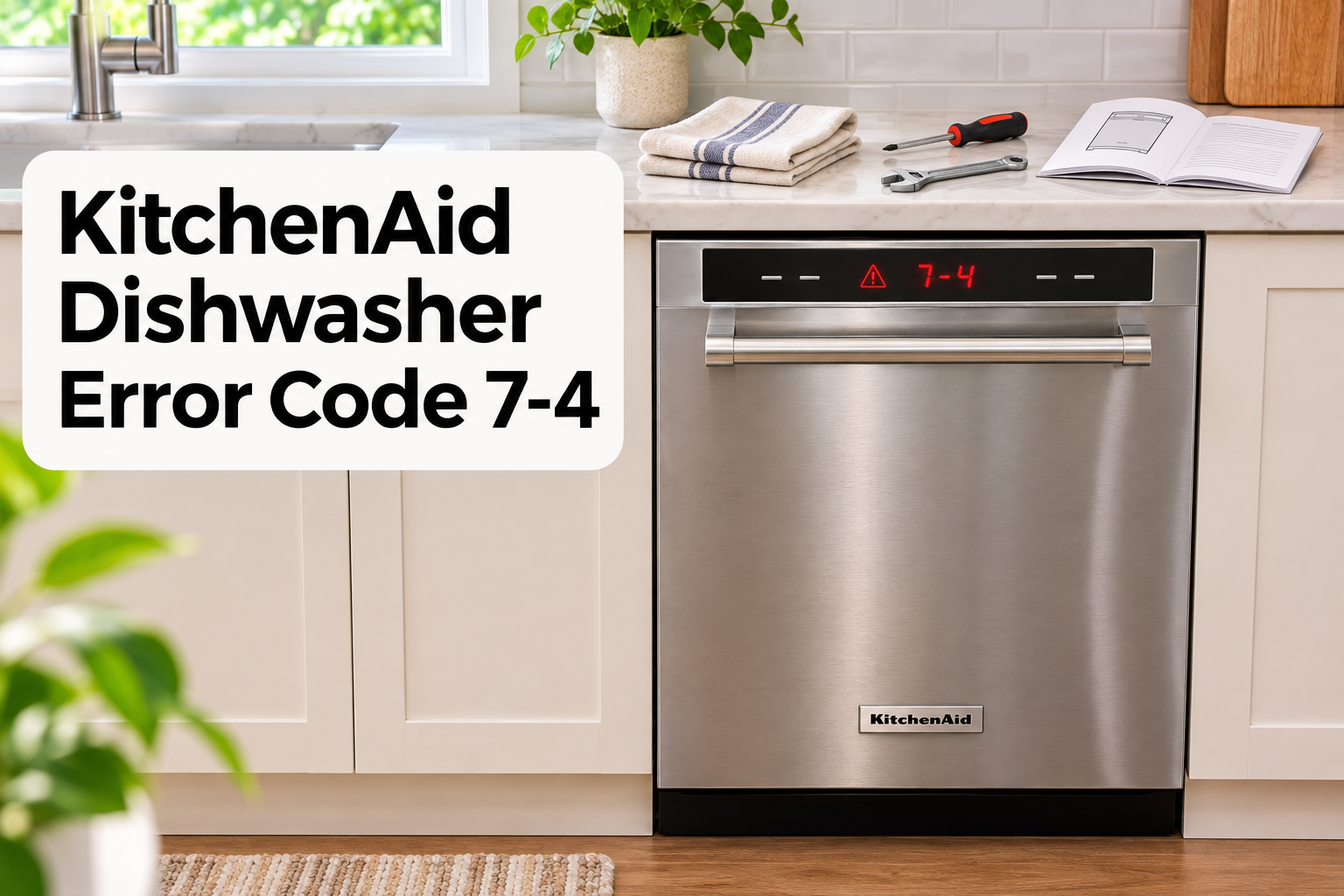
What Does the KitchenAid Dishwasher Error Code 7-4 Mean?
The KitchenAid dishwasher error code 7-4, also written as F7E4, indicates a plugged RIF filter on certain KitchenAid dishwashers equipped with a microfiltration washing system.
RIF refers to the dishwasher’s rotating internal filter system. This system separates food particles from wash water so the appliance can circulate cleaner water through the spray arms.
During normal operation, water passes through the filtration system before the circulation pump sends it back to the spray arms. Food particles remain in the filter housing and are eventually carried away during draining.
When the internal filter becomes restricted by accumulated debris, water cannot move through the system as intended. The dishwasher’s electronic control may detect the resulting change in wash motor performance and record the 7-4 fault.
You might notice dishes coming out dirty, weak water circulation, or unusual washing sounds. Some dishwashers may also experience draining problems, although the 7-4 code specifically identifies a filter restriction on the models covered by KitchenAid’s microfiltration service documentation.
An important distinction is that the RIF filter isn’t the same as the removable filter found in many older dishwashers. On affected microfiltration models, the main internal filter is part of the pump and filtration assembly and isn’t intended for routine removal by the owner.
Also, KitchenAid uses different error code systems across dishwasher generations. Confirm that F7E4 has this meaning for your particular model before attempting repairs.
KitchenAid Dishwasher Error Code 7-4: Common Causes
The 7-4 error is primarily associated with restricted filtration, but several conditions can contribute to the blockage. Identifying what’s collecting inside the system can help you choose the appropriate cleaning method.
1. Excessive Food Debris in the Filter System
Food particles accumulating inside the dishwasher’s filtration system are a leading cause of the 7-4 error.
Although KitchenAid’s microfiltration system is designed to separate and remove food particles, heavy debris buildup can eventually restrict the internal filter.
This may happen when plates containing large pieces of food are repeatedly loaded without scraping them first. Rice, pasta, vegetable scraps, and other food remains can collect around the filtration area.
Over time, excessive food particles may interfere with water movement through the filter assembly.
You might notice small food particles remaining on washed dishes or an unpleasant smell coming from the dishwasher. Cleaning performance may also gradually worsen before the fault appears.
However, the presence of ordinary food residue doesn’t automatically mean the internal filter is blocked. The code and additional symptoms should guide your diagnosis.
2. Grease and Hardened Food Residue
Grease and sticky food residue can contribute to restrictions within the dishwasher’s filtration system.
When greasy cookware and heavily soiled dishes are washed repeatedly, some residue may accumulate around the filter housing, particularly if the appliance isn’t cleaned regularly.
Over time, deposits can become harder to remove. They may also trap smaller food particles, creating a thicker buildup that interferes with normal water circulation.
You may notice an oily film inside the dishwasher, unpleasant odors, or residue collecting around the bottom of the tub.
These symptoms suggest that the dishwasher needs cleaning, although they don’t confirm a blocked internal filter by themselves.
A dishwasher cleaning cycle may help remove grease and detergent residue from accessible and internal surfaces. However, heavily compacted debris may require direct access to the filter assembly.
3. Hard Water Mineral Buildup
Hard water contains dissolved minerals, mainly calcium and magnesium, that can leave deposits on dishwasher components.
These minerals can gradually accumulate inside the tub, on spray arms, and around water passages.
If deposits form within the filtration system, they may contribute to restricted water movement. KitchenAid’s service documentation also recognizes hard water buildup as a possible contributor to filtration and washing problems.
One recognizable clue is a chalky white coating on the dishwasher walls or spray arms. Glasses may also come out cloudy or covered in spots.
However, white residue doesn’t automatically confirm the 7-4 error. Hard water deposits can affect washing performance without completely blocking the internal filter.
If your home has hard water, regular dishwasher cleaning and appropriate water treatment can help reduce future mineral accumulation.
4. Foreign Objects Entering the Filter Area
Small objects accidentally left on dishes can sometimes enter the bottom of the dishwasher.
Examples include fruit pits, toothpicks, broken glass, plastic fragments, and small pieces of food packaging.
These objects may become trapped around the coarse filter or other parts of the water circulation system.
If an object reaches an area where it interferes with normal water movement, the resulting restriction may contribute to poor circulation or filtration problems.
You might notice rattling, clicking, or grinding sounds during washing. However, these noises can also indicate problems with the spray arms or pump.
Avoid reaching into concealed openings to search for trapped objects. Broken glass and sharp fragments can cause injuries, while some parts of the filtration assembly aren’t designed for owner access.
5. Damaged Internal Filter or Pump Assembly
Sometimes, the 7-4 error continues even after the dishwasher has been cleaned and visible debris has been removed.
On affected KitchenAid models, the rotating filter operates as part of the wash motor and sump assembly. Damage or mechanical problems within this assembly can interfere with filtration and water circulation.
For example, a damaged internal component may prevent the system from moving or filtering water correctly.
You might notice persistent weak spray pressure, unusual pump sounds, or repeated error codes despite normal water filling.
KitchenAid’s technical guidance recommends checking the filter first and then testing the wash motor and related assembly when the fault continues.
However, a damaged motor shouldn’t be assumed simply because the dishwasher displays F7E4. Professional testing is needed before replacing expensive components.
KitchenAid Dishwasher Error Code 7-4: How to Fix
Begin by checking the parts you can safely reach inside the dishwasher. The goal is to remove visible debris, reduce buildup, and determine whether the internal filter restriction requires professional attention.
1. Remove Food Debris From the Bottom of the Dishwasher
Start by cleaning the accessible area at the bottom of the dishwasher.
First, cancel the current cycle and allow the appliance to stop completely. Disconnect the dishwasher from its electrical supply before handling components in the filtration area.
Next, remove the lower dish rack to expose the bottom of the tub.
Follow these steps.
- Inspect the bottom of the dishwasher for accumulated food particles.
- Carefully remove visible scraps, labels, and other loose debris.
- Check the coarse filter or protective screen for trapped food.
- Wipe accessible surfaces using a soft damp cloth.
- Remove any loose residue without pushing it into the filter openings.
Be particularly careful if you suspect broken glass or sharp objects. Use suitable protection and avoid reaching into hidden openings.
On KitchenAid microfiltration dishwashers, the visible coarse filter may be the only filtration component accessible from inside the tub.
Cleaning this area can prevent additional debris from entering the system. However, it may not remove a blockage already trapped inside the RIF filter.
If you cannot safely reach the suspected blockage, don’t attempt to dismantle the internal filter assembly.
2. Clean the Removable Filter if Your Model Has One
KitchenAid dishwashers use different filtration systems, so the filter cleaning procedure depends on your model.
Some models have removable upper and lower filters that owners can clean. Others use an internal microfiltration system without a conventional removable filter cup.
Check your owner’s manual before attempting to remove any filtration components.
If your model has a removable filter, follow these general steps.
- Disconnect power and remove the lower dish rack.
- Locate the filter assembly at the bottom of the tub.
- Turn the upper filter counterclockwise if your model uses a twist-lock design.
- Lift out the filter according to the manufacturer’s instructions.
- Rinse it under warm running water.
- Use a soft brush to remove stubborn deposits.
- Reinstall every filter component securely before operating the dishwasher.
Avoid using wire brushes, sharp tools, or abrasive cleaning pads because they can damage the filter surfaces.
Once the filter is clean, check that it locks properly into position.
Never operate your dishwasher with a required filter removed. Doing so can allow debris to enter the pump and cause further damage.
If your model has a sealed microfiltration system, don’t force the coarse screen or internal components out of position. A technician may need to access the RIF filter from beneath the dishwasher.
3. Run a Dishwasher Cleaning Cycle
If grease, detergent residue, or mineral buildup is contributing to the problem, cleaning the dishwasher interior may help.
KitchenAid recommends regular interior cleaning to reduce residue buildup and maintain washing performance.
You can use a dishwasher cleaning product approved for your appliance, such as affresh Dishwasher Cleaner.
For a typical empty cleaning cycle, follow these steps.
- Remove all dishes and utensils.
- Check that visible food debris has been cleared from the tub.
- Place the dishwasher cleaner in the location specified on its packaging.
- Select the recommended wash cycle.
- Run the dishwasher without adding regular detergent unless the cleaner’s instructions specifically require it.
- Inspect the interior after the cycle finishes.
KitchenAid’s guidance allows one affresh dishwasher cleaning tablet in the detergent dispenser for an empty normal cleaning cycle.
Cleaning products may help remove deposits from the tub, circulation hoses, and other areas that water reaches during washing.
However, a cleaning cycle isn’t guaranteed to clear a heavily blocked RIF filter. If the dishwasher cannot circulate water normally or repeatedly stops with the same fault, further cleaning cycles may accomplish little.
Avoid pouring drain cleaners, strong chemicals, or large quantities of household cleaning products into the dishwasher. These substances can damage components and create safety hazards.
4. Inspect the Spray Arms and Correct Dish Loading
Although blocked spray arms aren’t the specific fault identified by F7E4, they can cause poor cleaning and make a filtration problem harder to evaluate.
With the dishwasher stopped and the racks accessible, check whether the spray arms rotate freely.
Gently turn each accessible spray arm by hand. If an arm hits a plate, pot handle, or utensil, rearrange the dishes to provide enough clearance.
Next, inspect the spray holes for visible food particles or mineral deposits.
If your owner’s manual permits spray arm removal, clean the affected arm according to those instructions. Otherwise, gently wipe accessible surfaces without forcing tools into the openings.
Pay attention to how you load your dishwasher as well.
Scrape large food scraps from plates before loading them. There’s usually no need to rinse away every trace of food, but removing large pieces helps reduce the amount of debris entering the filtration system.
Also, place bowls and cups with their openings facing downward so they don’t collect wash water.
When the spray arms move freely and dishes are correctly arranged, run a normal washing cycle and observe the results.
If cleaning performance improves but the 7-4 code remains, the internal filter may still need attention.
5. Check for Drainage Problems
A clogged internal filter can sometimes occur alongside a drainage problem.
On certain KitchenAid models, the F9E1 error code indicates a draining fault, while F7E4 points to the RIF filter.
If both codes appear, the technician may need to investigate the filtration system and drainage components together.
You can begin with a few safe checks.
First, inspect the bottom of the dishwasher after the cycle ends. A small amount of water remaining in the sump or filter area may be normal, depending on the model.
However, water covering a large portion of the tub floor after a completed drain cycle suggests a possible drainage problem.
Next, check the dishwasher’s accessible drain hose beneath the kitchen sink.
Look for visible kinks, crushing, or sharp bends that could restrict water flow.
If the dishwasher drains into a garbage disposal, check whether the disposal is operating properly. On newly installed systems, an unopened disposal inlet can also prevent drainage.
Don’t disconnect hoses, remove the drain pump, or reach into concealed plumbing openings without the necessary experience.
If standing water remains after a drain attempt, stop running additional wash cycles until the cause has been identified.
Correcting a separate drainage problem may improve operation, but it doesn’t automatically mean the internal RIF filter is clear.
6. Reset the Dishwasher and Test Its Operation
After cleaning the accessible filter area and correcting any visible problems, you can restart the dishwasher to check whether normal operation has returned.
A power reset can clear some temporary electronic problems. However, it won’t physically remove food debris or repair a damaged pump.
For a basic reset, follow these steps.
- Press Cancel/Drain if a wash cycle is still active.
- Allow the dishwasher to finish any draining operation.
- Unplug the appliance if its plug is safely accessible.
- If the dishwasher is permanently wired, turn off its dedicated circuit breaker instead.
- Leave the power disconnected for at least 30 seconds.
- Restore power and select a normal wash cycle.
Make sure all required filter components are correctly installed before starting the test.
During operation, listen for normal washing sounds and check whether water appears to circulate through the spray arms.
You can also inspect the dishes after the cycle to see whether cleaning performance has improved.
If the cycle finishes normally, continue monitoring the dishwasher over the next few uses.
However, some models retain previous fault codes in their diagnostic history. A stored F7E4 code doesn’t necessarily mean the blockage is still present.
If the dishwasher repeatedly records a new 7-4 fault, the internal filtration system may still be restricted.
7. Contact a Qualified Appliance Technician
If the error continues after the accessible cleaning and troubleshooting steps, contact a qualified appliance repair technician.
This is particularly important for KitchenAid models with an internal rotating filter that cannot be removed from inside the tub.
KitchenAid’s service procedure for F7E4 involves inspecting the RIF filter assembly and removing accumulated soil. This may require removing the drain pump to access and inspect the internal filter.
The procedure also calls for checking wash motor operation and performing electrical tests when the problem persists.
These tasks involve internal components and should be handled by a trained technician.
A technician can determine whether the filter needs cleaning, whether an internal component is damaged, or whether the motor and sump assembly requires replacement.
Before arranging service, record your dishwasher’s model number, the displayed fault code, and any related symptoms.
Also, mention whether you’ve noticed unusual pump sounds, standing water, or poor cleaning performance.
If you notice a burning smell, electrical problems, or water leaking near electrical components, stop using the dishwasher and arrange service immediately.
Wrap-Up
The KitchenAid dishwasher 7-4 error code generally indicates a plugged internal RIF filter on models equipped with the relevant microfiltration system. Food debris, grease, mineral deposits, and foreign objects can contribute to restrictions that affect water circulation.
Start by removing visible debris, cleaning any owner-accessible filters, and running an appropriate dishwasher cleaning cycle. Also, check the spray arms and look for drainage problems. If the error persists, a qualified technician can inspect the internal filter and pump assembly to identify the exact cause and carry out the necessary repair.