Seeing the F6E1 error code on your KitchenAid wall oven can be concerning, especially when the appliance becomes unusually hot or stops working during cooking. You may also notice that the oven continues heating beyond the selected temperature or refuses to start another cycle.
This error generally indicates an overheating problem or an incorrect temperature reading. Understanding what triggers it can help you identify the possible causes, take the right safety precautions, and determine which repairs are necessary.
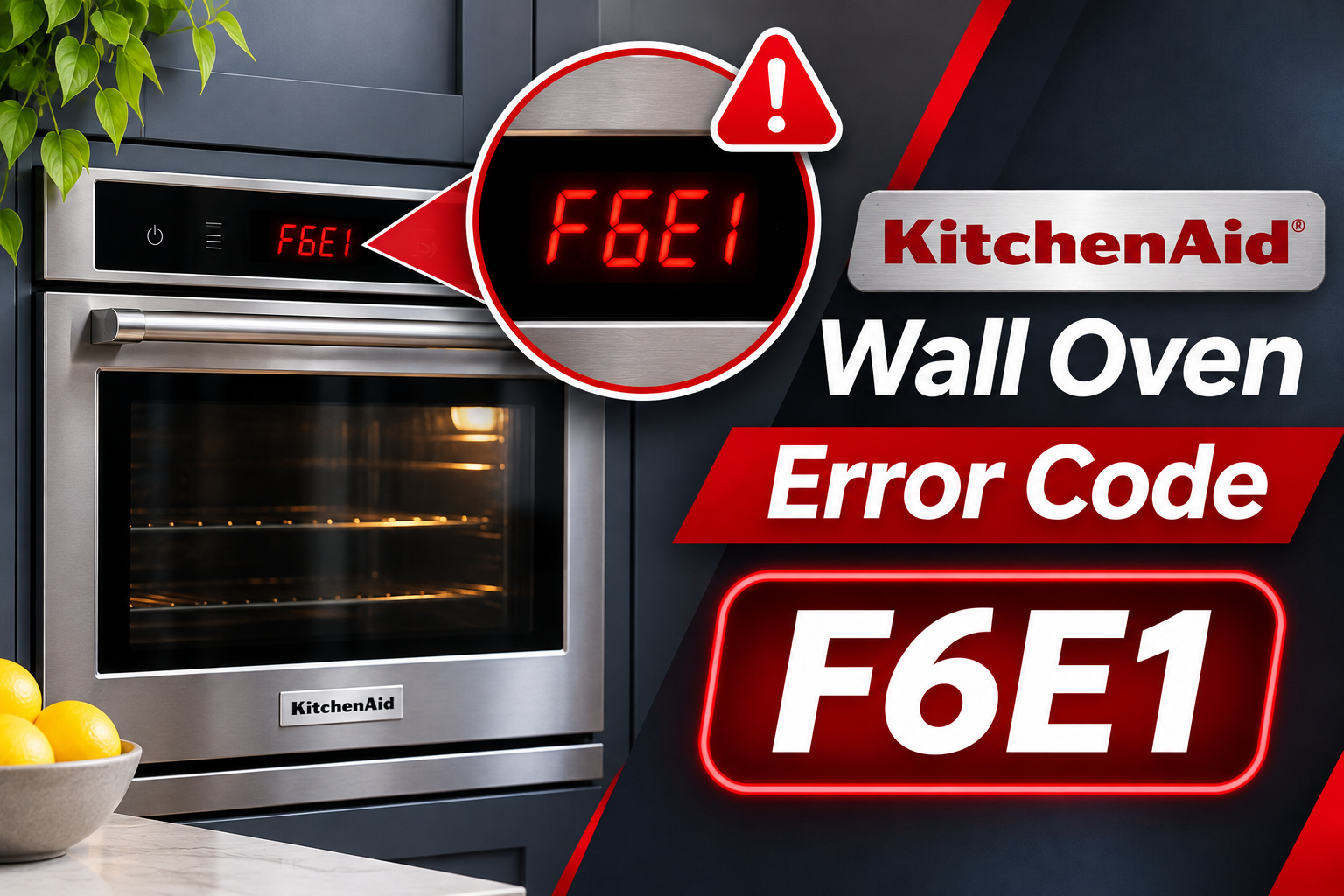
What Does Error Code F6E1 Mean on a KitchenAid Wall Oven?
KitchenAid wall oven error code F6E1 indicates an oven overtemperature condition. On certain models, the electronic control displays this error when it detects a temperature above 601°F (316°C) outside the self-cleaning cycle.
Your oven uses a temperature sensor to monitor heat inside the cooking compartment. The sensor sends information to the electronic control board, which manages the heating elements to maintain the selected cooking temperature.
When the control detects an excessively high temperature, it may stop normal cooking functions and display F6E1. On some models, the affected oven cavity remains locked out until the control detects that the temperature has dropped below its specified limit.
However, F6E1 doesn’t always mean the oven is physically overheating. A damaged temperature sensor or faulty wiring can send incorrect information to the control board, making it register an extremely high temperature even when the appliance is cool.
The error is different from the overheating codes used for self-cleaning on certain models, such as F6E2. Because error definitions vary by model, check your oven’s technical documentation before replacing components.
KitchenAid Wall Oven Error Code F6E1 [FIXED]: Common Causes
Several problems can cause your KitchenAid wall oven to display F6E1. The most relevant involve the temperature sensor, its electrical connections, the heating circuit, and the electronic control board.
1. Faulty Oven Temperature Sensor
A defective oven temperature sensor is one possible cause of F6E1. This component measures the temperature inside the oven and provides the electronic control board with information needed to regulate heating.
Most affected KitchenAid electric wall ovens use a resistance temperature detector, commonly called an RTD sensor. Its electrical resistance changes as the temperature changes, allowing the control board to estimate how hot the oven is.
If the sensor develops an internal fault, it may produce a resistance reading that doesn’t match the actual temperature. Consequently, the control board may interpret the signal as an overheating condition.
For example, your oven might display F6E1 even though it hasn’t been used recently and feels completely cool. This can happen when the sensor reports an abnormally high temperature.
On certain KitchenAid models, the service specifications indicate that the temperature sensor should measure approximately 1,000 to 1,200 ohms at room temperature. However, the correct values depend on the sensor design and model.
A technician can compare the sensor’s resistance with the manufacturer’s specifications. If the readings fall outside the expected range, replacing the sensor may resolve the error.
2. Loose or Damaged Temperature Sensor Wiring
The temperature sensor communicates with the electronic control board through a wiring harness. If this connection becomes loose or damaged, the control may receive incorrect temperature information.
A poorly seated connector, broken wire, corroded terminal, or damaged insulation can interfere with the sensor signal. In some cases, a wiring fault may produce a reading that suggests the oven is much hotter than it actually is.
The problem may appear intermittently, particularly when electrical connections expand and contract as the oven heats and cools. However, inconsistent errors can also result from a defective sensor or control board.
You may notice that F6E1 appears shortly after switching on the oven, even before it has reached a normal cooking temperature.
KitchenAid’s service procedures include checking the sensor wiring and control board connections before replacing major components. Because these connections are inside the appliance, inspection and electrical testing should be handled by a qualified technician.
3. Faulty Electronic Control Board
The electronic control board manages your KitchenAid wall oven’s heating functions. It receives information from the temperature sensor and controls when the heating elements should operate.
During normal cooking, the board cycles the heating elements to maintain the selected temperature. If part of the control circuitry fails, it may no longer regulate heating correctly.
One possible fault involves a heating relay that remains closed when it should switch off. This can allow a heating element to continue receiving electricity after the oven reaches its selected temperature.
As a result, the oven may become excessively hot and eventually display F6E1. In some cases, the heating element may remain energized even after you cancel the cooking cycle.
The control board can also develop problems when interpreting temperature sensor readings. This may cause an overheating error even without excessive heat inside the oven.
However, these failures require different diagnostic checks. A technician must determine whether the control board is misreading the sensor or incorrectly supplying power to the heating elements before replacing it.
4. Shorted Heating Element or Damaged Heating Circuit
A damaged heating element or related wiring can sometimes cause uncontrolled heating.
Your KitchenAid wall oven uses heating elements to generate heat during baking and broiling. Depending on the model, additional elements may support convection cooking.
If an element develops an electrical fault that creates an unintended path for current, it may receive power when it shouldn’t. Damaged wiring within the heating circuit can create a similar problem.
You might notice that the oven continues producing heat after a cooking cycle has been canceled. In some cases, an element may remain visibly hot or begin heating unexpectedly.
However, a glowing element during normal broiling doesn’t indicate a fault by itself. The important warning sign is continued or unexpected heating when the element should be off.
KitchenAid’s technical procedures include checking for heating elements that receive unwanted electrical power and identifying whether the problem originates from the wiring or control board.
Because this condition can create a serious overheating hazard, professional diagnosis is necessary.
KitchenAid Wall Oven Error Code F6E1 [FIXED]: How to Fix
The appropriate solution depends on whether your oven is genuinely overheating or the control system is receiving an incorrect temperature reading. Start with safe checks that don’t require opening the appliance.
1. Turn Off the Oven and Allow It to Cool
When F6E1 appears, the first priority is to prevent further heating.
Press the Cancel or Off button to stop the active cooking function. If the oven is extremely hot, continues heating after cancellation, or produces smoke or a burning smell, disconnect electricity at the circuit breaker when it is safe to do so.
Don’t open the oven door unnecessarily while the cooking compartment is excessively hot. Opening it can release a sudden burst of hot air.
Allow the appliance to cool naturally. Depending on how hot the oven became, cooling may take considerable time.
Avoid touching the heating elements, oven walls, or nearby metal surfaces to check their temperature.
If the door remains locked, don’t force it open. Some KitchenAid models prevent access while the control detects an unsafe temperature.
Once the oven has cooled, observe whether the error remains on the display. If the appliance was clearly overheating, leave it disconnected until a technician has identified the cause.
2. Reset Your KitchenAid Wall Oven
If the oven is completely cool and there were no signs of uncontrolled heating, a power reset may clear a temporary control error.
KitchenAid commonly recommends disconnecting power for one minute when troubleshooting oven error codes.
Follow these steps.
- Make sure all cooking functions are canceled.
- Locate the circuit breaker supplying electricity to your KitchenAid wall oven.
- Switch off the appropriate breaker or breakers.
- Wait for one full minute.
- Restore electricity at the circuit breaker.
- Check whether F6E1 appears again.
If the display returns to normal, the reset may have cleared a temporary fault.
However, a successful reset doesn’t confirm that the oven’s temperature control system is working correctly. The error may return if the underlying problem involves damaged wiring, a faulty sensor, or a defective heating relay.
If F6E1 reappears while the oven is still cool, further diagnosis is needed.
Likewise, don’t attempt another cooking cycle if the oven previously continued heating after being switched off. A reset cannot repair a heating circuit that supplies power unexpectedly.
3. Check for Signs of Actual Overheating
Understanding whether the oven was genuinely overheating can help identify the source of F6E1.
After switching off the appliance and allowing it to cool, consider what happened before the error appeared.
For example, did the oven become unusually hot during baking, or did the code appear immediately after switching on an appliance that hadn’t been used for several hours?
These observations help distinguish a possible temperature sensing fault from a heating control problem.
Pay attention to the following warning signs.
- The oven became significantly hotter than expected during ordinary cooking.
- Food burned unusually quickly despite selecting a familiar temperature.
- A heating element appeared to remain energized after the cooking cycle was canceled.
- The oven continued producing heat after the controls were switched off.
- F6E1 appeared while the oven was cool and hadn’t recently been used.
If the oven continued heating after cancellation, disconnect power at the breaker and arrange professional service.
If the error appeared while the appliance was cool, the temperature sensor, wiring, or electronic control board may be providing an incorrect reading.
However, these observations aren’t enough to confirm the defective component.
Don’t attempt to reproduce uncontrolled overheating to identify the fault. A technician can use the oven’s diagnostic functions and electrical tests without exposing you to unnecessary danger.
4. Have the Oven Temperature Sensor Tested
If F6E1 appears while the oven is cool, the temperature sensor should be checked.
A qualified technician can inspect the sensor and measure its electrical resistance using the appropriate testing equipment.
The sensor is usually positioned inside the cooking compartment, often near the upper rear wall. Its exact location and accessibility depend on the oven model.
On certain KitchenAid wall ovens, a functioning sensor measures approximately 1,000 to 1,200 ohms at room temperature. The resistance increases as the sensor becomes hotter.
The technician compares the measured value with the specifications in your oven’s service documentation.
If the sensor reports an excessively high temperature while the oven is cool, it may be defective. However, damaged wiring can produce a similar reading, so the sensor should be tested separately from its harness when necessary.
If testing confirms a defective sensor, the technician can replace it with the correct part for your model.
After replacement, the oven’s temperature readings and heating operation should be checked to confirm that the fault has been corrected.
Avoid disconnecting or replacing the sensor yourself if doing so requires removing panels, accessing internal wiring, or handling electrical connections.
5. Inspect and Repair the Temperature Sensor Wiring
If the sensor itself is functioning correctly, damaged wiring between the sensor and control board may be causing the incorrect temperature reading.
A technician can inspect the wiring harness for loose connections, broken conductors, corrosion, or damaged insulation.
The inspection should focus on the connection points identified in the service information for your model.
For example, certain KitchenAid wall oven technical sheets identify connector P10 as part of the temperature sensor circuit. However, other models may use different connector arrangements.
The technician can compare resistance measurements at the sensor with readings taken through the wiring harness. If the readings differ significantly, the wiring or its connections may be responsible.
A loose connector may simply need to be secured properly. However, a damaged wiring harness generally requires replacement with an approved component.
KitchenAid service documentation for some models specifically instructs technicians to replace damaged harnesses rather than modifying them.
After the necessary repair, the technician should confirm that the electronic control receives accurate temperature information.
If the sensor and wiring both test correctly but F6E1 remains, the electronic control board or heating circuit may need further examination.
6. Have the Heating Elements and Control Board Checked
If your KitchenAid wall oven becomes excessively hot during cooking, the technician should investigate whether a heating element is receiving electricity when it shouldn’t.
This is particularly important if the oven continues heating after the selected temperature has been reached or after the cooking cycle has been canceled.
A qualified technician can inspect the heating elements for electrical faults and check the control circuitry responsible for switching them on and off.
Depending on the oven model, the diagnostic procedure may involve determining whether an element is receiving unwanted power because of a defective relay, damaged wiring, or a shorted component.
If testing identifies a faulty heating element, the correct replacement should be installed.
However, if the control board continues supplying electricity to an element when it should be off, the board may require replacement.
It’s important to confirm the diagnosis before purchasing parts because replacing a working element won’t correct a defective control board.
Similarly, installing a new control board won’t resolve a wiring fault that continues supplying unwanted electricity to a heating element.
Once the defective component has been replaced, the technician should check the oven’s temperature regulation and verify that the heating elements switch off as intended.
The appliance should also be checked for stored error codes and normal operation before being returned to service.
7. Contact a Qualified KitchenAid Appliance Technician
If F6E1 returns after the oven has cooled and been reset, professional diagnosis is the safest option.
The error can involve temperature sensing problems or uncontrolled heating, and these faults require different repairs.
A qualified appliance technician can inspect the temperature sensor, wiring harness, heating elements, and electronic control board using the service procedures for your oven model.
Seek professional assistance immediately if the oven continues heating after cancellation, produces smoke, or shows signs of electrical damage.
Before arranging service, gather your oven’s model number and note when the error appeared.
Explain whether the oven was unusually hot, whether the error appeared during baking or broiling, and whether it returned after a reset.
For double wall ovens, identify which cooking compartment displayed the problem.
This information can help the technician narrow down the fault and avoid replacing components unnecessarily.
If your oven is covered by a warranty, check the applicable terms before authorizing repairs.
Wrap-Up
KitchenAid wall oven error code F6E1 indicates an overheating condition or an incorrect temperature reading on affected models. A faulty temperature sensor, damaged wiring, defective control board, or heating circuit problem may be responsible.
If the error appears, stop using the oven and allow it to cool. A power reset may clear a temporary fault, but recurring errors require proper diagnosis.
Never continue using an oven that heats unexpectedly or fails to switch off. Identifying and repairing the defective component will help restore safe temperature control and reliable cooking performance.