Although E3 can indicate an internal fault, its exact meaning depends on your air fryer model. Understanding the possible causes and knowing which troubleshooting steps are safe can help you avoid unnecessary repairs and further damage.
What Does the E3 Error Mean on an Ambiano Air Fryer?
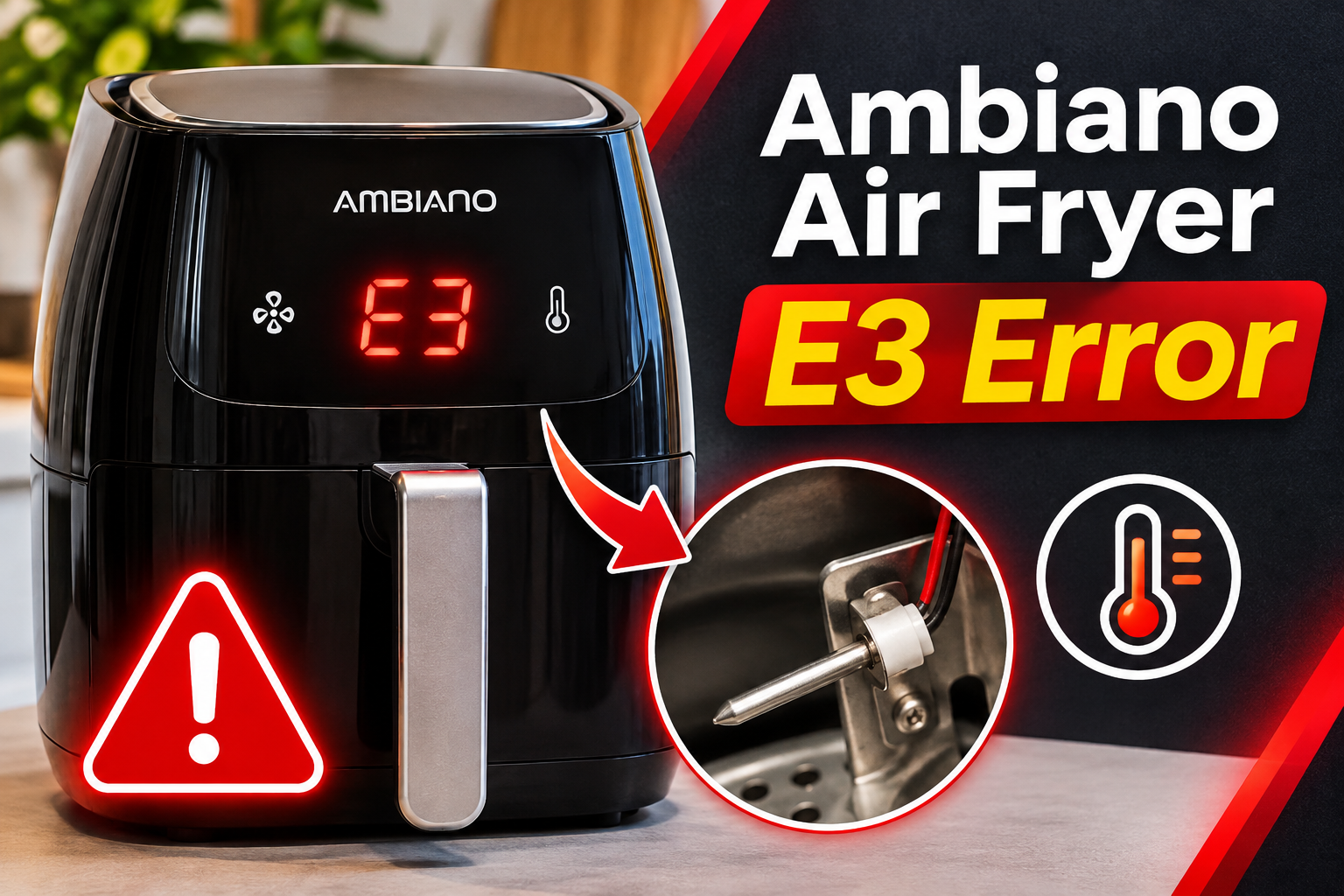
The E3 error code on an Ambiano air fryer indicates a problem that the appliance’s electronic control system has detected, but the exact fault varies between models. It may involve the temperature monitoring system, an electrical component, or another internal malfunction.
For example, the Ambiano GT-GAF-01 air fryer with grill identifies E1, E2, E3, and E4 as internal appliance errors. Its user manual recommends contacting the service center rather than attempting to repair the appliance yourself. Meanwhile, the Ambiano MD 18763 air fryer manual documents E1 and E2 as temperature sensor faults but doesn’t provide an E3 definition.
Manualzz+1
Your air fryer uses several electronic components to regulate cooking. The control board receives information from temperature sensors, processes your selected settings, and controls the heating element. If the board detects an electrical fault or receives information outside its expected range, it may interrupt operation and display an error code.
You might notice E3 appearing alongside other symptoms, including the heating element switching off, the cooking timer stopping, or the control buttons becoming unresponsive. However, these symptoms alone cannot identify the faulty part. Avoid using the appliance while the error remains displayed, especially if it has stopped heating unexpectedly or shows signs of overheating.
Ambiano Air Fryer E3 Error: Common Causes
Several faults can cause an air fryer’s electronic system to stop working and display an error. Since Ambiano models don’t all use the same error definitions, the following causes are possibilities that require confirmation rather than guaranteed explanations for E3.
1. A Faulty Temperature Sensor
The temperature sensor helps your Ambiano air fryer maintain the correct cooking temperature. Many electronic air fryers use an NTC thermistor, a small component whose electrical resistance changes as the surrounding temperature increases or decreases.
The control board interprets these resistance changes to determine how hot the appliance has become. If the sensor stops working or sends an abnormal reading, the board may interrupt heating to prevent unsafe operation.
Temperature sensors can deteriorate through repeated heating and cooling. Internal electrical damage may also prevent a sensor from communicating properly with the control board.
One possible clue is an error that appears shortly after the appliance starts heating. In other cases, the error may appear immediately when power is connected, especially if the sensor circuit has developed a permanent electrical fault.
However, a sensor fault isn’t a confirmed interpretation of E3 on every Ambiano model. A qualified technician must check the sensor against the manufacturer’s specifications to establish whether it’s responsible.
2. Loose or Damaged Internal Wiring
An electrical connection problem can interfere with communication between the various components inside your air fryer.
The temperature sensor, control board, and other electrical components depend on wires and connectors to function correctly. If a connection becomes loose or a wire deteriorates, the electronic system may receive incorrect information or lose an important signal.
Repeated temperature changes, mechanical stress, or physical damage can contribute to wiring faults. For example, an air fryer that has been dropped may develop internal connection problems even when its housing appears undamaged.
Sometimes, wiring faults are intermittent. Your appliance might work normally during one cooking session but develop an error during another. A damaged connection can also become unreliable as internal components heat up.
Nevertheless, this behavior doesn’t prove that a wire is broken. Similar symptoms can occur when a temperature sensor or electronic control board begins to fail.
Because the wiring is inside the appliance, inspecting and repairing these connections should be left to a qualified technician. Opening the housing can expose electrical components and create a shock hazard.
3. A Malfunctioning Electronic Control Board
The electronic control board serves as the main control center of your Ambiano air fryer. It processes information from sensors, controls heating, and responds to the cooking settings you select.
If an electronic component on the board becomes defective, the appliance may struggle to perform one or more of these functions. Depending on the model’s fault detection system, an internal control problem could result in E3.
Control board faults may develop because of component deterioration, electrical damage, or moisture entering the appliance. In some cases, you may notice that the display freezes, the buttons stop responding, or the air fryer shuts down unexpectedly.
However, these symptoms aren’t exclusive to control board failure. A faulty sensor or damaged electrical connection can produce similar behavior.
Replacing the control board without testing the other components may result in unnecessary expenses. Therefore, a technician should examine the relevant circuits and determine whether the board itself needs replacement.
4. Overheating or a Faulty Thermal Protection System
Air fryers generate considerable heat during normal cooking. To help prevent unsafe temperatures, they use temperature monitoring components and, depending on their design, thermal protection devices.
If an appliance becomes excessively hot, its protection system may interrupt heating. Some air fryer brands use E3 to indicate overheating, although this meaning hasn’t been established for every Ambiano model.
Blocked ventilation openings, insufficient clearance around the appliance, and excessive grease buildup can contribute to heat management problems. A malfunctioning cooling fan or temperature regulating component may also interfere with normal operation.
You might suspect an overheating problem if the appliance becomes unusually hot, stops during cooking, or produces an unexpected burning smell.
However, the E3 code alone doesn’t confirm overheating. The Ambiano GT-GAF-01 manual identifies E3 as an internal fault without assigning it specifically to excessive temperature.
If your air fryer has overheated or triggered a thermal safety device, don’t attempt to bypass that protection or force the appliance to continue cooking. Professional inspection may be necessary to determine why the problem occurred.
Ambiano Air Fryer E3 Error: How to Fix
The safest approach to an E3 error is to begin with simple checks that don’t require opening the appliance. These steps can help identify external operating problems, although they cannot repair a defective internal sensor, control board, or electrical connection.
1. Identify Your Ambiano Air Fryer Model
Before attempting any fix, check the model number of your air fryer and consult its user manual.
Ambiano sells several types of air fryers, including compact digital models, larger basket models, and appliances that combine air frying with grilling. These products can have different internal components and error code systems.
Start by switching off the appliance and disconnecting it from the electrical outlet. Once it has cooled completely, inspect the identification label, usually located underneath or at the back.
Look for the following information.
-
Model number
-
Product code
-
Serial number, if available
-
Manufacturer or distributor details
-
Electrical rating
With this information, find the corresponding user manual and check its troubleshooting section.
For instance, the GT-GAF-01 manual identifies E3 as an internal fault requiring service. If you own this model, the manufacturer’s recommended solution is to contact the service center instead of attempting further operation.
It’s also important to distinguish E3 from similar codes such as E1, E2, or E03. Their meanings may differ, and using instructions intended for another error can lead to an incorrect diagnosis.
If your manual doesn’t explain E3, contact the service provider listed in your product documentation.
2. Switch Off the Appliance and Allow It to Cool
If E3 appears while you’re cooking, stop using the appliance immediately.
Although E3 isn’t necessarily an overheating warning, allowing the air fryer to cool is a sensible safety precaution. It also gives you an opportunity to examine the exterior for any signs of damage.
Follow these steps.
-
Press the power or stop button if it responds.
-
Disconnect the plug from the wall outlet.
-
Keep the appliance on a stable, heat-resistant surface.
-
Allow it to cool completely without covering the ventilation openings.
-
Once cool, inspect the exterior, power cord, and accessible cooking compartment.
Pay attention to unusual smells, melted plastic, cracks, and discoloration around the housing.
If you noticed smoke, sparks, or a strong electrical burning smell before E3 appeared, leave the appliance unplugged.
Cooling may help with temporary heat related operating conditions, but it won’t repair an internal electrical fault. Therefore, the disappearance of E3 after cooling doesn’t automatically mean the problem has been resolved.
If your model’s manual instructs you to contact customer support when E3 appears, follow that recommendation even after the appliance has cooled.
3. Check the Basket and Ventilation Openings
Next, inspect the external components that influence how your Ambiano air fryer operates.
Start with the cooking basket or tray. Once the appliance has cooled, remove it and look for food particles or other objects preventing it from fitting correctly.
Check that any removable cooking inserts are positioned according to your model’s instructions.
A poorly seated basket may prevent certain air fryers from starting because they use a safety switch to detect whether the cooking compartment is properly closed.
However, this isn’t an established cause of E3. Checking the basket simply helps rule out a separate operating problem.
You should also examine the air intake and exhaust openings.
Air fryers depend on circulating air to cook food and manage heat. If the ventilation openings become blocked, the appliance may struggle to release heat properly.
Make sure kitchen towels, packaging, and nearby objects aren’t obstructing the vents. Position the air fryer according to the clearance requirements in its manual.
If you notice dust or loose debris around the external ventilation openings, remove it gently while the appliance is unplugged and cool. Avoid pushing anything through the openings.
Correcting an airflow problem can help prevent overheating, but it cannot repair a faulty temperature sensor or control board.
4. Clean the Accessible Cooking Components
Grease and food residue can accumulate inside an air fryer after repeated cooking sessions.
When these deposits collect around the cooking compartment, they may cause unpleasant smells, smoke, or additional heating problems. Although grease buildup isn’t a confirmed direct cause of the Ambiano E3 error, cleaning the appliance can eliminate separate maintenance issues.
First, unplug the air fryer and allow it to cool completely.
Remove the basket, cooking tray, and other accessories identified as removable in your manual. Clean these components using the recommended method.
For parts suitable for handwashing, warm water, mild dish soap, and a soft sponge are generally appropriate. Avoid abrasive cleaning materials that could damage protective coatings.
If your model permits cleaning the accessible cooking chamber, wipe the approved surfaces gently with a slightly damp cloth. Don’t force your hand or a cleaning tool into the heating element compartment.
Be particularly careful around the heating element and nearby electrical components.
Never spray water or cleaning products into ventilation openings, immerse the main housing, or attempt to wash internal electrical parts.
After cleaning, dry all removable components thoroughly before reassembling them.
If liquid has entered the electrical housing, don’t reconnect the appliance. A technician should inspect it before further use.
Although cleaning may resolve problems involving residue or restricted airflow, it won’t repair an internal fault that is responsible for E3.
If the error persists, repeated cleaning isn’t likely to help.
5. Try a Power Reset if Your Model Allows It
Some electronically controlled appliances can occasionally develop temporary operating problems that disappear after their power supply is disconnected and restored.
A power reset may clear a temporary control problem, but it cannot fix a defective sensor, damaged wiring, or a faulty circuit board.
Importantly, a reset should only be attempted if your model’s manual permits restarting after an error. For models such as the Ambiano GT-GAF-01, which directs users to service for E3, skip this step.
If your manual allows a reset and there are no signs of overheating or electrical damage, follow these steps.
-
Switch off the air fryer.
-
Disconnect the plug from the wall outlet.
-
Allow the appliance to cool completely.
-
Leave it disconnected for approximately 10 minutes.
-
Reconnect it to a suitable electrical outlet.
-
Check whether E3 remains on the display.
The 10-minute waiting period is a general troubleshooting suggestion rather than a confirmed reset time for every Ambiano model.
If E3 appears immediately after reconnecting the appliance, stop troubleshooting and arrange professional inspection.
Even if the code disappears, that doesn’t confirm that the internal fault has been repaired. An intermittent electrical problem may temporarily disappear and return later.
Avoid repeatedly resetting the appliance or running cooking cycles to see whether the problem returns. If E3 previously interrupted cooking or appears again, contact a qualified technician before using the air fryer.
6. Contact a Qualified Appliance Repair Technician
If the E3 error remains displayed, or your user manual identifies it as an internal fault, contact Ambiano after-sales support or a qualified small appliance repair technician.
The correct repair depends on the model and the component responsible for the problem.
A technician may need to examine the temperature sensor, wiring, electrical connectors, thermal protection components, and electronic control board.
For example, if testing confirms that the temperature sensor is defective, replacing it with the correct compatible component may resolve the fault.
If the sensor works correctly but its signal cannot reach the control board, the problem may involve a damaged wire or connector.
Similarly, an internal control board fault may require repair or replacement when other components have been ruled out.
These tasks require suitable electrical testing equipment and knowledge of the appliance’s design. Attempting them without the necessary skills can cause further damage or create electrical hazards.
Before arranging a repair, check whether your air fryer is still under warranty. The service contact details are often printed on the warranty card or included in the user manual.
When contacting customer support, provide the model number and explain when E3 appears. Mention whether the error occurs immediately after switching on, during cooking, or after the appliance becomes hot.
Also report any unusual sounds, smells, smoke, or other changes that occurred before the error appeared.
If the appliance is out of warranty, request a repair estimate before approving the work.
The cost of replacement parts and labor may sometimes approach the price of another air fryer. In that situation, replacing the appliance may be the more economical option.
Avoid purchasing generic temperature sensors, control boards, or other internal components based solely on the E3 code. The replacement part must match your particular model, and the fault should be confirmed before any component is changed.
Wrap-Up
The Ambiano air fryer E3 error indicates that the appliance has detected a problem, but its exact meaning depends on the model. Temperature sensor faults, damaged wiring, control board problems, and heat protection issues are possible explanations that require proper diagnosis.
Begin by checking your user manual, switching off the appliance, and inspecting the accessible components for obvious problems. If your model permits a reset, follow its instructions carefully. However, when E3 persists or the manual recommends servicing, stop using the air fryer and contact a qualified technician to determine the safest repair option.