Seeing an Error 1 or E1 code on your Gourmia Air Fryer can be frustrating, especially when the appliance suddenly stops cooking or refuses to start. The warning might appear immediately after switching it on or halfway through preparing your food.
On many Gourmia models, E1 indicates a problem with the temperature sensor circuit. This can happen when the sensor fails or its electrical connection becomes interrupted. Although internal repairs require professional attention, several safe checks can help you understand the problem and identify the next step.
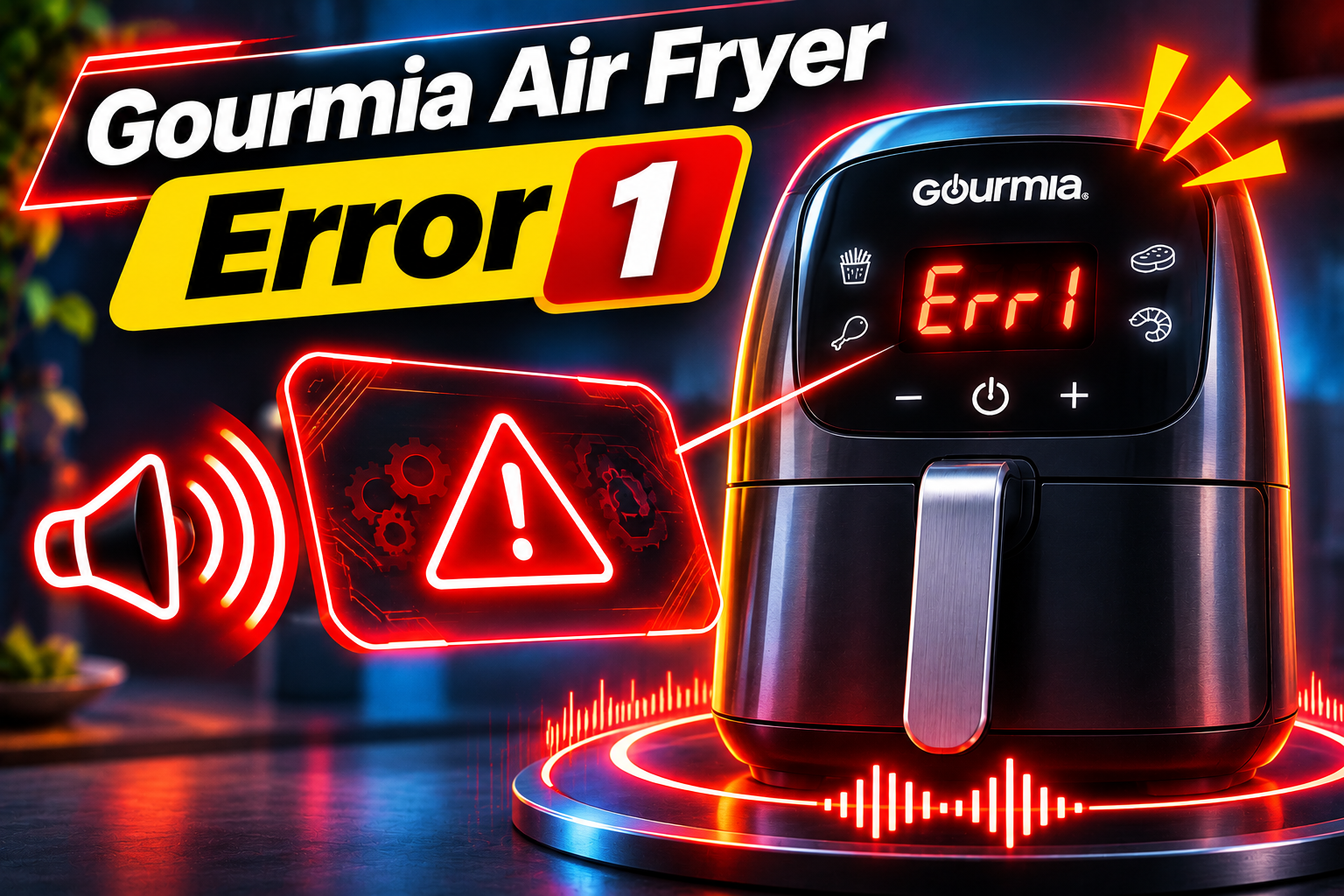
What Does Gourmia Air Fryer Error 1 Mean?
The E1 error on many Gourmia air fryers means the appliance has detected an open circuit in its NTC temperature sensor. This indicates that the electronic control system cannot receive the expected electrical signal from the sensor.
The NTC sensor is a small component responsible for monitoring the temperature inside your air fryer. As the cooking chamber heats up, the sensor’s electrical resistance changes, allowing the control board to determine how hot the appliance has become.
When this connection becomes interrupted, the control board may no longer receive reliable temperature information. As a result, the air fryer can display E1 and stop operating to prevent uncontrolled heating.
Gourmia uses different error codes to identify temperature sensor problems. For example, the GAF784 and GAF836 manuals identify E1 as an open sensor circuit, E2 as a short circuit, and E3 as an excessive temperature reading. Other models may display E01 instead of E1. <Cite refs={[“turn516701search5″,”turn516701search2″,”turn962208search24”]}/>
You may notice that the heating element stops working, the display remains stuck on E1, or the appliance refuses to begin another cooking cycle.
Although an E1 warning doesn’t automatically mean the temperature sensor itself is damaged, a persistent error usually indicates that the sensing circuit needs professional inspection.
Gourmia Air Fryer Error 1: Common Causes
Several faults can interrupt the electrical connection between your air fryer’s temperature sensor and its control board. Understanding these possible causes can help you recognize the problem without attempting unsafe electrical repairs.
1. Faulty Temperature Sensor
A faulty NTC temperature sensor is one of the main possible causes of an E1 error.
During normal operation, the sensor measures temperature through changes in its electrical resistance. The control board uses these readings to regulate the heating element and maintain the cooking temperature you’ve selected.
If the sensor’s internal electrical connection breaks, the control board may detect an open circuit and display E1.
Temperature sensors can fail due to component deterioration, physical damage, or an internal manufacturing defect. However, a properly functioning sensor should withstand the temperatures specified for normal operation.
One clue is an E1 warning that appears immediately after switching on the appliance, even when it hasn’t been used recently. This suggests an electrical sensing problem rather than excessive cooking heat.
However, the error alone cannot confirm that the sensor needs replacement. Damaged wiring or a disconnected electrical connector can produce the same warning.
2. Loose or Damaged Sensor Wiring
The temperature sensor communicates with the air fryer’s control board through internal wires and electrical connectors.
If one of these connections becomes loose, damaged, or disconnected, the control board may stop receiving the sensor’s signal.
This can happen after physical damage, deterioration of internal connections, or a fault affecting the wiring assembly.
Sometimes, a damaged connection causes an intermittent error. For example, the appliance may operate normally during one cooking session but display E1 the next time you switch it on.
You might also notice that the warning appears after the air fryer has been moved or accidentally dropped.
These symptoms can suggest a connection problem, although they aren’t enough to confirm the exact fault.
Because the affected wiring is inside the appliance, checking or repairing it requires appropriate electrical testing equipment and professional knowledge.
3. Moisture or Grease Damage
Air fryers regularly handle hot food, cooking vapors, and grease. These conditions are normal, but liquid entering the electrical housing can damage sensitive components.
For example, water may reach internal connections if the main unit is accidentally immersed or cleaned with excessive liquid.
Moisture can affect electrical contacts and contribute to corrosion. If this damage interrupts the temperature sensor circuit, the appliance may display E1.
You might suspect moisture exposure if the error appeared after a liquid spill or after water entered the appliance during cleaning.
However, ordinary grease buildup inside the cooking basket isn’t a confirmed cause of E1. The concern is contamination reaching electrical components or damaging internal connections.
If liquid has entered the main unit, don’t reconnect it to see whether the error disappears. The appliance needs professional inspection before further use.
4. Faulty Electronic Control Board
The electronic control board manages your Gourmia Air Fryer’s heating system, cooking programs, and temperature monitoring.
It receives information from the NTC sensor and uses that data to control the heating element.
If the board develops an electrical fault, it may fail to recognize the sensor’s signal even when the sensor itself is working correctly.
A damaged connector, failed electronic component, or interrupted circuit on the board could cause the appliance to display E1.
You may also experience unusual behavior, such as controls that stop responding or a display that behaves inconsistently.
However, these symptoms can occur with other electrical faults. A control board shouldn’t be replaced simply because E1 appears.
Professional testing is necessary to determine whether the problem involves the sensor, wiring, or electronic control system.
Gourmia Air Fryer Error 1: DIY Fixes
If your Gourmia Air Fryer displays E1, begin with simple checks that don’t involve opening the appliance. While these methods can help rule out temporary operating problems, a confirmed temperature sensor circuit fault usually requires professional repair.
1. Switch Off the Air Fryer and Let It Cool
The first step is to disconnect your air fryer from its power supply.
Press the power button to switch it off if the controls still respond. Then unplug the power cord from the wall outlet.
Allow the appliance to cool completely before handling the cooking basket or inspecting accessible surfaces.
Once it has cooled, check for visible signs of damage, including melted plastic, discoloration, or an unusual burning smell.
If you notice any of these warning signs, don’t reconnect the appliance.
Cooling helps protect you from burns and makes external inspection safer. However, it won’t repair a damaged temperature sensor or broken electrical connection.
If E1 appeared during normal operation, follow Gourmia’s recommendation to contact customer service before attempting further cooking.
2. Check the Error Code and Air Fryer Model
Before attempting another fix, confirm that your appliance is displaying E1 rather than E2 or E3.
These codes have different meanings on many Gourmia models.
- E1: An open circuit in the NTC temperature sensor.
- E2: A short circuit in the temperature sensor.
- E3: An unusually high temperature reading detected by the sensor.
Some Gourmia models display E01, E02, and E03 instead.
Check the identification label on your air fryer to find its model number. This information is usually printed underneath or on the back of the appliance.
Next, consult the troubleshooting section of your user manual.
For example, the Gourmia GAF784, GAF836, and GAF1190 manuals identify E1 as an NTC open circuit and recommend contacting customer service.
Knowing the exact code helps you avoid attempting repairs intended for unrelated problems.
If your model’s manual identifies E1 as an internal electrical fault, don’t continue operating the appliance.
3. Inspect and Clean Accessible Parts
Although food residue isn’t a confirmed cause of an E1 sensor circuit fault, cleaning accessible areas can help you identify other problems affecting your air fryer.
Start by ensuring the appliance is unplugged and completely cool.
Remove the cooking basket and crisper tray. Check for accumulated grease, leftover food, or visible damage.
Wash the removable parts using warm water, mild dish soap, and a soft sponge.
If stubborn food residue remains, allow the removable components to soak in warm, soapy water according to your model’s cleaning instructions.
Next, wipe the accessible exterior surfaces using a slightly damp cloth.
Avoid allowing water to enter the appliance’s electrical openings or ventilation areas.
Never immerse the main air fryer unit in water or attempt to clean internal electrical connectors.
Allow all cleaned surfaces to dry completely.
While cleaning, look for evidence of liquid entering the main unit. If you suspect internal moisture damage, don’t attempt to operate the appliance.
Cleaning helps maintain your air fryer, but it won’t restore an interrupted internal temperature sensor circuit.
4. Check the Power Cord and Outlet
A loose power connection can cause an air fryer to lose power or behave unexpectedly.
Although this isn’t an established cause of the E1 sensor error, checking the external power supply may help identify a separate problem.
Begin by examining the power cord while the appliance is unplugged.
Look for cracked insulation, exposed wires, bent plug pins, or signs of overheating.
If the cord or plug is damaged, stop using the appliance.
Next, confirm that your electrical outlet is working correctly. You can test it with another suitable household device, provided the outlet shows no signs of damage.
Also, check the voltage requirements printed on your air fryer’s identification label.
Make sure the appliance is compatible with your household power supply.
Avoid overloaded power strips, damaged extension cords, and unsuitable adapters.
If the cord and outlet appear normal, the E1 warning is more likely to involve the appliance’s internal temperature sensing circuit.
Don’t attempt to open the main unit or inspect wiring yourself.
5. Restart the Air Fryer if It’s Safe
A temporary control problem may occasionally clear after the appliance is disconnected from power.
However, because E1 identifies a sensor circuit fault on many Gourmia models, restarting isn’t a guaranteed solution.
If the appliance has no visible damage, hasn’t been exposed to liquid, and shows no signs of overheating, you can perform a single basic restart unless your model’s instructions advise against it.
Follow these steps.
- Switch off the air fryer.
- Unplug it from the wall outlet.
- Leave it disconnected for several minutes.
- Make sure the appliance is cool and dry.
- Reconnect it to a suitable outlet.
- Check whether the E1 warning remains.
If E1 disappears, the control system may have recovered from a temporary problem.
However, this doesn’t confirm that the temperature sensing system is functioning correctly. Contact Gourmia support before returning the appliance to regular cooking.
If the warning immediately reappears, unplug the appliance again.
Repeatedly restarting it won’t repair a faulty sensor, disconnected wiring, or damaged control board.
6. Contact Gourmia Customer Support or a Qualified Technician
If your Gourmia Air Fryer continues displaying Error 1, professional assistance is the safest solution.
Gourmia’s troubleshooting manuals recommend contacting customer service when E1 appears because the error indicates an internal temperature sensor circuit problem.
A qualified technician can determine whether the fault involves the NTC sensor, its wiring, or the electronic control board.
Depending on the diagnosis, the repair may involve replacing a faulty sensor or another damaged electrical component.
However, parts shouldn’t be replaced without confirming the actual cause.
Before contacting customer support, gather the following information.
- Your Gourmia Air Fryer’s model number.
- The exact error code displayed.
- When the warning first appeared.
- Whether it occurs immediately or during cooking.
- Any unusual sounds, smells, or shutdowns.
- Your purchase receipt, if available.
You can contact Gourmia through www.gourmia.com, email info@gourmia.com, or call 888-552-0033 for U.S. customer service.
If your appliance is still under warranty, ask about the available repair or replacement options before arranging independent servicing.
Avoid bypassing the temperature sensor, opening the electrical housing, or replacing internal components without the proper qualifications.
The temperature sensor helps regulate cooking heat, so operating an air fryer with an unresolved sensing fault may be unsafe.
If the appliance is no longer covered by warranty, compare the expected repair cost with the price of a replacement.
Wrapping Up
A Gourmia Air Fryer Error 1 usually indicates an interrupted temperature sensor circuit. The problem may involve a faulty NTC sensor, damaged wiring, moisture exposure, or an electronic control board failure. Identifying the exact cause is essential before replacing any components.
Start by unplugging the appliance, checking the error code, and inspecting accessible parts for visible damage. Although these checks can help rule out simple issues, a persistent E1 warning requires professional attention. Contact Gourmia support to determine the safest repair option and avoid further damage to your appliance.