If your KitchenAid ice maker displays E0 but isn’t producing ice, you might think something is wrong with the machine. However, this code doesn’t necessarily indicate a fault.
On many KitchenAid refrigerators, E0 means the ice maker hasn’t detected an error. Still, problems with the water supply, freezer temperature, or ice maker components can prevent ice production without triggering an error code.
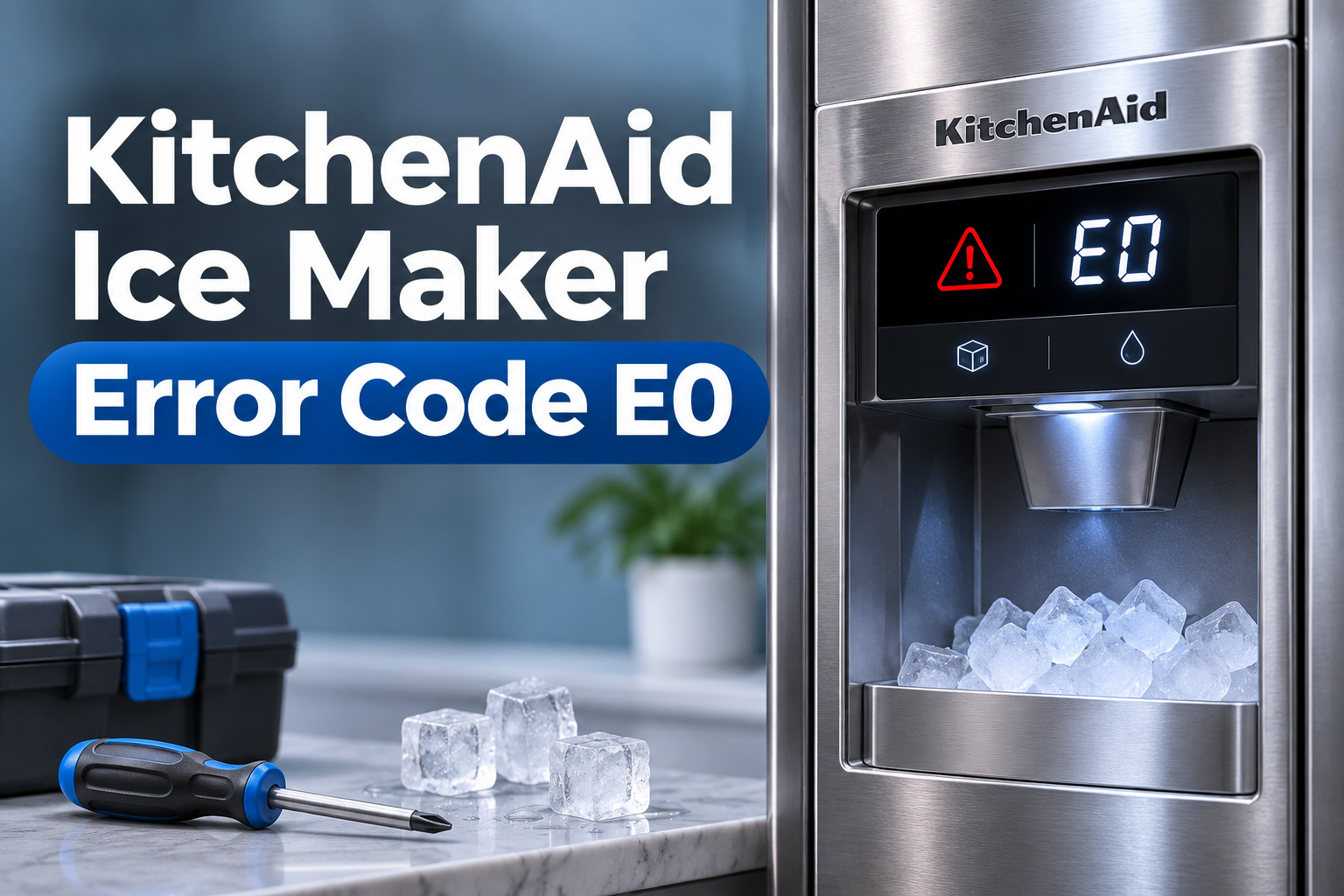
What Does KitchenAid Ice Maker Error Code E0 Mean?
KitchenAid ice maker error code E0 generally means “No Errors” on refrigerator models that support Service Test 56. It indicates that the control system hasn’t detected a specific ice maker malfunction.
However, E0 doesn’t guarantee that your ice maker is working properly. For example, the machine might stop producing ice because of restricted water flow, incorrect temperature settings, or an obstructed ice storage bin.
The exact meaning of E0 can vary depending on your KitchenAid model, so check your owner’s manual before troubleshooting.
KitchenAid Ice Maker Error Code E0: Common Causes
Although E0 isn’t normally a fault code, several problems can explain why your KitchenAid ice maker isn’t producing ice.
1. Ice Maker Is Turned Off
Your KitchenAid ice maker won’t produce ice if its power switch is off or the shutoff arm is in the wrong position.
This can happen after cleaning, maintenance, or removing the ice storage bin. Some models also use sensors that stop production when the bin is full.
If the bin isn’t positioned correctly or something blocks the sensor, the machine may stop making ice even when the bin is empty.
2. Restricted Water Supply
Your ice maker needs enough water to fill the ice mold. If the supply line is blocked, bent, or connected to a partially closed valve, ice production may slow down or stop.
Low household water pressure can cause similar problems. You might notice smaller ice cubes or an empty ice mold.
If your refrigerator has a water dispenser, weak water flow can also suggest a restriction in the supply system.
3. Clogged Water Filter
A clogged water filter can reduce the amount of water reaching your ice maker.
Over time, the filter collects particles that can restrict water flow. As a result, your ice maker might produce smaller cubes, take longer to make ice, or stop producing ice completely.
An incorrectly installed filter can cause similar symptoms, especially if the problem started immediately after a filter replacement.
4. Incorrect Freezer Temperature
Your ice maker needs sufficiently cold conditions to freeze water and release ice cubes.
KitchenAid generally recommends setting the freezer to 0°F (-18°C). If the temperature is too high, ice may freeze slowly or the machine may struggle to complete its normal cycle.
Frequent door openings, blocked air vents, and damaged door seals can also affect cooling.
5. Ice Buildup or Mechanical Problems
Ice can sometimes get stuck inside the ice mold, storage bin, or dispenser chute.
If the harvesting mechanism cannot release frozen cubes, the machine may stop producing new batches. You might notice clicking sounds or ice remaining in the mold.
A faulty motor or related component can also cause harvesting problems, although some of these faults may eventually trigger a different diagnostic code.
KitchenAid Ice Maker Error Code E0: How to Fix
Since E0 usually means no error was detected, the solution depends on why your ice maker isn’t working.
1. Check the Ice Maker Settings
Start by making sure your ice maker is switched on.
Locate the power switch, shutoff arm, or control panel setting, depending on your refrigerator model.