KitchenAid dishwasher error code 7-1 can be frustrating, especially when your dishwasher stops washing properly, leaves dishes wet, or fails to complete a cycle. The error indicates a problem that needs attention, although its exact meaning depends on your dishwasher model.
On older KitchenAid models, code 7-1 usually indicates a heating problem. However, some newer models use the same code for a wash motor failure. Identifying which system is affected will help you find the cause and avoid unnecessary repairs.
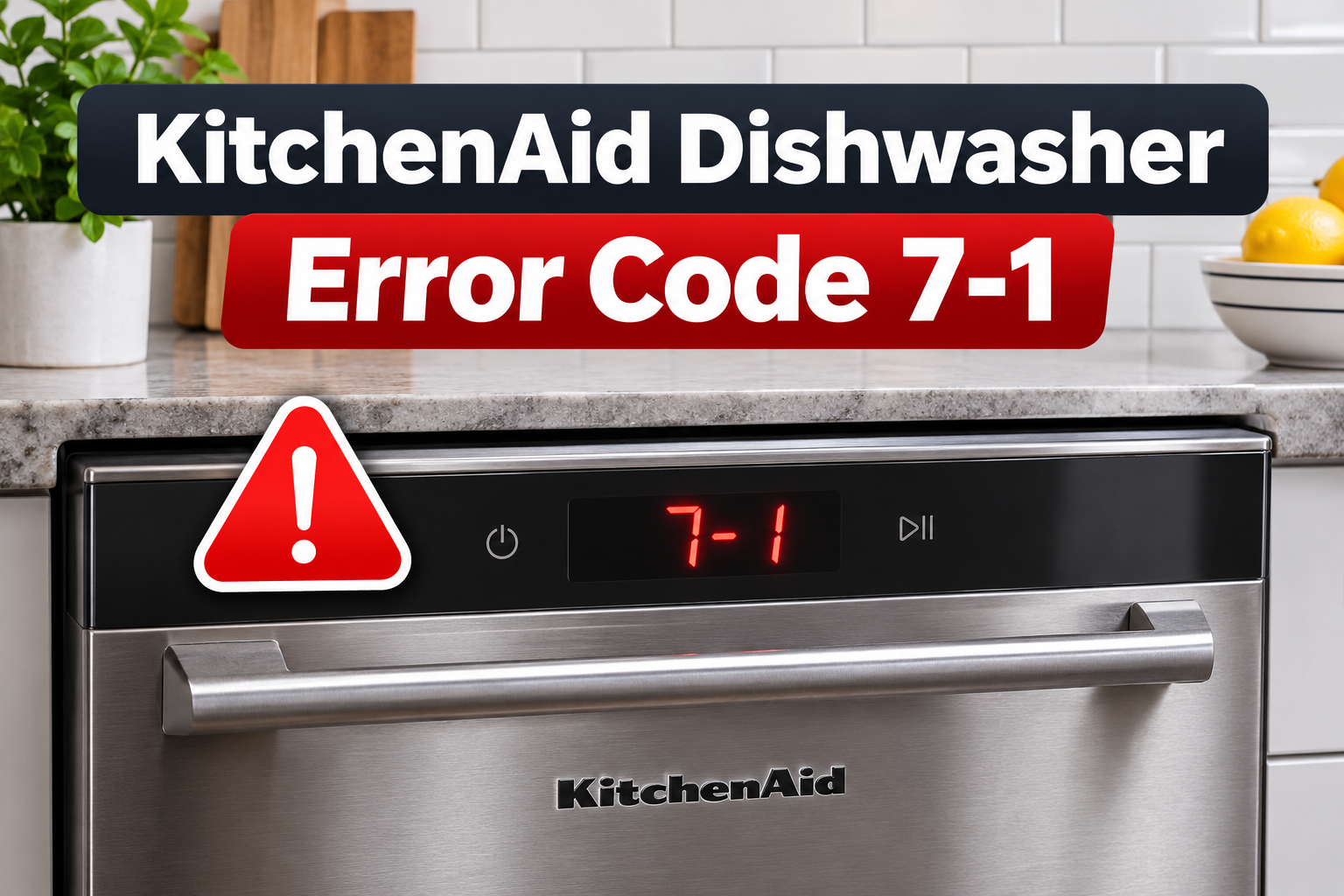
What Does KitchenAid Dishwasher Error Code 7-1 Mean?
KitchenAid dishwasher error code 7-1, sometimes displayed as F7E1, can indicate a heating system fault or a wash motor failure. The meaning depends on your dishwasher’s model and electronic control system.
On older models, the code generally means the dishwasher cannot heat water properly. The heating element helps maintain suitable water temperatures during washing and supports the drying process. When heating fails, dishes may remain wet, cleaning performance may suffer, or the dishwasher may disable its heating function.
Newer KitchenAid models may use F7E1 to indicate a wash motor problem. The wash motor circulates water through the spray arms, allowing them to remove food and grease from dishes. If the motor stops working, the dishwasher may fill with water but fail to wash properly.
You might notice unusual humming sounds, interrupted wash cycles, poor cleaning results, or dishes that remain wet after washing. However, these symptoms alone cannot confirm the faulty component.
Check your dishwasher’s model number and error code information before attempting repairs. This helps you determine whether to investigate the heating system or the wash motor.
KitchenAid Dishwasher Error Code 7-1: Common Causes
Several mechanical and electrical problems can trigger error code 7-1. The following causes apply to different KitchenAid dishwasher models, so identifying your model’s specific error meaning is essential.
1. A Faulty Wash Motor
The wash motor circulates water through the spray arms during cleaning. If it fails, water cannot move through the dishwasher properly, even when the appliance fills normally.
Motor problems can develop because of damaged electrical windings, worn internal components, or mechanical failure. A motor that cannot start may produce a humming sound without the usual noise of water spraying inside the dishwasher.
You might also notice that the dishwasher fills with water but stops shortly afterward. In some cases, the drain pump continues working, making it seem as though the dishwasher is functioning normally.
However, a motor that doesn’t run isn’t necessarily defective. Loose wiring or a faulty control circuit can produce similar symptoms. Proper diagnosis is necessary before replacing the motor.
2. Loose Wiring or Damaged Electrical Connections
The dishwasher’s wash motor and heating system depend on electrical connections to receive power from the control board. If these connections become loose or damaged, the affected component may stop working.
Heat, moisture, vibration, and normal wear can contribute to electrical connection problems. A damaged connector may interrupt power completely or cause intermittent operation.
For example, your dishwasher might start a cycle normally but stop when the wash motor should operate. On models with a heating fault, the dishwasher may continue washing without producing enough heat.
Since these connections are usually located behind protective panels or underneath the appliance, electrical testing should be handled by a qualified technician.
3. A Damaged Heating Element
On older KitchenAid dishwashers, a faulty heating element is a major cause of error code 7-1. The heating element converts electrical energy into heat, helping the dishwasher maintain suitable water temperatures.
Over time, the element can fail internally or develop an open electrical circuit. When this happens, electricity can no longer pass through it properly, preventing the dishwasher from heating as expected.
You may notice that dishes remain unusually wet after a heated drying cycle. Cleaning results may also become worse, particularly when washing greasy dishes.
However, poor drying doesn’t always indicate a defective heating element. Cycle settings, rinse aid levels, and the types of dishes being washed can also affect drying performance.
4. A Faulty Heating Relay or Control Board
The dishwasher’s electronic control board manages several functions, including wash motor operation, water filling, and heating. It uses electrical circuits and switching components to control these systems.
On older models, a failed heating relay or control circuit can prevent the heating element from receiving power. As a result, the dishwasher may report error code 7-1 even when the element itself is working.
Some older KitchenAid dishwashers also disable the heater after detecting a heating fault. This protective response can remain active until the underlying problem is repaired and the appropriate diagnostic procedure is completed.
A control board problem can be difficult to distinguish from faulty wiring or a failed heating element without electrical testing. Replacing the board without confirming the fault can lead to unnecessary expenses.
5. Restricted Water Circulation or Foreign Objects
Food particles, broken glass, and other debris can sometimes collect around the dishwasher’s filtration and circulation system. These obstructions may interfere with water movement and reduce cleaning performance.
A clogged filter can make dishes come out dirty, while debris around accessible water passages may contribute to poor circulation. However, blocked filters aren’t a confirmed cause of F7E1 on every KitchenAid model.
Some newer dishwashers use a separate error code for filtration problems. Therefore, a dirty filter should be treated as something worth checking rather than proof that it caused error code 7-1.
If cleaning the accessible filter doesn’t improve performance, the problem may involve the wash motor or another internal component.
KitchenAid Dishwasher Error Code 7-1: How to Fix
Once you’ve identified what error code 7-1 means on your dishwasher, you can begin troubleshooting. Start with simple checks that don’t require opening electrical compartments or removing internal components.
1. Confirm Your Dishwasher Model and Error Code
Before attempting any repairs, check your dishwasher’s model number. KitchenAid dishwashers use different electronic control systems, meaning the same error code can indicate different problems.
The model number is usually printed on a label around the dishwasher’s door opening or tub frame.
Once you’ve located it, consult the owner’s manual or the model’s technical documentation to confirm the meaning of error code 7-1.
Some dishwashers display F7E1 directly, while others communicate the error through flashing indicator lights. On certain models, seven flashes followed by one flash indicate code 7-1.
If your model identifies the code as a heating fault, focus on heating related symptoms. If it identifies a wash motor failure, concentrate on water circulation and motor operation.
This step can save time and prevent you from replacing a perfectly working component.
2. Reset the Dishwasher
A temporary electronic fault can sometimes interrupt dishwasher operation. Resetting the electronic control may help restore normal operation if the problem was temporary.
Follow these steps.
- Press Cancel if your dishwasher is running and allow any normal draining to finish.
- Disconnect the dishwasher from its power supply using its accessible plug or dedicated circuit breaker.
- Leave the power disconnected for at least 30 seconds.
- Restore power and check whether the control responds normally.
- Start an appropriate wash cycle and see whether the error returns.
If the dishwasher operates normally afterward, the interruption may have been temporary.
However, resetting the dishwasher doesn’t repair a damaged motor, heating element, or electrical connection. If error code 7-1 returns, further diagnosis is necessary.
Also, some older KitchenAid models require a specific service diagnostic procedure to restore heating after a heater fault has been corrected. A basic power reset may not clear that condition.
3. Clean the Dishwasher Filter and Remove Accessible Debris
If your dishwasher isn’t circulating water properly, checking the accessible filter is a useful maintenance step.
Food particles, labels, and other debris can accumulate inside the filtration system. Although cleaning the filter won’t repair a defective wash motor, it can help restore proper water movement when debris is restricting circulation.
For dishwashers with a removable filter, follow these steps.
- Disconnect power and allow the dishwasher to cool.
- Remove the lower dish rack.
- Locate the filter assembly at the bottom of the dishwasher.
- Remove the filter according to your owner’s manual.
- Rinse it under running water to remove food particles.
- Use a soft brush to clean stubborn residue.
- Check the accessible area for loose debris without reaching into hidden pump openings.
- Reinstall the filter securely.
Some KitchenAid models have filtration systems that aren’t designed for regular owner removal. If your filter doesn’t release easily, check the manual instead of forcing it.
After cleaning, run an appropriate wash cycle and observe whether water circulation improves.
If the dishwasher still hums without spraying water or displays error code 7-1 again, the wash motor or electrical control system may require professional attention.
4. Check the Water Supply and Temperature
Your dishwasher needs an adequate water supply to clean dishes properly. Restricted filling or unusually cold incoming water can cause washing problems that resemble certain symptoms associated with error code 7-1.
Start by checking the water supply valve beneath your kitchen sink. Make sure it’s fully open and look for visible kinks in any accessible supply hose.
Next, check the incoming hot water temperature if your dishwasher has a heating related fault.
KitchenAid generally recommends an incoming water temperature of approximately 120°F (49°C) for proper washing performance.
You can check this using a kitchen thermometer.
- Run hot water at the kitchen sink until it reaches its normal hot temperature.
- Collect some water in a suitable container.
- Measure the temperature with a kitchen thermometer.
- Compare the reading with the recommended temperature.
If the water is considerably colder than 120°F, check your household water heater settings and follow the heater manufacturer’s instructions.
Be careful when handling hot water to avoid burns.
Correcting the incoming water temperature may improve washing performance. However, it won’t repair a failed heating element or wash motor.
5. Check the Wash Cycle and Drying Settings
Your dishwasher’s selected cycle can affect washing and drying results. Before assuming that a heating component has failed, confirm that you’re using appropriate settings.
On models with a heating related error, select a normal wash cycle with Heated Dry if your dishwasher offers that option.
Also, check the rinse aid dispenser. Rinse aid helps water drain away from dishes more easily, reducing the amount of moisture left behind after washing.
If dishes remain unusually wet despite using appropriate settings, the dishwasher may have a heating problem.
However, plastic containers often retain more moisture than glass or ceramic dishes. Therefore, wet plastic items alone aren’t enough to confirm a heater failure.
For newer KitchenAid models with a wash motor error, listen for the normal sound of water spraying after the dishwasher fills.
If the machine fills but produces only a humming sound, stops unexpectedly, or displays F7E1 again, stop testing it.
Avoid repeatedly operating a dishwasher that appears unable to circulate water properly.
6. Contact a Qualified Appliance Repair Technician
If error code 7-1 continues appearing after the basic checks, a qualified appliance technician can identify the faulty component.
For older KitchenAid dishwashers, the technician may test the heating element, its electrical connections, and the control board’s heating circuit.
If the heating element has failed, replacing it with the correct model compatible part may resolve the issue. However, if the fault involves a relay or damaged wiring, replacing the element won’t help.
On newer models, a technician can examine the wash motor, motor connections, and electronic control system to determine why circulation has failed.
Depending on the findings, repairs may involve fixing damaged wiring, replacing the wash motor assembly, or addressing a control board fault.
You should also seek immediate professional assistance if your dishwasher produces a burning smell, smoke, electrical sparking, or leaks near electrical components.
When contacting a repair technician, provide your model number, error code, and a description of what happens during the wash cycle. This information helps narrow down the possible causes.
Wrapping Up
KitchenAid dishwasher error code 7-1 can indicate a heating failure or a wash motor problem, depending on the model. Understanding this difference is essential because each fault requires a different repair approach.
Begin by confirming the error code, resetting the dishwasher, and checking the accessible filter, water supply, and cycle settings. If the error continues, professional diagnosis is the safest next step. Addressing the actual cause early can help prevent further problems, avoid unnecessary replacement parts, and get your dishwasher working properly again.