Your Minn Kota Endura is only as good as the battery powering it. You could have the smoothest trolling motor on the water, but if your battery quits at noon on a full-day fishing trip, you’re paddling back to the dock. That’s a frustrating experience most anglers know all too well.
Getting the right battery matters more than most people think. Capacity, chemistry, weight, and cycle life all play a role in how your motor performs and how long you stay out on the water. A battery that looks fine on paper can disappoint in practice if it wasn’t designed for the demands of a trolling motor.
We tested and researched the best options available for the Minn Kota Endura series, covering a range of budgets and use cases. Whether you fish all day from a kayak or run a full-sized bass boat with heavy accessory loads, the right battery is on this list.
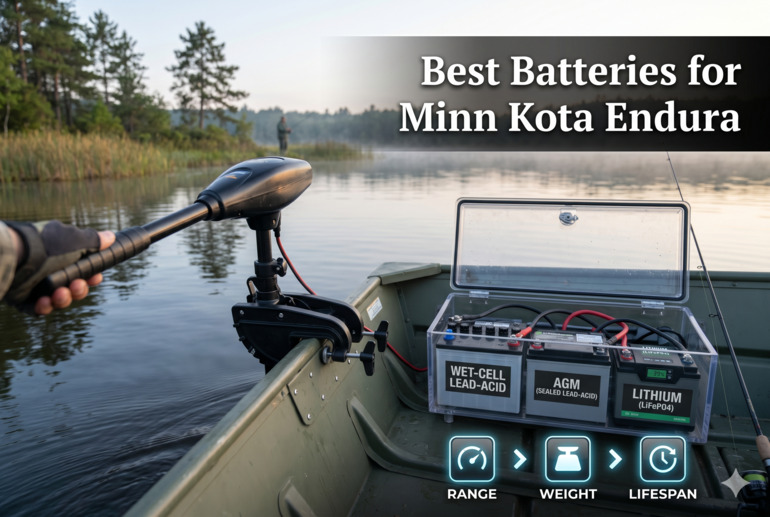
How We Selected the Best Batteries for Minn Kota Endura
Our team spent time evaluating each battery against real-world trolling motor demands, not just spec sheets. We looked at how each option holds up under sustained loads, how quickly it recharges, and whether it delivers consistent power from the first cast to the last.
Here are the factors that guided our picks:
- Capacity (Amp Hours): A higher Ah rating means more time on the water. We prioritized options with enough capacity to handle all-day trips without stranding you mid-lake.
- Battery Chemistry: AGM and LiFePO4 both have real advantages. We evaluated which chemistry makes sense at each price point and use case.
- Weight: On kayaks and small boats, a heavy battery creates real problems. We factored in portability where it matters.
- Cycle Life: How many charge and discharge cycles a battery can handle before performance drops off tells you a lot about long-term value.
- Maintenance Requirements: Nobody wants to check water levels or deal with corrosion. We favored sealed, maintenance-free designs throughout.
- Cold Weather Performance: A battery that shuts down on a chilly morning is a liability. We looked at how each option handles temperature extremes.
- Vibration and Shock Resistance: Marine environments are rough. A battery that can’t handle the pounding of choppy water won’t last long in a boat.
Every pick on this list earned its spot through a combination of these factors, not just one. Here’s what we found.
Best Batteries for Minn Kota Endura (2026 Expert Review)
Five batteries made this list, covering premium AGM options, budget-friendly deep cycle picks, compact lithium solutions, and high-capacity LiFePO4 powerhouses. Each one matches a different type of angler and a different set of priorities.
1. OPTIMA D34M BLUETOP: The Premium Dual-Purpose Workhorse

If you want a battery that genuinely does it all, the OPTIMA D34M BLUETOP is the one to beat. It’s built for both starting and deep cycle use, which means it can power your trolling motor for hours and still crank your outboard at the end of the day. That dual-purpose capability is rare and genuinely useful on boats that need a single battery to do multiple jobs.
The standout feature here is OPTIMA’s proprietary SPIRALCELL technology, which uses 99.99% pure lead wound into tight spiral cells. This design delivers more consistent power output and recharges faster than conventional flat-plate batteries. We found it handles sustained trolling motor loads without the voltage sag you see from cheaper alternatives.
The physical build is confidence-inspiring. At 43.5 pounds, it’s not light, but it’s compact at about 10 inches long and built to handle punishment. It’s more than 15 times more resistant to vibration than standard flooded batteries, which matters a lot when you’re running across choppy water on a small boat. It can also be mounted in virtually any position, which gives you more flexibility with installation.
One practical note worth sharing: the D34M comes with dual SAE and 5/16-inch stainless steel stud posts, giving you connection options that most batteries don’t offer. Reserve capacity sits at 120 minutes, which translates to solid all-day performance on moderate-thrust motors.
Key Specs:
- Voltage: 12V
- Capacity: 55Ah (C20), 750 CCA
- Reserve Capacity: 120 minutes
- Weight: 43.5 lbs
- Dimensions: 10.06″ L x 6.88″ W x 7.94″ H
- Warranty: 24 months
- Dual-purpose design handles both deep cycling and engine starting
- SPIRALCELL technology delivers faster recharging and stronger, more consistent output
- Exceptional vibration resistance at 15x the standard of flooded batteries
- Premium price point is a significant investment compared to other options
- At 43.5 lbs, it’s heavy for kayak or small boat setups where weight is a concern
2. Newport Vessels 12V 50Ah: The Lightweight All-Day Companion

The Newport Vessels 12V 50Ah AGM battery is what you reach for when you want solid performance without hauling around an anchor. At just 32 pounds, it’s noticeably easier to carry, load, and install than most marine batteries in its class. For kayak anglers and small boat owners, that weight difference is felt on every single trip.
We were impressed by how consistently this battery maintains voltage under load. One of our team members ran it on a 55lb thrust trolling motor at moderate speeds for over four hours and found the voltage held steady throughout, with no noticeable power drop-off. That kind of flat discharge curve is exactly what you want from a deep cycle battery.
The sealed AGM construction means zero maintenance and no worries about acid spills, even if the battery takes a bump or gets knocked around during transport. One reviewer put it well when they noted that the battery survived a tumble from a truck bed at speed without any swelling or performance issues afterward. That’s a real-world stress test that says something about the build quality.
It’s worth noting that some buyers have reported receiving the battery without terminal bolts included. This is a small inconvenience, but worth keeping in mind so you have the right hardware on hand before your first trip out.
Key Specs:
- Voltage: 12V
- Capacity: 50Ah
- Battery Type: Sealed AGM
- Weight: 32 lbs
- Warranty: 1 year limited
- 32-pound weight makes it genuinely easy to carry and transport
- Sealed AGM construction is spill-proof and completely maintenance-free
- Consistent voltage output under sustained trolling motor loads
- Terminal bolts are not always included, so have hardware ready
- 1-year warranty is shorter than some competing options
3. Akiisolo 12V 15Ah LiFePO4: The Compact Powerhouse for Light Setups

Not every angler needs a massive battery. If you’re running a fish finder, a small kayak-mounted trolling motor, or a lightweight setup on a canoe, the Akiisolo 12V 15Ah LiFePO4 is a compelling choice that punches well above its size and price. It weighs just 3 pounds, which is a dramatic difference from anything else on this list.
The LiFePO4 chemistry is the real story here. This battery technology is inherently more stable than lithium-ion alternatives and delivers a flat discharge curve, meaning you get consistent voltage output for up to 95% of its capacity before it drops off. That translates to steady power for your electronics right up until the battery needs a recharge.
Cycle life is where this battery genuinely impresses. It’s rated for over 2,000 full cycles at 100% depth of discharge and up to 8,000 cycles at partial capacity. That kind of longevity is roughly four times what you’d get from a traditional lead-acid battery of similar capacity. The battery also supports parallel and series connections, so you can combine units to scale up capacity for longer trips.
One practical consideration: the terminals use F2 blade-style connectors rather than standard post terminals. Most kayak and small boat setups adapt to this easily, but it’s something to verify with your wiring setup before you buy. A compatible charger is included, though it’s a low-amperage unit, so charging time will be longer than with a dedicated charger.
Key Specs:
- Voltage: 12.8V
- Capacity: 15Ah
- Battery Type: LiFePO4
- Weight: 3 lbs
- Cycle Life: 2,000+ at 100% DOD, up to 8,000 at 50% DOD
- Warranty: 12 months
- Exceptionally lightweight at just 3 pounds, ideal for kayaks and small vessels
- LiFePO4 chemistry offers up to 8,000 cycles and approximately 10 years of use
- Wide operating temperature range from -20°C to +60°C
- 15Ah capacity limits it to lighter setups and shorter or less demanding trips
- F2 blade-style terminals require the right connectors for a secure installation
4. SUPER EMPOWER 12V 100Ah LiFePO4: The High-Capacity Lithium Upgrade

If you want to make the leap from lead-acid to lithium without sacrificing compatibility, the SUPER EMPOWER 12V 100Ah LiFePO4 is one of the best drop-in replacements available at this price point. It uses Grade A+ cells, comes in a BCI Group 24 footprint, and fits directly into most standard battery boxes without any modifications. Installing it is genuinely as simple as swapping out your old battery.
At 13.2 pounds for 100Ah of capacity, the weight difference compared to a traditional AGM battery is striking. A typical 100Ah AGM unit tips the scales at 60 to 70 pounds. This battery delivers the same capacity at a fraction of the weight, which opens up real possibilities for smaller boats and setups where weight distribution matters.
We were particularly impressed by the cold weather protection built into this battery. Charging automatically pauses below 32°F to protect the cells, and discharge stops below -4°F, resuming automatically once temperatures rise above 41°F. For anglers who fish in early spring or late fall, that kind of thermal management is a practical advantage over standard lithium batteries that lack this protection.
The battery is rated for approximately 5,000 cycles at 100% depth of discharge and up to 15,000 cycles at 60% depth of discharge, backed by a 5-year warranty. One important note: this battery is designed for energy storage and deep cycling only. It is not suitable for engine cranking or starting applications, so plan your electrical setup accordingly.
Key Specs:
- Voltage: 12.8V
- Capacity: 100Ah (1280Wh)
- Battery Type: LiFePO4, BCI Group 24
- Weight: 13.2 lbs (Mini version listed); 21.6 lbs (standard dimensions)
- Cycle Life: 5,000 at 100% DOD, up to 15,000 at 60% DOD
- Warranty: 5 years
- Dramatically lighter than AGM alternatives with equivalent capacity
- Drop-in BCI Group 24 size fits most standard battery boxes without modification
- Built-in low-temperature protection automatically manages charging in cold conditions
- 5-year warranty is among the strongest in this category
- Not suitable for engine starting or cranking, so additional starting battery may be needed
- Requires a dedicated LiFePO4 charger for optimal performance
5. VMAX MR127-100: The Heavy-Duty AGM Built for All-Day Power
UNAVAILABLEThe VMAX MR127-100 is a Group 27 AGM battery that was purpose-built for demanding marine applications. With a 100Ah capacity and a 200-minute reserve rating, it’s designed to power trolling motors through full fishing days without giving up. VMAX USA has been in the battery business since 1991, and this unit reflects that experience in its construction and performance.
What makes this battery stand out among traditional AGM options is the use of high-performance AGM plates paired with military-grade construction. It’s sealed and maintenance-free, handles shocks and vibration well, and can be charged via alternator, solar, or a standard AC charger. We found that it kept powering a 55lb thrust motor well past the five-hour mark, with reserve to spare.
At 68 pounds, this is the heaviest battery on the list by a significant margin. That weight reflects the capacity and the build, but it’s a genuine consideration for anyone who has to move the battery frequently. For anglers with a fixed mounting point in a larger boat, the weight is manageable. For kayak users or anyone carrying their battery to and from the water, it’s a real challenge.
The 8mm terminals and sealed, spill-proof design give you flexibility in how and where you mount it. The 200-minute reserve capacity is one of the most generous on this list, and it pairs especially well with higher-thrust Endura models that draw more current over the course of a day.
Key Specs:
- Voltage: 12V
- Capacity: 100Ah
- Reserve Capacity: 200 minutes
- Battery Type: AGM, Group 27
- Weight: 68 lbs
- Dimensions: 12.1″ L x 6.7″ W x 8.46″ H
- Warranty: 1 year
- 100Ah capacity with a 200-minute reserve rating delivers exceptional run time
- Military-grade AGM construction handles vibration, shock, and harsh marine conditions
- Can be charged via alternator, solar, or standard AC charger
- At 68 pounds, it’s the heaviest option on this list by a wide margin
- 1-year warranty is relatively short given the investment
Best Batteries for Minn Kota Endura: A Quick Rundown
- OPTIMA D34M BLUETOP: Best dual-purpose battery for anglers who need both starting and deep cycle capability in one unit
- Newport Vessels 12V 50Ah: Best lightweight AGM option for kayaks, canoes, and small boats where portability counts
- Akiisolo 12V 15Ah LiFePO4: Best compact lithium battery for light setups, fish finders, and minimal-weight kayak builds
- SUPER EMPOWER 12V 100Ah LiFePO4: Best lithium upgrade for anglers who want maximum capacity with minimal weight
- VMAX MR127-100: Best high-capacity AGM battery for larger boats and anglers who want proven all-day performance
Final Thoughts
Choosing the right battery for your Minn Kota Endura comes down to a few key questions: How long do you fish? How much does the battery need to weigh? And how important is long-term value versus upfront cost? A compact 15Ah lithium battery is ideal for a kayak angler running a fish finder and a small motor. A 100Ah AGM or LiFePO4 option makes far more sense for an angler putting in 8 to 10 hour days on a larger boat.
Chemistry matters too. AGM batteries are reliable, widely compatible, and often less expensive upfront. LiFePO4 batteries cost more initially but deliver dramatically longer cycle life, lighter weight, and more consistent output over time. Pick the option that fits your actual fishing habits and your boat’s specific setup, and you’ll be rewarded with a battery that keeps you on the water when it matters most.