Picking the right steering wheel for your racing simulator can feel like its own mini-competition. There are budget picks, mid-range contenders, and premium options that promise the moon, and the differences between them matter more than most people realise. Get the wrong one and you will be fighting the wheel instead of the track.
That is why we put together this guide. We looked closely at five of the most popular racing wheels available right now, comparing their force feedback systems, build quality, platform compatibility, and overall value. Whether you are brand new to sim racing or looking to upgrade from a basic setup, this breakdown will help you make a confident decision.
Every product featured here was evaluated on real-world usability, not just spec sheets. By the time you finish reading, you will know exactly which wheel fits your situation.
How We Selected the Best Steering Wheels for Racing Simulator
Our evaluation process started with a wide scan of the racing wheel market, from entry-level gear-driven options to belt-driven setups aimed at more serious sim racers. We narrowed the field based on hands-on research, real user feedback across thousands of verified purchases, and a consistent set of criteria that reflects what everyday racers actually care about.
Here is what guided our selections:
- Force feedback quality: We examined the type of feedback system used (gear, belt, or dual-belt) and how accurately it translates road feel, tyre grip, and surface changes to the driver’s hands.
- Platform compatibility: We looked at which consoles and operating systems each wheel supports, since compatibility is often a deal-breaker before anything else.
- Build materials and construction: Wheel rim material, pedal frame quality, and paddle shifter finish all factor into how a wheel holds up under regular, aggressive use.
- Rotation range: The number of degrees of lock-to-lock rotation affects realism significantly, particularly for players switching from standard controllers.
- Ease of setup and mounting: We considered how quickly each wheel mounts to a desk or rig, and how much technical knowledge the setup actually requires.
- Upgrade potential: Wheels that support add-on shifters, pedal upgrades, and alternative rims offer more long-term value as your setup grows.
- Pedal responsiveness: We paid close attention to pedal feel and precision, since poor pedals can undermine an otherwise excellent wheel.
Our picks represent a range of budgets and use cases. Whether you want a dependable starter kit or a wheel that can grow with your rig, you will find a strong option here.
Best Steering Wheels for Racing Simulator (2026 Expert Review)
Five wheels made our final list, covering a price range from entry-level to intermediate premium. Each one brings something different to the table, from Logitech’s proven dual-motor systems to Thrustmaster’s belt-driven precision. Here is our full breakdown.
1. Logitech G920 Driving Force: The Reliable All-Rounder for Xbox and PC

The Logitech G920 Driving Force is the go-to wheel for anyone on Xbox Series X, Xbox One, or PC who wants a properly built, no-nonsense entry into sim racing. It delivers a complete package right out of the box, covering everything from force feedback to floor pedals, without asking you to hunt down extra accessories before your first race.
The wheel’s hand-stitched leather cover gives it a premium feel that punches above its price class. Paired with the stainless steel paddle shifters and a brushed metal spoke design, the G920 looks and feels far more serious than a lot of gear at this level. It holds up well under sustained use, too.
The dual-motor force feedback system uses anti-backlash helical gears to deliver smooth, quiet steering response. It simulates understeer, oversteer, tyre slip, and terrain changes through the wheel with genuine effectiveness. The 900-degree lock-to-lock rotation means you can turn the wheel two and a half times, just like in a real car.
We found the separate pedal unit to be one of the G920’s most practical features. The nonlinear pressure-sensitive brake mimics real-world braking behaviour, and the adjustable pedal faces give you the ability to fine-tune foot positioning for your setup. The whole rig mounts cleanly to a desk or rig thanks to built-in clamps and bolt points.
Key Specs:
- Compatible platforms: Xbox Series X, Xbox One, PC, Mac
- Wheel rotation: 900 degrees
- Force feedback: Dual-motor with helical gears
- Pedals: 3-pedal floor unit (throttle, brake, clutch)
- Connectivity: USB (wired)
- Buttons: 16
- Hand-stitched leather wheel and stainless steel paddles give it a quality feel that stands out at this price.
- Smooth, quiet dual-motor feedback accurately simulates real driving conditions including tyre slip and terrain changes.
- Solid desk and rig mounting with both clamps and bolt points for a stable, shake-free setup.
- Does not work with PlayStation consoles, limiting it to Xbox and PC users only.
- The brake pedal is noticeably firm, which can catch new users off guard before they adjust their in-game settings.
2. Logitech G29 Driving Force: The PlayStation Racer’s Best Entry Point
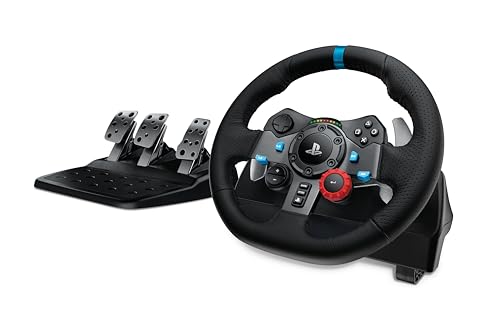
If your setup is built around PlayStation 5, PS4, or PC, the G29 is essentially the same proven package as the G920, tuned for Sony’s ecosystem. It offers the same dual-motor feedback and leather-wrapped wheel in a form that works across PlayStation’s full current and previous generation lineup.
One feature worth highlighting is the RPM shift indicator LEDs built directly into the wheel. These colour-coded lights tell you exactly when to change gears without taking your eyes off the track, which is a genuinely useful addition for both casual racers and those starting to chase lap times seriously.
The build quality mirrors what Logitech has delivered across the entire Driving Force range. The pedal unit uses automotive-grade rolled steel on the throttle, and the pressure-sensitive nonlinear brake provides a realistic, responsive feel that rewards careful technique. The hand-stitched leather rim and stainless steel paddle shifters round out a package that feels built to last.
Key Specs:
- Compatible platforms: PS5, PS4, PC, Mac
- Wheel rotation: 900 degrees
- Force feedback: Dual-motor with helical gears
- Pedals: 3-pedal floor unit (throttle, brake, clutch)
- Connectivity: RCA/USB (wired)
- Buttons: 16
- Full PS5 and PS4 compatibility makes it the natural choice for PlayStation sim racers.
- RPM shift indicator LEDs let you monitor your rev range without looking away from the action.
- Premium construction with hand-stitched leather, stainless steel paddles, and a sturdy metal ball-bearing axle.
- Supports optional Driving Force Shifter for those who want to build a more complete manual setup.
- Does not work with Xbox consoles, so it is strictly a PlayStation and PC option.
- Pressure required on the brake pedal takes some getting used to, especially for new wheel users.
3. Logitech G923 with TRUEFORCE: When You Want More Than Standard Feedback

The G923 is where Logitech made a real generational leap. The headline feature is TRUEFORCE, a proprietary feedback system that connects directly to supported game engines rather than just reacting to basic physics data. It processes information up to 4,000 times per second, which translates into a noticeably more textured and honest representation of what the car is doing under your hands.
The programmable dual clutch is another standout addition. In supported games, it simulates a real race car launch assist system, giving you the ability to manage wheelspin off the line in a way that standard wheel setups simply cannot replicate. It is a feature that becomes genuinely useful once you move past casual racing and start working on race starts and traction management.
The G923 is available in both PlayStation and Xbox versions, making it one of the more flexible choices in this article. Construction follows Logitech’s proven standard: hand-stitched leather, polished metal pedals, and stainless steel paddle shifters. The built-in LED RPM indicator and 24-point selector dial add useful on-wheel controls that keep your eyes on the track.
We found that the force feedback from the G923 delivers a noticeably richer feel than the G920 or G29 during extended sessions on titles with TRUEFORCE support. On games without it, the experience still holds up well.
Key Specs:
- Compatible platforms: PS5, PS4, PC, Mac (PlayStation version) or Xbox Series X, Xbox One, PC (Xbox version)
- Wheel rotation: 900 degrees
- Force feedback: TRUEFORCE (up to 1000 Hz processing)
- Pedals: 3-pedal unit with progressive brake spring
- Connectivity: USB (wired)
- Buttons: 10
- TRUEFORCE technology delivers a more detailed, nuanced feedback experience than standard force feedback systems.
- Programmable dual clutch adds realistic launch control in supported games.
- Available for both PlayStation and Xbox, offering wider platform flexibility than either the G920 or G29.
- TRUEFORCE benefits are limited to supported titles, so the upgrade feels less impactful in games that do not use the system.
- Priced higher than the G920 and G29, which narrows the case for casual or occasional racers.
4. Thrustmaster TMX: The Budget Entry Point That Punches Reasonably Hard

The Thrustmaster TMX earns its place as the most affordable option in this lineup, and it does so without feeling like a throwaway product. Its primary advantage over similarly priced gear-driven wheels is the belt-pulley force feedback system, which produces smoother and quieter steering resistance than a standard gear system can deliver at this price range.
The 11-inch wheel rim is ergonomically shaped to work across different racing styles, from F1 to rally to GT. The 12-bit optical sensor gives the steering axis 4,096 values of resolution, which translates to genuinely precise movement tracking. Combined with the adjustable rotation (270 to 900 degrees), the TMX gives new sim racers a lot of flexibility to match different game types.
We tested the wheel against Forza titles and Euro Truck Simulator, and the force feedback communicated rumble strips, surface changes, and tyre breakaway reasonably well for a wheel at this price. The all-metal sequential paddle shifters are a genuine highlight, offering a clean, positive click with each gear change.
The honest caveat is the pedals. They are lightweight plastic, they can slide on hard floors, and they do not carry the same build confidence as the wheel itself. Upgrading to Thrustmaster’s optional pedal sets later is a smart move if you commit to the platform.
Key Specs:
- Compatible platforms: Xbox Series X, Xbox One, PC
- Wheel rotation: 270 to 900 degrees (adjustable)
- Force feedback: Belt-pulley system
- Pedals: 2-pedal floor unit (throttle, brake)
- Connectivity: USB (wired)
- Buttons: 10
- Belt-pulley force feedback is smoother and quieter than gear-driven systems at this price point.
- All-metal paddle shifters feel solid and responsive for a wheel in this category.
- Adjustable rotation from 270 to 900 degrees allows it to adapt across different game types.
- Compatible with Thrustmaster’s upgrade ecosystem, including higher-end pedals and a separate shifter.
- Pedals are lightweight plastic and tend to slide on hard floors without additional anchoring.
- No PlayStation support, keeping it strictly in the Xbox and PC camp.
5. Thrustmaster T300RS GT: The Belt-Driven Step Up for Serious PS5 Racers
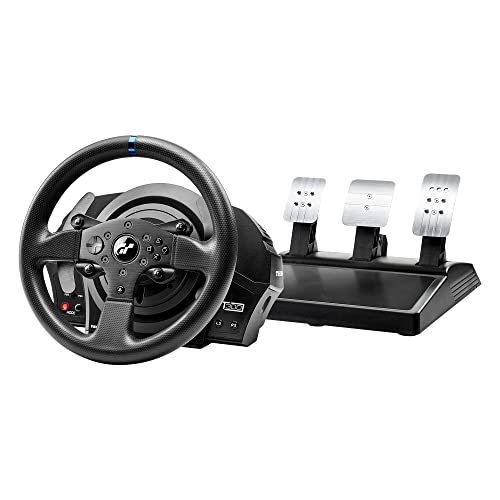
The T300RS GT is the premium option in this roundup, and it earns that position with a dual-belt drive system built around a fast, powerful brushless servomotor. Where gear-driven wheels can feel slightly notchy or artificial during high-speed corrections, the T300RS GT produces a fluid, continuous feel that comes much closer to real power-assisted steering. The difference is tangible from your first session.
The package includes the GT Edition 3-pedal set, which features brushed metal pedal faces on a reasonably solid base. An included conical rubber stop gives the brake a progressive resistance curve that genuinely improves modulation feel, particularly for trail braking. The pedals are a meaningful step up from what you get with Thrustmaster’s entry-level offerings.
The wheel itself is built around a proprietary magnetic sensor technology that Thrustmaster says maintains precision without degrading over time. The 11-inch rubber-rimmed rim connects to the base via a quick-change mount, which opens up the possibility of swapping to alternative Thrustmaster wheel rims down the line. The 1080-degree rotation range adds an extra layer of realism compared to the 900-degree options in this lineup.
The T300RS GT also runs a cooling fan inside the servo base, which keeps the motor temperature in check during long sessions and reduces the risk of force feedback weakening from heat buildup. We found the wheel noticeably quieter than gear-driven alternatives during sustained use.
Key Specs:
- Compatible platforms: PS5, PS4, PC
- Wheel rotation: 1080 degrees
- Force feedback: Dual-belt brushless servomotor
- Pedals: 3-pedal GT set with conical brake mod
- Connectivity: USB (wired)
- Buttons: 18
- Dual-belt brushless motor delivers smoother, quieter force feedback than any gear-driven wheel in this list.
- 1080-degree rotation provides more steering precision than the 900-degree range offered by competing wheels.
- Quick-change wheel mount allows for future rim upgrades within the Thrustmaster ecosystem.
- Only compatible with PlayStation and PC, making it unavailable to Xbox users.
- Durability can be inconsistent across units, with some users reporting motor and PCB issues under heavier use patterns.
Best Steering Wheels for Racing Simulator: A Quick Rundown
- Logitech G920 Driving Force: Best overall pick for Xbox and PC sim racers looking for a complete, well-built package.
- Logitech G29 Driving Force: Best choice for PlayStation and PC users who want proven performance and RPM indicator LEDs.
- Logitech G923 with TRUEFORCE: Best for PS5 and Xbox racers who want a more advanced feedback system with future-ready technology.
- Thrustmaster TMX: Best budget entry into force feedback sim racing, with a smooth belt system and solid upgrade path.
- Thrustmaster T300RS GT: Best premium option for PlayStation and PC users who want belt-driven realism and a modular rig setup.
Final Thoughts
Choosing the right sim racing wheel comes down to three things: the platform you race on, the level of immersion you want, and how far you plan to grow your setup. A gear-driven wheel at a lower price is a perfectly sensible place to start. A belt-driven wheel gives you a noticeable improvement in feedback smoothness that you will feel in every session. And if you are building a rig you plan to keep for years, modularity matters as much as out-of-the-box performance.
Your next step is simply matching what you have read here to where you are right now as a racer. If you are just starting out, do not overthink the specs. If you are ready to invest in a setup you will grow into, prioritise the feedback system and the upgrade ecosystem. Either way, moving to a proper sim wheel is one of the best decisions any racing game fan can make.