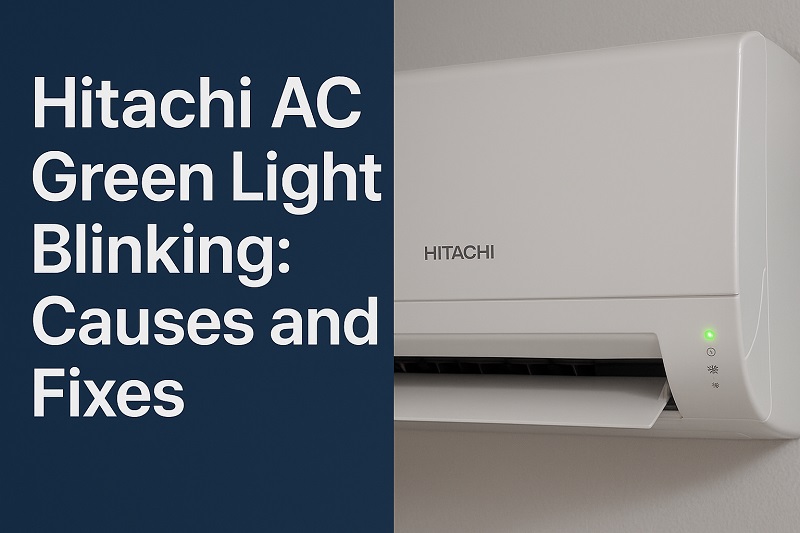
So there you are, trying to cool down your house, and suddenly your Hitachi AC starts acting weird. That little green light that usually stays put is now flashing like it’s having some kind of panic attack.
Here’s the thing: your AC isn’t broken. It’s actually trying to help you out by giving you a heads-up that something needs your attention. Think of it like your car’s check engine light, but way less scary to deal with.
Most of the time, you can fix this yourself in about 10 minutes. No need to call anyone or spend money you don’t have. Let me show you exactly what to do.
What’s Really Going On With That Light
Your Hitachi AC has this neat feature where it talks to you through lights. Sounds fancy, but it’s pretty basic. When everything’s working fine, that green light just sits there, steady and quiet. When something goes wrong, it starts blinking to get your attention.
The blinking isn’t random either. Your AC has sensors all over the place checking temperatures, airflow, and electrical stuff. When one of these sensors picks up something that doesn’t look right, boom – blinking light time.
Different blink patterns mean different things. Some units blink fast for one problem and slow for another. Your particular model might have its own special way of doing things, but they all follow the same basic idea.
What’s cool is that your AC is actually protecting itself. Instead of just breaking down and leaving you sweating, it gives you warning signs first. This way, you can fix small problems before they turn into big, expensive ones that’ll have you calling repair people and emptying your wallet.
Hitachi AC Green Light Blinking: Common Causes
Your AC doesn’t just decide to start blinking for fun. There are real reasons behind it, and once you know what to look for, you can usually spot the problem pretty quickly.
Let me walk you through the most common troublemakers.
1. Your Air Filter is Completely Clogged
This happens more than you’d think. Your air filter catches all the dust, pet hair, and random stuff floating around your house. After a while, it gets so packed that air can barely squeeze through.
When your AC can’t pull enough air through that clogged filter, it has to work way harder than it should. All that extra effort triggers sensors that detect something’s not right with the airflow.
Your unit knows this is bad news. Without good airflow, important parts can freeze up or overheat. So it starts blinking that green light to tell you “Hey, clean me out!”
2. Temperature Sensor Acting Up
Your AC has a little sensor that checks the temperature so it knows when to turn on and off. Sometimes this sensor starts giving weird readings that don’t match what’s actually happening in your room.
Maybe it thinks your house is 90 degrees when it’s really 75, or it can’t figure out the temperature at all. When this happens, your AC gets confused about what it’s supposed to be doing.
The blinking light kicks in because your unit recognizes that something’s off with its temperature readings. It’s like having a broken thermometer – you know the readings don’t make sense, but you’re not sure what the real temperature is.
3. Not Enough Refrigerant in the System
Refrigerant is the stuff that actually makes your AC cold. When you don’t have enough of it, your whole system gets thrown out of whack. Temperatures and pressures start going all over the place.
Your AC’s sensors pick up on these crazy readings right away and start the blinking light show. This isn’t just about comfort either – running low on refrigerant can seriously damage your compressor, which is an expensive part to replace.
Refrigerant doesn’t just disappear on its own, so if it’s low, you probably have a leak somewhere. That’s definitely something you’ll want to get checked out by a pro once you figure out this is what’s causing your problem.
4. Loose Wires or Bad Connections
Electrical connections can get loose or start corroding over time, especially if your unit’s been around for a while. When this happens, power doesn’t flow smoothly to all the parts that need it.
Your AC starts getting inconsistent power, which confuses all the control circuits inside. The unit can tell something’s not stable with the electrical supply, so out comes the blinking light.
Sometimes it’s just a wire that worked itself loose from vibrations. Other times, moisture or age has caused corrosion on the connection points. Either way, it’s usually not too hard to spot and fix.
5. Control Board Having Communication Problems
Think of your AC’s control board as the brain that coordinates everything. It talks to sensors, motors, and other parts to keep your system running smoothly. When communication breaks down, things get messy fast.
The control board realizes it can’t properly chat with other components and starts blinking the green light as a distress signal. This can happen from electrical interference, parts getting old, or moisture getting where it shouldn’t be.
Sometimes these communication hiccups fix themselves, but if the blinking keeps going, there’s usually a real problem that needs fixing.
Hitachi AC Green Light Blinking: DIY Fixes
Good news – you can probably fix this yourself without calling anyone or spending a bunch of money. Most blinking light problems come from simple stuff that’s easy to handle with basic tools and a little patience.
Always start with the easy stuff first. You’d be surprised how often the simplest fix solves the whole problem.
1. Deal With Your Air Filter First
This should be your first stop because dirty filters cause more blinking lights than anything else, and it’s the easiest thing to check. Turn off your AC completely before you mess with the filter – just to be safe.
Find your filter compartment, which is usually behind the front panel of your inside unit. Pull out the filter and hold it up to any light. If you can’t see much light coming through, that’s your problem right there.
If you have a washable filter, rinse it with lukewarm water until the water runs clear, then let it dry completely before putting it back. For throwaway filters, just get a new one that’s exactly the same size. Make sure any arrows on the filter point toward the inside of your unit when you install it.
2. Give Your AC a Fresh Start
Sometimes your AC just needs to clear its head, like restarting your computer when it’s acting weird. Use your remote to turn off the unit, then go to your circuit breaker and flip it off for about five minutes.
This complete shutdown lets all the electrical parts reset themselves. When everything powers back up, your AC goes through its normal startup routine and might just forget whatever was making it blink.
Turn the breaker back on first, wait a minute, then fire up your AC with the remote. Keep an eye on that green light to see if it goes back to normal.
3. Check Your Electrical Connections
Before you touch anything electrical, make sure your AC is completely off at the breaker. Pop off the access panel on your outside unit so you can see the wire connections.
Look for any loose connections, green or white crusty stuff on metal parts (that’s corrosion), or wires that look like they’ve come loose. Give wire connections a gentle wiggle – if they move around, they need tightening.
If you see corrosion on any metal terminals, clean it off with a wire brush or some fine sandpaper. You can also spray a little electrical contact cleaner on there to help prevent it from happening again. Just make sure everything’s tight and clean before you put the panel back and restore power.
4. Double-Check Your Thermostat
Sometimes the problem isn’t with your AC at all – it’s with the thermostat sending mixed signals. Make sure it’s actually set to cool mode and that the temperature you want is several degrees cooler than what your house currently is.
If your thermostat runs on batteries, swap them out even if they seem okay. Weak batteries can make your thermostat send weird signals to your AC. While you’re at it, pop the thermostat off the wall and wipe down the connection points with a clean cloth.
5. Clean Everything Up
Dirt and junk around your AC can mess with normal operation and trigger those warning lights. Start outside by clearing away any leaves, grass clippings, or other debris from around your condenser unit – give it at least three feet of clear space.
Take your garden hose and gently spray the condenser coils from the inside out. Be careful not to bend those thin metal fins. For your inside unit, wipe down everything you can reach and make sure nothing’s blocking the vents.
Pay extra attention to any small plastic sensors you can see, usually near the front of your inside unit. Dust and grime on these sensors can make them give false readings that trigger the blinking light.
6. When to Call in the Pros
If you’ve tried everything and that green light is still blinking away, it’s time to call a certified HVAC technician. Some problems – like refrigerant leaks, control board failures, or internal electrical faults – need special tools and know-how to fix safely.
Don’t feel bad about calling for help. You’ve already saved money by trying the simple fixes first, and now you know it’s something that really does need professional attention.
Wrapping Up
That blinking green light on your Hitachi AC doesn’t have to drive you crazy or cost you a fortune to fix. Most of the time, it’s pointing to something simple that you can handle yourself in a few minutes.
The trick is working through the possibilities systematically, starting with the most common culprits like dirty filters. Keep up with regular maintenance, and you’ll prevent most of these problems before they even start. Your AC will run better, your house will stay comfortable, and your wallet will thank you.