Your Genie garage door opener light stopped working, and now you’re fumbling in the dark every time you pull into your garage. It’s frustrating, especially after a long day when all you want is a well-lit space to unload groceries or gather your things.
This happens more often than you’d think, and the good news is that you can usually fix it yourself without calling a technician. We’ll walk through what’s actually going on with your opener light, why it might have stopped working, and exactly how to get it shining again.
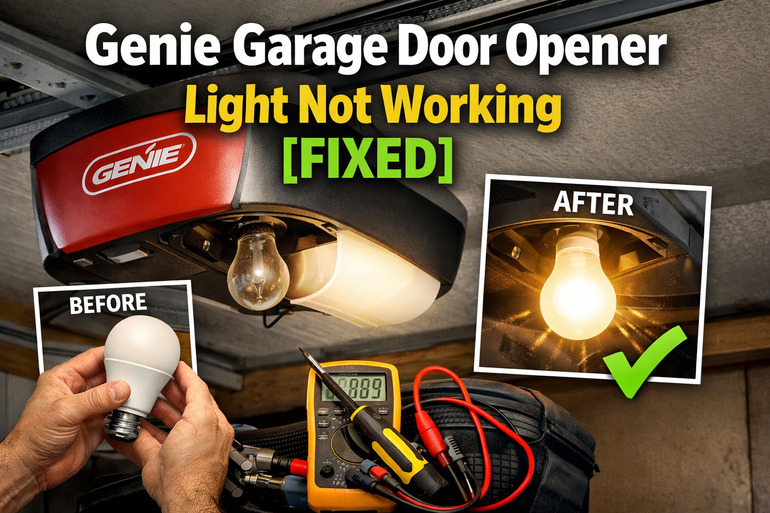
What’s Really Happening With Your Opener Light
Your Genie garage door opener has a built-in light socket that’s supposed to turn on when you activate the door. It stays lit for a few minutes, giving you time to get inside safely. This seems like a simple feature, but several things work together to make it happen.
The light connects to your opener’s circuit board, which controls when it turns on and off. Your opener uses sensors, timers, and electrical connections to manage this lighting system. Any hiccup in these parts can leave you in the dark.
Here’s what makes this tricky. Your garage door opener vibrates every single time it operates. Those vibrations shake the bulb, the socket, and all the wiring inside. Over time, this constant movement wears things down faster than a regular ceiling light in your house.
If you ignore a non-working light, you’re setting yourself up for safety issues. You might trip over tools, miss that skateboard your kid left out, or struggle to see the door closing properly. Beyond safety, a dark garage just feels unwelcoming and makes simple tasks harder than they need to be.
Genie Garage Door Opener Light Not Working: Common Causes
Several things can make your Genie opener light go dark. Most of them are simple issues that don’t require fancy tools or special skills to identify. Let’s look at what’s probably happening with your system.
1. Wrong Bulb Type
You might have put in a regular household bulb without realizing your opener needs something specific. Standard LED bulbs or CFLs can interfere with your opener’s radio frequency, causing the light to flicker, fail, or even mess with your remote control.
Garage door opener manufacturers recommend rough service bulbs or specially marked garage door opener bulbs. These bulbs are built to handle vibration and won’t create radio interference. Using the wrong type is one of the most common mistakes people make.
Your opener’s manual probably lists the right bulb specs, but if you tossed that manual years ago, you’re definitely not the first person to do so.
2. Loose Socket Connection
Each time your garage door moves, everything attached to that motor unit shakes. The light socket takes a beating from all this movement, and the connections inside can work themselves loose over time.
This loosening happens gradually. One day the light works fine, the next it flickers, and eventually it just quits altogether. The socket might look fine from the outside, but the internal wiring could be disconnected or barely hanging on.
3. Burned Out Bulb
This sounds obvious, but sometimes the simplest answer is the right one. Your bulb might have just reached the end of its life span. Even quality bulbs designed for garage door openers eventually burn out.
What makes this confusing is that the bulb might look perfectly fine. You can’t always see a broken filament or tell that it’s dead just by looking at it. The only way to know for sure is to test it in another fixture or try a new bulb in your opener.
4. Faulty Circuit Board
Your opener’s circuit board is like its brain. It tells the light when to turn on, how long to stay lit, and when to shut off. If this board develops a problem, your light might stop responding even though everything else seems fine.
Circuit boards can fail because of power surges, age, or moisture getting into your opener unit. Your garage experiences temperature swings and humidity changes that indoor electronics never face.
The tricky part here is that your door might still open and close perfectly fine while the light stays dead. This happens because different parts of the circuit board control different functions. Your motor circuit could be working great while your lighting circuit is fried.
5. Incorrect Light Settings
Modern Genie openers have settings you can adjust through buttons on the unit or through connected apps. Someone might have accidentally disabled the light feature without realizing it.
Maybe you were adjusting the force settings or trying to program a new remote, and you pressed the wrong button combination. Your opener could be working exactly as it’s been told to work, which is to keep that light off.
Genie Garage Door Opener Light Not Working: DIY Fixes
Getting your light working again usually takes less time than you’d expect. Here are the fixes that work for most people, starting with the easiest ones. Try them in order before moving on to more involved solutions.
1. Replace With the Right Bulb
Start by getting the correct bulb type. Head to your hardware store and ask for rough service bulbs or bulbs specifically labeled for garage door openers. These cost a bit more than regular bulbs but they’re worth it.
Here’s how to swap it out:
- Turn off power to your opener at the breaker for safety
- Let the old bulb cool if it was recently on
- Unscrew the old bulb and check the socket for any debris or corrosion
- Screw in your new rough service bulb snugly but don’t overtighten
- Turn the power back on and test it
Your new bulb should light up when you activate the door. If it doesn’t, you know the problem goes deeper than just a bad bulb. That’s actually helpful information because you can cross this off your list and move to the next fix.
2. Check and Tighten Socket Connections
Power off your opener at the breaker before touching anything electrical. Remove the light cover on your opener unit. This usually twists off or has clips holding it in place.
Take out the bulb and inspect the socket closely. Look for any wires that seem loose, burned, or disconnected. Sometimes you’ll spot the problem right away.
Follow these steps carefully:
- Examine where wires connect to the socket base
- Gently wiggle the socket to see if it moves independently from the mounting
- If wires are loose, carefully reconnect them
- Make sure the socket itself is securely fastened to the opener housing
Put everything back together and test. This fix works surprisingly often because those vibrations really do shake things loose over time.
3. Adjust Your Light Timer Settings
Your Genie opener lets you control how long the light stays on after activation. If someone changed this setting to zero minutes, your light might be turning on and off so fast you don’t even notice.
Locate the adjustment buttons on your opener’s motor unit. These are usually on the side or back panel. Find the light timer button, which might be labeled or shown in a diagram on the unit itself.
Press the button to cycle through timing options. Most Genie models offer settings like 1.5 minutes, 4.5 minutes, or various other intervals. Pick a time that works for your needs.
4. Reset the Light Feature
Sometimes your opener just needs a fresh start. A simple reset can clear glitches that keep your light from working.
Here’s a basic reset process:
- Press and hold the light button on your wall console or remote for about 10 seconds
- Release and wait a few seconds
- Test the light by operating your door
- If your model has a learn button, press it briefly and then test again
Different Genie models have slightly different reset procedures, but this general approach works for most. Your opener’s programming might have gotten confused, and this helps clear its memory.
5. Test With a Different Light Fixture
This helps you figure out if your bulb is actually good or bad. Take the bulb out of your garage door opener and screw it into a regular lamp or light fixture in your house.
If it lights up there, you know the bulb is fine and your problem is with the opener itself. If it stays dark, you’ve confirmed the bulb is dead and you need a replacement.
This simple test saves you from buying unnecessary parts or spending time on repairs that won’t help. Sometimes you think you already tried a new bulb, but testing confirms whether that bulb was actually working.
6. Inspect the Circuit Board
This gets a bit more technical, but it’s still manageable. Turn off power at the breaker and remove the cover panel on your opener’s motor unit. Look at the circuit board inside.
Check for any obvious signs of damage like burn marks, melted components, or corrosion. Sometimes you’ll see a clearly fried section that explains everything. Look at where wires connect to the board and make sure nothing has come loose.
If you spot damage, you’ll need to replace the circuit board. You can order one from Genie directly or find them through appliance parts suppliers. Replacing it involves disconnecting a few wire harnesses and mounting the new board in place of the old one.
7. Call a Professional Technician
If you’ve tried everything above and your light still won’t work, it’s time to bring in someone with specialized knowledge. A qualified garage door technician has diagnostic tools and experience with these specific systems.
They can test electrical components you can’t easily access and identify problems that aren’t obvious. Sometimes the issue ties into your home’s electrical system or involves parts that require special ordering. A pro can handle these situations efficiently and safely.
Wrapping Up
Your Genie garage door opener light serves a real purpose beyond just convenience. It keeps you safe and makes your garage usable at any time of day or night. Most lighting problems come down to simple issues like wrong bulbs, loose connections, or settings that got changed accidentally.
Start with the easy fixes first. Swap your bulb for the right type, check those connections, and look at your settings. These steps solve the problem for most people without requiring any special skills or expensive parts. If those don’t work, you can always escalate to more involved repairs or call someone who fixes these systems every day.